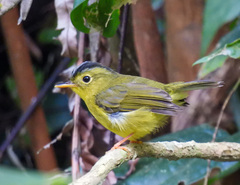
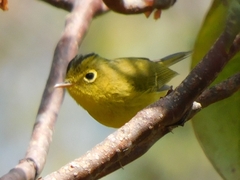
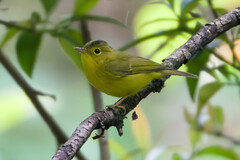
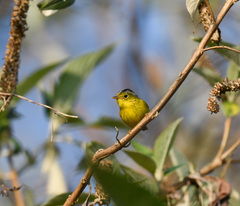
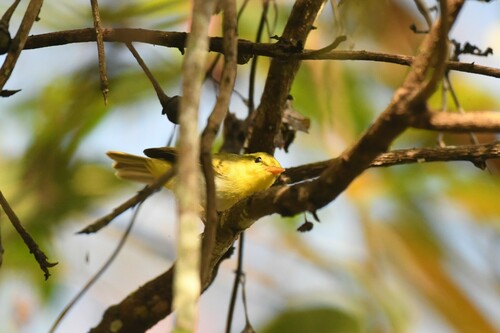
Whistler's Warbler

Whistler's Warbler

Seicercus whistleri

Silhouette: Jiekun He · PhyloPic

Daily sighting probability ~10% · With luck
at Royal Manas National Park

In 3 days ~10% in a week ~30%

64 Verified sightings at Royal Manas National Park From 2019 to 2026
491 In all 6 parks
November Best month
🌅 Crepuscular When it's spotted

About the Whistler's Warbler

Whistler's warbler (Phylloscopus whistleri) is a species of leaf warbler (family Phylloscopidae). It was formerly included in the "Old World warbler" assemblage. It is found in the Indian subcontinent, from the Himalayas to Myanmar. Its natural habitats are subtropical or tropical moist montane forests and heavily degraded former forest.

Whistler's warbler was previously placed in the genus Seicercus. A molecular phylogenetic study published in 2018 found that neither Phylloscopus nor Seicercus were monophyletic. In the subsequent reorganization the two genera were merged into Phylloscopus which has priority under the rules of the International Commission on Zoological Nomenclature. The common name commemorates the English ornithologist Hugh Whistler (1889–1943). Wikipedia →

Sounds

Recording0:35

India · 2023

© dbeadle · iNaturalist · CC BY-NC 4.0

Global Distribution

Parks Where Found

# Park Country Daily sighting probability
1 Langtang National Park 🇳🇵 Nepal
~20%
2 Jim Corbett National Park 🇮🇳 India
~10%
3 Namdapha National Park 🇮🇳 India
~10%
4 Royal Manas National Park 🇧🇹 Bhutan
~10%
5 Manas National Park 🇮🇳 India
<5%
6 Kaziranga National Park 🇮🇳 India
<5%

Cities Where Found

# City Country Daily sighting probability
1 Dehradun 🇮🇳 India
~20%
2 Kathmandu 🇳🇵 Nepal
<5%
3 New Delhi 🇮🇳 India
<5%

Before you go

What are the chances of seeing a Whistler's Warbler in Royal Manas National Park?

With luck

About 10% of wildlife watchers report a Whistler's Warbler sighting in Royal Manas National Park on a given day, based on 64 verified sightings from GBIF citizen-science data from 2019 to 2026. It is the 196th most-seen of the 388 birds we can rate there. Over three days the chance rises to about 10%, and over a week to about 30%, if each day is a fresh chance.

When is the best time to see a Whistler's Warbler in Royal Manas National Park?

January–February, April and November

In those months about 10% of wildlife watchers report a Whistler's Warbler in Royal Manas National Park on a given day, against under 5% in March, May–July, October and December, the lowest months. Those are among Royal Manas National Park's driest months, with about 75 mm of rain a month against 930 mm in July. August and September have too few records to rate.

What time of day is best to see a Whistler's Warbler?

Between 4 and 7 am

Across all the parks we cover, that three-hour window holds the most Whistler's Warbler sightings with a recorded time, and about 6 in 10 of them come between 6 am and 6 pm: it is most active around dawn and dusk.

Is Royal Manas National Park the best place to see a Whistler's Warbler?

4th of 6

Of the 6 parks where we can rate Whistler's Warbler sightings, Royal Manas National Park ranks 4th at about 10%. The best odds are in Langtang National Park (Nepal, about 20%), Jim Corbett National Park (India, about 10%) and Namdapha National Park (India, about 10%).

Which relatives of the Whistler's Warbler live in Royal Manas National Park?

Same genus: Seicercus

The closest relatives of the Whistler's Warbler that you can see in Royal Manas National Park (genus Seicercus) are Chestnut-crowned Warbler (about 10%) and Gray-cheeked Warbler (about 10%), with each one's daily chance of a sighting.

Where does the Whistler's Warbler sighting chance come from?

GBIF citizen-science records

It is estimated from how often the Whistler's Warbler is recorded against all the birds logged in Royal Manas National Park (64 verified sightings from 2019 to 2026), calibrated against known sighting rates. Figures are rounded to the nearest 10% because citizen-science data supports honest approximations, not decimals, and months with records from fewer than five people show "—". How it works.

← Back to Royal Manas National Park