Hibiscus Harlequin Bug

Hibiscus Harlequin Bug

Tectocoris diophthalmus

Daily sighting probability ~10% · With luck
at Royal National Park

In 3 days ~30% in a week ~60%

17 Verified sightings at Royal National Park From 2019 to 2026
75 In all 4 parks
July Best month
☀️ Diurnal When it's spotted

About the Hibiscus Harlequin Bug

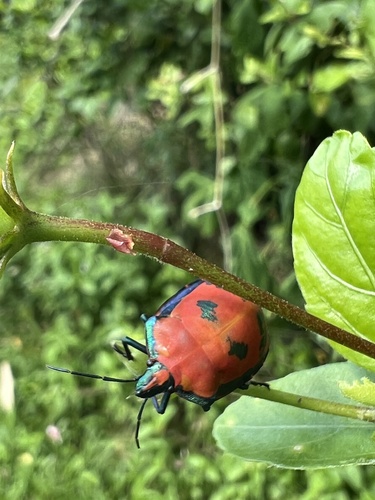
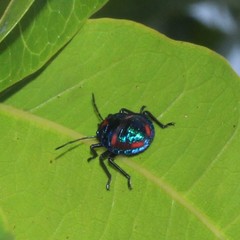
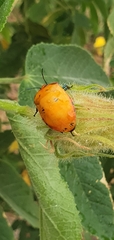
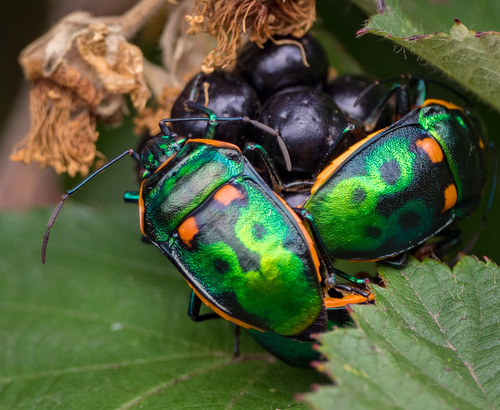
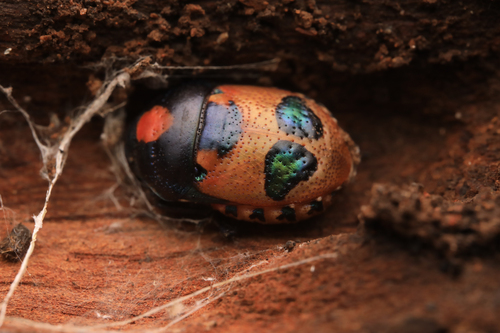
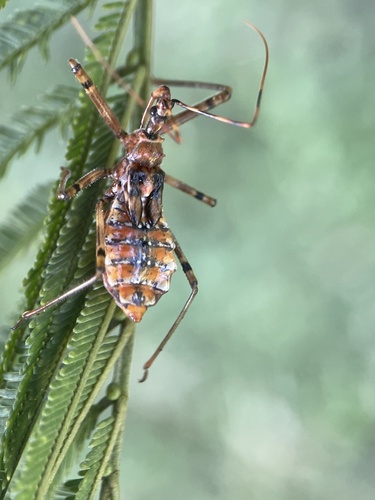
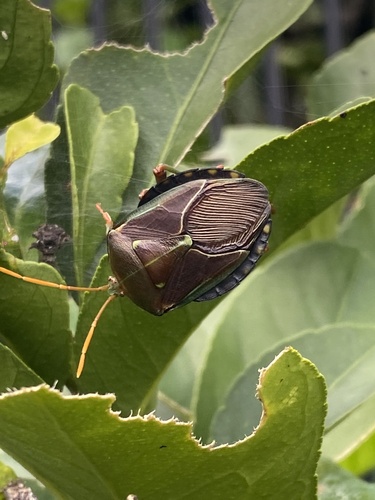
Tectocoris diophthalmus, commonly known as the hibiscus harlequin bug or cotton harlequin bug, is the sole member of the genus Tectocoris and subfamily Tectocorinae. It is a brightly coloured convex and rounded shield-shaped bug with a metallic sheen that grows to about 20 mm. Adult females are mostly orange and males are both blue and red or orange, while nymphs are typically metallic green and purple. The colours are quite variable, and experiments suggest that the variation in colour may reduce bird predation, especially on the immature stages. This extreme level of variation is such that different taxonomists have, since 1781, described this species under different new names at least 16 times, some of these supernumerary names remaining in use until 2006, when it was finally confirmed that they were all colour forms of a single organism. It is common in Eastern Australia, New Guinea and several Pacific Islands in habitats ranging from urban to agricultural and coastal areas.

Hibiscus harlequin bugs feed on many species of the family Malvaceae, as well as cultivated cotton. They will also feed on Illawarra flame tree flowers, Grevillea and bottlebrush saplings. They pierce the stems of young shoots and suck the sap. Females lay clusters of eggs around stems of usually the hibiscus plant and then guards them until they hatch. Wikipedia →

Global Distribution

Parks Where Found

# Park Country Daily sighting probability
1 Noosa National Park 🇦🇺 Australia
~20%
2 Royal National Park 🇦🇺 Australia
~10%
3 Daintree National Park 🇦🇺 Australia
~10%
4 Blue Mountains National Park 🇦🇺 Australia
~10%

Cities Where Found

# City Country Daily sighting probability
1 Brisbane 🇦🇺 Australia
~30%
2 Sydney 🇦🇺 Australia
~20%

Before you go

What are the chances of seeing a Hibiscus Harlequin Bug in Royal National Park?

With luck

About 10% of wildlife watchers report a Hibiscus Harlequin Bug sighting in Royal National Park on a given day, based on 17 verified sightings from GBIF citizen-science data from 2019 to 2026. It is the 57th most-seen of the 175 insects we can rate there. Over three days the chance rises to about 30%, and over a week to about 60%, if each day is a fresh chance.

When is the best time to see a Hibiscus Harlequin Bug in Royal National Park?

May, July and September

In those months about 20% of wildlife watchers report a Hibiscus Harlequin Bug in Royal National Park on a given day, against under 5% in February, June and December, the lowest months.

What time of day is best to see a Hibiscus Harlequin Bug?

Between 2 and 5 pm

Across all the parks we cover, that three-hour window holds the most Hibiscus Harlequin Bug sightings with a recorded time, and about 7 in 10 of them come between 6 am and 6 pm: it is a daytime animal.

Is Royal National Park the best place to see a Hibiscus Harlequin Bug?

2nd of 4

Of the 4 parks where we can rate Hibiscus Harlequin Bug sightings, Royal National Park ranks 2nd at about 10%. The best odds are in Noosa National Park (Australia, about 20%).

Which relatives of the Hibiscus Harlequin Bug live in Royal National Park?

Same family: Scutelleridae

The closest relatives of the Hibiscus Harlequin Bug that you can see in Royal National Park (family Scutelleridae, Jewel Bugs) are Metallic Shield Bug (about 30%) and Red Jewel Bug (about 10%), with each one's daily chance of a sighting.

Where does the Hibiscus Harlequin Bug sighting chance come from?

GBIF citizen-science records

It is estimated from how often the Hibiscus Harlequin Bug is recorded against all the insects logged in Royal National Park (17 verified sightings from 2019 to 2026), calibrated against known sighting rates. Figures are rounded to the nearest 10% because citizen-science data supports honest approximations, not decimals, and months with records from fewer than five people show "—". How it works.

← Back to Royal National Park