Red Jewel Bug

Red Jewel Bug

Choerocoris paganus

Endemic
Daily sighting probability ~10% · With luck
at Royal National Park

In 3 days ~30% in a week ~50%

14 Verified sightings at Royal National Park From 2019 to 2026
232 In all 10 parks
November Best month
☀️ Diurnal When it's spotted

About the Red Jewel Bug

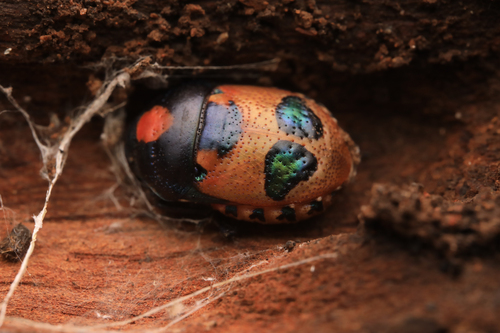
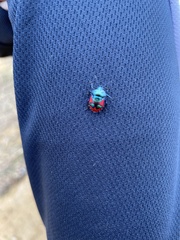
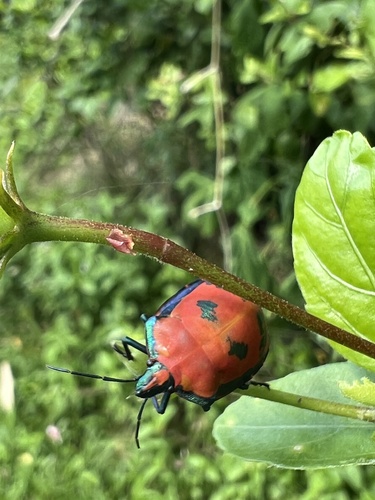
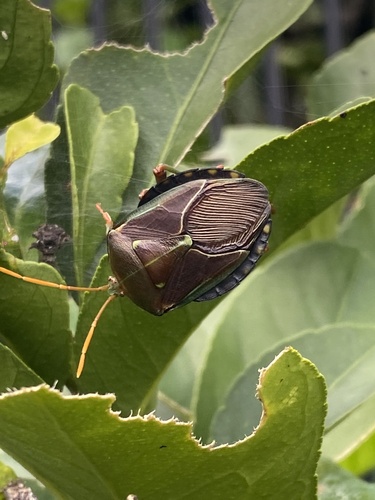
Choerocoris paganus, is a native Australian insect, also commonly known as both the red jewel bug and ground shield bug. This small bug with a body length of 1cm is easily recognisable with its large, mostly crimson scutella with a large blue black blotch towards the front and two small blotches towards the back that have a copper, green hue. The head and legs are dark blue.They are one of the most commonly encountered jewel bugs in Australia and can easily be distinguished from other species by textured areas on and around the pronotum. It is generally not harmful, but can excrete pungent stink fluid if handled roughly.

The first scientific description of the Australian red jewel bug was made in 1775 by Danish entomologist Johan Christian Fabricius as a species of true bug in the family Scutelleridae, the 'shield backed bugs'. These are not be confused with jewel beetles which are from the order coleoptera with different mouth and wing features.

The genus name Choerocoris is derived its name from the Greek words 'choiros', for its 'pig-like' rounded appearance, and 'koris', for its convex bug shape. The species epithet paganus comes from its latin root... Wikipedia →

Global Distribution

Parks Where Found

# Park Country Daily sighting probability
1 Grampians National Park 🇦🇺 Australia
~40%
2 Hattah-Kulkyne National Park 🇦🇺 Australia
~40%
3 Flinders Ranges National Park 🇦🇺 Australia
~30%
4 Uluru-Kata Tjuta National Park 🇦🇺 Australia
~20%
5 Nitmiluk National Park 🇦🇺 Australia
~20%
6 Freycinet National Park 🇦🇺 Australia
~20%
7 Royal National Park 🇦🇺 Australia
~10%
8 Kosciuszko National Park 🇦🇺 Australia
~10%
9 Blue Mountains National Park 🇦🇺 Australia
~10%
10 Great Otway National Park 🇦🇺 Australia
~10%

Cities Where Found

# City Country Daily sighting probability
1 Hobart 🇦🇺 Australia
~10%
2 Perth 🇦🇺 Australia
~10%
3 Melbourne 🇦🇺 Australia
~10%
4 Sydney 🇦🇺 Australia
~10%

Before you go

What are the chances of seeing a Red Jewel Bug in Royal National Park?

With luck

About 10% of wildlife watchers report a Red Jewel Bug sighting in Royal National Park on a given day, based on 14 verified sightings from GBIF citizen-science data from 2019 to 2026. It is the 65th most-seen of the 175 insects we can rate there. Over three days the chance rises to about 30%, and over a week to about 50%, if each day is a fresh chance.

When is the best time to see a Red Jewel Bug in Royal National Park?

November and December

In those months about 20% of wildlife watchers report a Red Jewel Bug in Royal National Park on a given day, against under 5% in February–July and September, the lowest months.

What time of day is best to see a Red Jewel Bug?

Between 11 am and 2 pm

Across all the parks we cover, that three-hour window holds the most Red Jewel Bug sightings with a recorded time, and about 9 in 10 of them come between 6 am and 6 pm: it is a daytime animal.

Which relatives of the Red Jewel Bug live in Royal National Park?

Same family: Scutelleridae

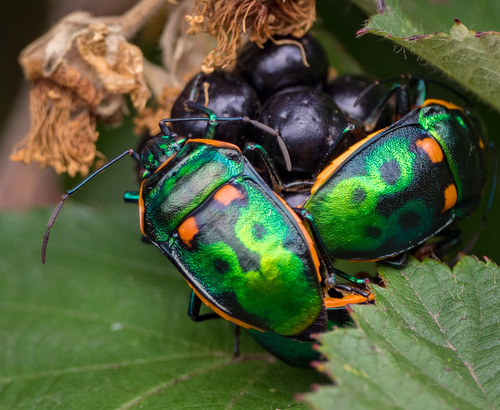
The closest relatives of the Red Jewel Bug that you can see in Royal National Park (family Scutelleridae, Jewel Bugs) are Metallic Shield Bug (about 30%) and Hibiscus Harlequin Bug (about 10%), with each one's daily chance of a sighting.

Where does the Red Jewel Bug sighting chance come from?

GBIF citizen-science records

It is estimated from how often the Red Jewel Bug is recorded against all the insects logged in Royal National Park (14 verified sightings from 2019 to 2026), calibrated against known sighting rates. Figures are rounded to the nearest 10% because citizen-science data supports honest approximations, not decimals, and months with records from fewer than five people show "—". How it works.

← Back to Royal National Park