


Completed

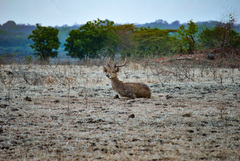

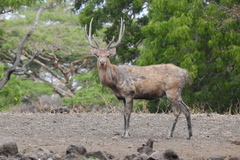
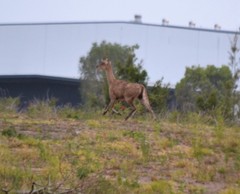
Javan Rusa
Rusa timorensis
Silhouette: Steven Traver · PhyloPic
- KingdomAnimalia (Animals)
- PhylumChordata (Chordates)
- ClassMammalia (Mammals)
- OrderArtiodactyla (Even-toed Ungulates and Cetaceans)
- FamilyCervidae (Deer)
- GenusRusa (Rusa Deer)
- SpeciesRusa timorensis (Javan Rusa)
In 3 days ~60% in a week ~90%
55 Verified sightings at Royal National Park From 2019 to 2026
418 In all 3 parks
May Best month
☀️ Diurnal When it's spotted
About the Javan Rusa
The Javan rusa or Sunda sambar (Rusa timorensis) is a large deer species native to Indonesia and Timor-Leste. Introduced populations exist in a wide variety of locations in the Southern Hemisphere. Rusa is the Malay word for "deer" in general as well as lending the name to its own genus.
The Javan rusa is dark blackish brown and has a gray forehead. Its back is almost black, the underparts and inner thighs are yellowish brown. The abdomen is lighter brown, and the tail tuft is dark blackish brown. The hair is coarse and longer on the chest than on the remaining body. Its ears are wide and a little shorter than the head. The antlers are medium long and rather wide, the upper branch points forward. Fawns are born without spots. Males are bigger than females; head-to-body length varies... Wikipedia →
Sounds
Recording0:14
Australia · 2023
© Christine Rand · iNaturalist · CC BY-NC 4.0
Recent sightings of Javan Rusa in Royal National Park
LIVEiNaturalistGlobal Distribution
Parks Where Found
| # | Park | Country | Daily sighting probability |
|---|---|---|---|
| 1 | Komodo National Park | 🇮🇩 Indonesia | |
| 2 | Bali Barat National Park | 🇮🇩 Indonesia | |
| 3 | Royal National Park | 🇦🇺 Australia |
Cities Where Found
| # | City | Country | Daily sighting probability |
|---|---|---|---|
| 1 | Sydney | 🇦🇺 Australia |
Zoos & Centres Where Found
| # | Zoo / Centre | Country | |
|---|---|---|---|
| 1 | Prague Zoo | 🇨🇿 Czechia | |
| 2 | Tierpark Berlin | 🇩🇪 Germany | |
| 3 | Taman Safari Bali (Bali Safari) | 🇮🇩 Indonesia | |
| 4 | Melaka Zoo and Bird Park | 🇲🇾 Malaysia | |
| 5 | Bali Zoo | 🇮🇩 Indonesia | |
| 6 | Taman Safari Indonesia | 🇮🇩 Indonesia | |
| 7 | National Zoo of Malaysia | 🇲🇾 Malaysia | |
| 8 | Halls Gap Zoo | 🇦🇺 Australia | |
| 9 | Lok Kawi Wildlife Park | 🇲🇾 Malaysia | |
| 10 | Gembira Loka Zoo | 🇮🇩 Indonesia | |
| 11 | Cebu Safari and Adventure Park | 🇵🇭 Philippines | |
| 12 | Surabaya Zoo | 🇮🇩 Indonesia | |
| 13 | Bandung Zoo | 🇮🇩 Indonesia | |
| 14 | Melaka Crocodile Farm | 🇲🇾 Malaysia | |
| 15 | Sea World Indonesia | 🇮🇩 Indonesia | |
| 16 | Rákosův pavilon | 🇨🇿 Czechia | |
| 17 | Velemlokárium | 🇨🇿 Czechia | |
| 18 | Jakarta Aquarium | 🇮🇩 Indonesia | |
| 19 | Maharani Zoo & Goa | 🇮🇩 Indonesia | |
| 20 | Suraloka Interactive Zoo | 🇮🇩 Indonesia | |
| 21 | Taman Safari Indonesia 2 | 🇮🇩 Indonesia |
Closest Relatives at Royal National Park
No species of the same family or order lives in Royal National Park, so these are its closest relatives here: other mammals.




Before you go
What are the chances of seeing a Javan Rusa in Royal National Park?
Possible
About 30% of wildlife watchers report a Javan Rusa sighting in Royal National Park on a given day, based on 55 verified sightings from GBIF citizen-science data from 2019 to 2026. It is the 3rd most-seen of the 15 mammals we can rate there. Over three days the chance rises to about 60%, and over a week to about 90%, if each day is a fresh chance.
When is the best time to see a Javan Rusa in Royal National Park?
May–June and August–September
In those months about 40% of wildlife watchers report a Javan Rusa in Royal National Park on a given day, against under 5% in December, the lowest month.
What time of day is best to see a Javan Rusa?
Between 11 am and 2 pm
Across all the parks we cover, that three-hour window holds the most Javan Rusa sightings with a recorded time, and about 8 in 10 of them come between 6 am and 6 pm: it is a daytime animal.
Is Royal National Park the best place to see a Javan Rusa?
3rd of 3
Of the 3 parks where we can rate Javan Rusa sightings, Royal National Park ranks 3rd at about 30%. The best odds are in Komodo National Park (Indonesia, about 90%) and Bali Barat National Park (Indonesia, about 70%).
Where does the Javan Rusa sighting chance come from?
GBIF citizen-science records
It is estimated from how often the Javan Rusa is recorded against all the mammals logged in Royal National Park (55 verified sightings from 2019 to 2026), calibrated against known sighting rates. Figures are rounded to the nearest 10% because citizen-science data supports honest approximations, not decimals, and months with records from fewer than five people show "—". How it works.
