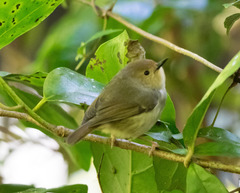
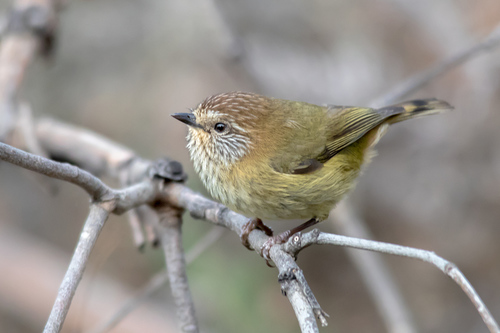
Large-billed Scrubwren

Large-billed Scrubwren

Sericornis magnirostra

Silhouette: Sheatherius · PhyloPic

LCLeast ConcernNTVUENCR Endemic
Daily sighting probability ~10% · With luck
at Royal National Park

In 3 days ~30% in a week ~60%

252 Verified sightings at Royal National Park From 2019 to 2026
2,804 In all 6 parks
October Best month
☀️ Diurnal When it's spotted

About the Large-billed Scrubwren

The large-billed scrubwren (Sericornis magnirostra) is a passerine bird in the family Acanthizidae, endemic to eastern Australia. It is found in denser undergrowth in temperate forest, subtropical or tropical moist lowland forest, and subtropical or tropical moist montane forest.

The large-billed scrubwren was described by ornithologist John Gould in 1838. The generic name Sericornis derives from Ancient Greek serikos 'silk' and ornis 'bird'. The specific epithet derives from Latin magnus 'great' and rostrum 'bill'.

It was placed in the family Pardalotidae in the Sibley-Ahlquist taxonomy, but this has met with opposition and indeed is now known to be wrong. Instead, the large-billed scrubwren belongs to the independent family Acanthizidae.

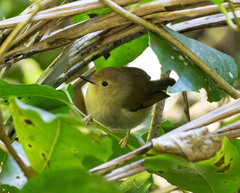
The large-billed scrubwren is 11.5 to 13 cm (4.5 to 5.1 in) in length and weighs 10 g (0.35 oz). It has a dark reddish-brown eye in a pale buff face, with a longish, black bill inclined slightly upwards. The upperparts are light grey-brown with an olive tint, the throat is a pale buffy-white, the belly greyish... Wikipedia →

Sounds

Call0:43

Australia · 2025

© Peter Boesman · XC1066967 · CC BY-NC-ND 4.0

Song0:10

Australia · 2023

© Marc Anderson · XC816430 · CC BY-NC-ND 4.0

Song0:05

Australia · 2020

© James Lambert · XC568596 · CC BY-NC-SA 4.0

Global Distribution

Parks Where Found

# Park Country Daily sighting probability
1 Lamington National Park 🇦🇺 Australia
~50%
2 Springbrook National Park 🇦🇺 Australia
~30%
3 Royal National Park 🇦🇺 Australia
~10%
4 Daintree National Park 🇦🇺 Australia
~10%
5 Noosa National Park 🇦🇺 Australia
<5%
6 Blue Mountains National Park 🇦🇺 Australia
<5%

Cities Where Found

# City Country Daily sighting probability
1 Brisbane 🇦🇺 Australia
<5%
2 Sydney 🇦🇺 Australia
<5%

Before you go

What are the chances of seeing a Large-billed Scrubwren in Royal National Park?

With luck

About 10% of wildlife watchers report a Large-billed Scrubwren sighting in Royal National Park on a given day, based on 252 verified sightings from GBIF citizen-science data from 2019 to 2026. It is the 70th most-seen of the 178 birds we can rate there. Over three days the chance rises to about 30%, and over a week to about 60%, if each day is a fresh chance.

When is the best time to see a Large-billed Scrubwren in Royal National Park?

September and October

In those months about 20% of wildlife watchers report a Large-billed Scrubwren in Royal National Park on a given day, against under 5% in June, the lowest month.

What time of day is best to see a Large-billed Scrubwren?

Between 10 am and 1 pm

Across all the parks we cover, that three-hour window holds the most Large-billed Scrubwren sightings with a recorded time, and about 9 in 10 of them come between 6 am and 6 pm: it is a daytime animal.

Is Royal National Park the best place to see a Large-billed Scrubwren?

3rd of 6

Of the 6 parks where we can rate Large-billed Scrubwren sightings, Royal National Park ranks 3rd at about 10%. The best odds are in Lamington National Park (Australia, about 50%) and Springbrook National Park (Australia, about 30%).

Which relatives of the Large-billed Scrubwren live in Royal National Park?

Same genus: Sericornis

The closest relatives of the Large-billed Scrubwren that you can see in Royal National Park (genus Sericornis, Typical Scrubwrens) are White-browed Scrubwren (about 50%) and Yellow-Throated Scrubwren (about 10%), with each one's daily chance of a sighting.

Where does the Large-billed Scrubwren sighting chance come from?

GBIF citizen-science records

It is estimated from how often the Large-billed Scrubwren is recorded against all the birds logged in Royal National Park (252 verified sightings from 2019 to 2026), calibrated against known sighting rates. Figures are rounded to the nearest 10% because citizen-science data supports honest approximations, not decimals, and months with records from fewer than five people show "—". How it works.

← Back to Royal National Park