Variegated Fairywren

Variegated Fairywren

Malurus lamberti

Silhouette: Michael Scroggie · PhyloPic

LCLeast ConcernNTVUENCR Endemic
Daily sighting probability ~40% · Likely
at Royal National Park

In 3 days ~70% in a week >90%

817 Verified sightings at Royal National Park From 2019 to 2026
2,078 In all 6 parks
October Best month
☀️ Diurnal When it's spotted

About the Variegated Fairywren

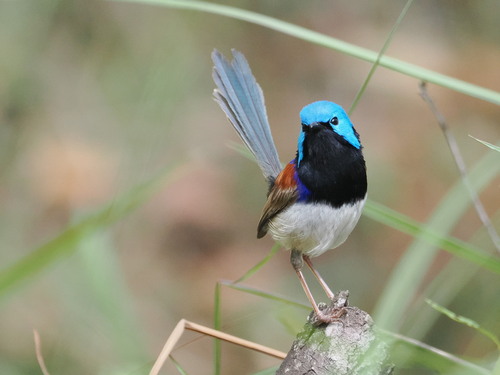
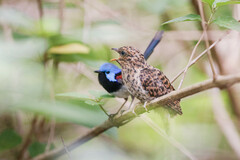
The variegated fairywren (Malurus lamberti) is a fairywren that lives in eastern Australia. As a species that exhibits sexual dimorphism, the brightly coloured breeding male has chestnut shoulders and azure crown and ear coverts, while non-breeding males, females and juveniles have predominantly grey-brown plumage, although females of two subspecies have mainly blue-grey plumage.

Like other fairywrens, the variegated fairywren is a cooperative breeding species, with small groups of birds maintaining and defending small territories year-round. Groups consist of a socially monogamous pair with several helper birds who assist in raising the young. Male wrens pluck yellow petals and display them to females as part of a courtship display. These birds are primarily insectivorous and forage and live in the shelter of scrubby vegetation east of the Great Dividing Range. Populations across central, northern and western Australia were considered subspecies of this species until 2018, when they were reclassified as the purple-backed fairywren.

The variegated fairywren was originally described by Nicholas Aylward Vigors and Thomas Horsfield in 1827, and was at first... Wikipedia →
Sounds

Song0:16

Australia · 2026

© Marc Anderson · XC1086950 · CC BY-NC-ND 4.0

Song and call0:46

Australia · 2025

© Peter Boesman · XC1066657 · CC BY-NC-ND 4.0

Begging call0:59

Australia · 2021

© nick talbot · XC694791 · CC BY-NC-SA 4.0

Global Distribution

Parks Where Found

# Park Country Daily sighting probability
1 Royal National Park 🇦🇺 Australia
~40%
2 Booderee National Park 🇦🇺 Australia
~30%
3 Blue Mountains National Park 🇦🇺 Australia
~20%
4 Noosa National Park 🇦🇺 Australia
~10%
5 Springbrook National Park 🇦🇺 Australia
~10%
6 Lamington National Park 🇦🇺 Australia
~10%

Cities Where Found

# City Country Daily sighting probability
1 Brisbane 🇦🇺 Australia
~20%
2 Sydney 🇦🇺 Australia
~10%

Zoos & Centres Where Found

# Zoo / Centre Country
1 Taronga Zoo 🇦🇺 Australia In captivity

Before you go

What are the chances of seeing a Variegated Fairywren in Royal National Park?

Likely

About 40% of wildlife watchers report a Variegated Fairywren sighting in Royal National Park on a given day, based on 817 verified sightings from GBIF citizen-science data from 2019 to 2026. It is the 29th most-seen of the 178 birds we can rate there. Over three days the chance rises to about 70%, and over a week to over 90%, if each day is a fresh chance.

When is the best time to see a Variegated Fairywren in Royal National Park?

January and October

In those months about 50% of wildlife watchers report a Variegated Fairywren in Royal National Park on a given day, against about 10% in May, the lowest month.

What time of day is best to see a Variegated Fairywren?

Between 11 am and 2 pm

Across all the parks we cover, that three-hour window holds the most Variegated Fairywren sightings with a recorded time, and nearly all of them come between 6 am and 6 pm: it is a daytime animal.

Is Royal National Park the best place to see a Variegated Fairywren?

Yes

Of the 6 parks where we can rate Variegated Fairywren sightings, Royal National Park has the highest daily chance: about 40%. Next come Booderee National Park (Australia, about 30%) and Blue Mountains National Park (Australia, about 20%).

Where does the Variegated Fairywren sighting chance come from?

GBIF citizen-science records

It is estimated from how often the Variegated Fairywren is recorded against all the birds logged in Royal National Park (817 verified sightings from 2019 to 2026), calibrated against known sighting rates. Figures are rounded to the nearest 10% because citizen-science data supports honest approximations, not decimals, and months with records from fewer than five people show "—". How it works.

← Back to Royal National Park