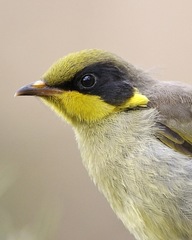
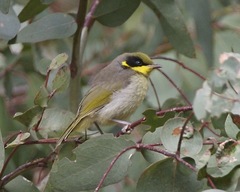
Yellow-tufted Honeyeater

Yellow-tufted Honeyeater

Lichenostomus melanops

Silhouette: Rachael Joakim · PhyloPic

LCLeast ConcernNTVUENCR Endemic
Daily sighting probability <5% · Rare
at Royal National Park

In 3 days ~10%

48 Verified sightings at Royal National Park From 2019 to 2026
246 In all 4 parks
October Best month
☀️ Diurnal When it's spotted

About the Yellow-tufted Honeyeater

The yellow-tufted honeyeater (Lichenostomus melanops) is a passerine bird found in the south-east ranges of Australia. A predominantly black and yellow honeyeater, it is split into four subspecies. The yellow-tufted honeyeater was first described by the English ornithologist John Latham in 1801, and given two different binomial names: Muscicapa auricomis and Turdus melanops. The latter name was retained as a nomen protectum, and the former a nomen oblitum, as the epithet melanops has been used consistently for over a century. It belongs to the honeyeater family Meliphagidae. More recently, DNA analysis has shown honeyeaters to be related to the Pardalotidae, and the Petroicidae (Australasian robins) in a large corvid superfamily; some researchers include all these families in a broadly defined Corvidae. The generic name Lichenostomus is derived from the Ancient Greek leikhēn 'lichen, callous' and stoma 'mouth'; the specific epithet melanops derives from Ancient Greek melas 'black' and opsis 'face'.

Four races are recognised: L. m. cassidix, helmeted honeyeater, is restricted to a 5 km length of remnant bushland along two streams in the Yellingbo Nature... Wikipedia →

Sounds

Call1:07

Australia · 2023

© Peter Boesman · XC859917 · CC BY-NC-ND 4.0

Song0:17

Australia · 2007

© Diego Caiafa · XC399104 · CC BY-NC-SA 4.0

Alarm call0:59

Australia · 2017

© Greg McLachlan · XC372851 · CC BY-NC-SA 4.0

Global Distribution

Parks Where Found

# Park Country Daily sighting probability
1 Kosciuszko National Park 🇦🇺 Australia
~10%
2 Grampians National Park 🇦🇺 Australia
<5%
3 Royal National Park 🇦🇺 Australia
<5%
4 Blue Mountains National Park 🇦🇺 Australia
<5%

Zoos & Centres Where Found

# Zoo / Centre Country
1 Healesville Sanctuary 🇦🇺 Australia In captivity
2 Moonlit Sanctuary Wildlife Conservation Park 🇦🇺 Australia In captivity

Before you go

What are the chances of seeing a Yellow-tufted Honeyeater in Royal National Park?

Rare

Under 5% of wildlife watchers report a Yellow-tufted Honeyeater sighting in Royal National Park on a given day, based on 48 verified sightings from GBIF citizen-science data from 2019 to 2026. It is the 125th most-seen of the 178 birds we can rate there. Over three days the chance rises to about 10%, if each day is a fresh chance.

When is the best time to see a Yellow-tufted Honeyeater in Royal National Park?

October

In that month about 10% of wildlife watchers report a Yellow-tufted Honeyeater in Royal National Park on a given day, against under 5% in November to September, the lowest months.

What time of day is best to see a Yellow-tufted Honeyeater?

Between 1 and 4 pm

Across all the parks we cover, that three-hour window holds the most Yellow-tufted Honeyeater sightings with a recorded time, and nearly all of them come between 6 am and 6 pm: it is a daytime animal.

Is Royal National Park the best place to see a Yellow-tufted Honeyeater?

3rd of 4

Of the 4 parks where we can rate Yellow-tufted Honeyeater sightings, Royal National Park ranks 3rd at under 5%. The best odds are in Kosciuszko National Park (Australia, about 10%) and Grampians National Park (Australia, under 5%).

Which relatives of the Yellow-tufted Honeyeater live in Royal National Park?

Same family: Meliphagidae

The closest relatives of the Yellow-tufted Honeyeater that you can see in Royal National Park (family Meliphagidae, Honeyeaters) are Lewin's Honeyeater (about 60%), Little Wattlebird (about 60%) and Noisy Miner (about 60%), with each one's daily chance of a sighting.

Where does the Yellow-tufted Honeyeater sighting chance come from?

GBIF citizen-science records

It is estimated from how often the Yellow-tufted Honeyeater is recorded against all the birds logged in Royal National Park (48 verified sightings from 2019 to 2026), calibrated against known sighting rates. Figures are rounded to the nearest 10% because citizen-science data supports honest approximations, not decimals, and months with records from fewer than five people show "—". How it works.

← Back to Royal National Park