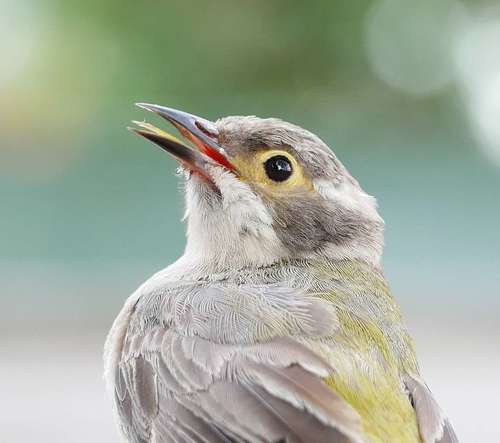
Yellow-faced Honeyeater

Yellow-faced Honeyeater

Caligavis chrysops

Silhouette: Rachael Joakim · PhyloPic

LCLeast ConcernNTVUENCR Endemic
Daily sighting probability ~40% · Likely
at Royal National Park

In 3 days ~80% in a week >90%

1,009 Verified sightings at Royal National Park From 2019 to 2026
7,373 In all 10 parks
June Best month
☀️ Diurnal When it's spotted

About the Yellow-faced Honeyeater

The yellow-faced honeyeater (Caligavis chrysops) is a small to medium-sized bird in the honeyeater family, Meliphagidae. It takes its common and scientific names from the distinctive yellow stripes on the sides of its head. Its loud, clear call often begins twenty or thirty minutes before dawn. It is widespread across eastern and southeastern Australia, in open sclerophyll forests from coastal dunes to high-altitude subalpine areas, and woodlands along creeks and rivers. Comparatively short-billed for a honeyeater, it is thought to have adapted to a diet of flies, spiders, and beetles, as well as nectar and pollen from the flowers of plants, such as Banksia and Grevillea, and soft fruits. It catches insects in flight as well as gleaning them from the foliage of trees and shrubs.

Some yellow-faced honeyeaters are sedentary, but hundreds of thousands migrate northwards between March and May to spend the winter in southern Queensland, and return in July and August to breed in southern New South Wales and Victoria. They form socially monogamous pairs and lay two or three eggs in a delicate cup-shaped nest. The success rate can be low, and the pairs nest several times during the breeding season.

Honeyeaters' preferred woodland habitat is vulnerable to the effects of land-clearing, grazing, and weeds. As it is common and widespread, the yellow-faced honeyeater is considered by the International Union for Conservation of Nature (IUCN) to be of least concern for conservation. It is considered a pest in orchards in some areas. Wikipedia →

Sounds

Call0:22

Australia · 2024

© Romuald Mikusek · XC1173999 · CC BY-NC-SA 4.0

Song0:47

Australia · 2025

© Étienne Leroy · XC1069735 · CC BY-NC-SA 4.0

Dawn song1:18

Australia · 2025

© Khristos Nizamis · XC1068260 · CC BY-NC-ND 4.0

Global Distribution

Parks Where Found

# Park Country Daily sighting probability
1 Kosciuszko National Park 🇦🇺 Australia
~70%
2 Booderee National Park 🇦🇺 Australia
~50%
3 Grampians National Park 🇦🇺 Australia
~50%
4 Blue Mountains National Park 🇦🇺 Australia
~50%
5 Great Otway National Park 🇦🇺 Australia
~40%
6 Royal National Park 🇦🇺 Australia
~40%
7 Springbrook National Park 🇦🇺 Australia
~30%
8 Lamington National Park 🇦🇺 Australia
~20%
9 Wilsons Promontory National Park 🇦🇺 Australia
~10%
10 Daintree National Park 🇦🇺 Australia
<5%

Cities Where Found

# City Country Daily sighting probability
1 Brisbane 🇦🇺 Australia
~10%
2 Sydney 🇦🇺 Australia
~10%
3 Melbourne 🇦🇺 Australia
~10%

Zoos & Centres Where Found

# Zoo / Centre Country
1 Featherdale Sydney Wildlife Park 🇦🇺 Australia In captivity

Before you go

What are the chances of seeing a Yellow-faced Honeyeater in Royal National Park?

Likely

About 40% of wildlife watchers report a Yellow-faced Honeyeater sighting in Royal National Park on a given day, based on 1,009 verified sightings from GBIF citizen-science data from 2019 to 2026. It is the 24th most-seen of the 178 birds we can rate there. Over three days the chance rises to about 80%, and over a week to over 90%, if each day is a fresh chance.

When is the best time to see a Yellow-faced Honeyeater in Royal National Park?

June

In that month about 70% of wildlife watchers report a Yellow-faced Honeyeater in Royal National Park on a given day, against about 20% in February and March, the lowest months.

What time of day is best to see a Yellow-faced Honeyeater?

Between 9 am and noon

Across all the parks we cover, that three-hour window holds the most Yellow-faced Honeyeater sightings with a recorded time, and nearly all of them come between 6 am and 6 pm: it is a daytime animal.

Which relatives of the Yellow-faced Honeyeater live in Royal National Park?

Same family: Meliphagidae

The closest relatives of the Yellow-faced Honeyeater that you can see in Royal National Park (family Meliphagidae, Honeyeaters) are Lewin's Honeyeater (about 60%), Little Wattlebird (about 60%) and Noisy Miner (about 60%), with each one's daily chance of a sighting.

Where does the Yellow-faced Honeyeater sighting chance come from?

GBIF citizen-science records

It is estimated from how often the Yellow-faced Honeyeater is recorded against all the birds logged in Royal National Park (1,009 verified sightings from 2019 to 2026), calibrated against known sighting rates. Figures are rounded to the nearest 10% because citizen-science data supports honest approximations, not decimals, and months with records from fewer than five people show "—". How it works.

← Back to Royal National Park