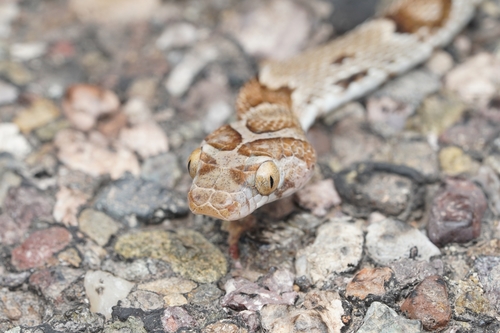
Black-necked Gartersnake

Black-necked Gartersnake

Thamnophis cyrtopsis

Silhouette: Alex Slavenko · PhyloPic

LCLeast ConcernNTVUENCR
Daily sighting probability ~20% · Possible
at Saguaro National Park

In 3 days ~40% in a week ~70%

87 Verified sightings at Saguaro National Park From 2019 to 2026
135 In all 4 parks
September Best month
☀️ Diurnal When it's spotted

About the Black-necked Gartersnake

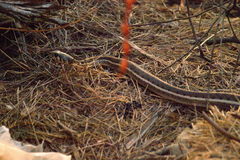
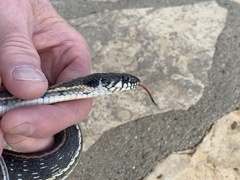
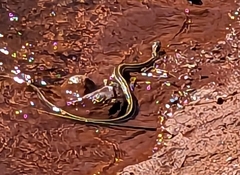
Common names: blackneck garter snake, black-neck garter snake Thamnophis cyrtopsis, the blackneck garter snake, is a species of garter snake of the genus Thamnophis. It is native to the southwestern United States, Mexico and Guatemala, and can be found in a wide range of different habitats, often near water sources.

There are three recognized subspecies of the blackneck garter snake, two of which, Thamnophis cyrtopsis cyrtopsis and Thamnophis cyrtopsis ocellatus, are described below. Thamnophis cyrtopsis cyrtopsis (Kennicott, 1860) The western blackneck garter snake may attain 107 cm (42 inches) in total length. The snake is colored dark olive with an orange-yellow stripe that is displayed on the middle of the body from the top while the underside is usually a cream or light shade of gray. The western blackneck is a water snake that lives near rivers, swims, and eats small fish and tadpoles.

Thamnophis cyrtopsis ocellatus (Cope, 1880) The eastern blackneck garter snake is smaller than the western blackneck garter snake, with an average total length of less than 51 cm (20 inches). It is frequently... Wikipedia →

Global Distribution

Parks Where Found

# Park Country Daily sighting probability
1 Saguaro National Park 🇺🇸 United States
~20%
2 Guadalupe Mountains National Park 🇺🇸 United States
~20%
3 Big Bend National Park 🇺🇸 United States
~10%
4 Cumbres de Monterrey National Park 🇲🇽 Mexico
<5%

Cities Where Found

# City Country Daily sighting probability
1 Austin 🇺🇸 United States
~10%

Zoos & Centres Where Found

# Zoo / Centre Country
1 Arizona-Sonora Desert Museum 🇺🇸 United States In captivity
2 ABQ BioPark Zoo 🇺🇸 United States In captivity

Before you go

What are the chances of seeing a Black-necked Gartersnake in Saguaro National Park?

Possible

About 20% of wildlife watchers report a Black-necked Gartersnake sighting in Saguaro National Park on a given day, based on 87 verified sightings from GBIF citizen-science data from 2019 to 2026. It is the 18th most-seen of the 51 reptiles we can rate there. Over three days the chance rises to about 40%, and over a week to about 70%, if each day is a fresh chance.

When is the best time to see a Black-necked Gartersnake in Saguaro National Park?

July to September

In those months about 30% of wildlife watchers report a Black-necked Gartersnake in Saguaro National Park on a given day, against under 5% in January and February, the lowest months. Those are among Saguaro National Park's wettest months, with about 50 mm of rain a month against almost none in May.

What time of day is best to see a Black-necked Gartersnake?

Between 9 am and noon

Across all the parks we cover, that three-hour window holds the most Black-necked Gartersnake sightings with a recorded time, and about 7 in 10 of them come between 6 am and 6 pm: it is a daytime animal.

Is Saguaro National Park the best place to see a Black-necked Gartersnake?

Yes

Of the 4 parks where we can rate Black-necked Gartersnake sightings, Saguaro National Park has the highest daily chance: about 20%. Next come Guadalupe Mountains National Park (United States, about 20%) and Big Bend National Park (United States, about 10%).

Where does the Black-necked Gartersnake sighting chance come from?

GBIF citizen-science records

It is estimated from how often the Black-necked Gartersnake is recorded against all the reptiles logged in Saguaro National Park (87 verified sightings from 2019 to 2026), calibrated against known sighting rates. Figures are rounded to the nearest 10% because citizen-science data supports honest approximations, not decimals, and months with records from fewer than five people show "—". How it works.

← Back to Saguaro National Park