
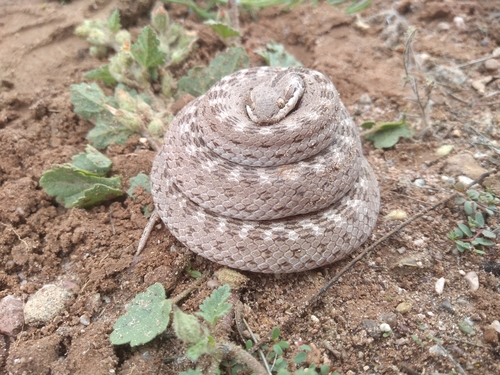
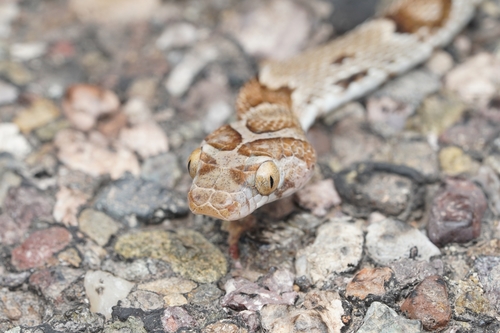
Western Patch-nosed Snake

Western Patch-nosed Snake

Salvadora hexalepis

Silhouette: Alex Slavenko · PhyloPic

LCLeast ConcernNTVUENCR
Daily sighting probability ~10% · With luck
at Saguaro National Park

In 3 days ~30% in a week ~50%

36 Verified sightings at Saguaro National Park From 2019 to 2026
204 In all 6 parks
May Best month
☀️ Diurnal When it's spotted

About the Western Patch-nosed Snake

Salvadora hexalepis, the western patch-nosed snake, is a species of non-venomous colubrid snake, which is endemic to the southwestern United States and northern Mexico. It is found in the southwestern United States in the states of Arizona, southern California, Nevada, southern New Mexico, and southwestern Texas. It is also found in northern Mexico in the Mexican states of Baja California, Baja California Sur, Chihuahua, Sinaloa, and Sonora.

The western patch-nosed snake inhabits arid deserts in its area. It feeds upon lizards, snakes, reptile eggs, and small rodents. 4-10 eggs are laid during spring or early summer and hatch in August through... Wikipedia →

Global Distribution

Parks Where Found

# Park Country Daily sighting probability
1 Death Valley National Park 🇺🇸 United States
~30%
2 Joshua Tree National Park 🇺🇸 United States
~20%
3 El Vizcaíno Biosphere Reserve 🇲🇽 Mexico
~20%
4 Grand Canyon National Park 🇺🇸 United States
~10%
5 Saguaro National Park 🇺🇸 United States
~10%
6 Zion National Park 🇺🇸 United States
~10%

Cities Where Found

# City Country Daily sighting probability
1 Mesa 🇺🇸 United States
~10%
2 Phoenix 🇺🇸 United States
<5%

Zoos & Centres Where Found

# Zoo / Centre Country
1 Arizona-Sonora Desert Museum 🇺🇸 United States In captivity

Before you go

What are the chances of seeing a Western Patch-nosed Snake in Saguaro National Park?

With luck

About 10% of wildlife watchers report a Western Patch-nosed Snake sighting in Saguaro National Park on a given day, based on 36 verified sightings from GBIF citizen-science data from 2019 to 2026. It is the 27th most-seen of the 51 reptiles we can rate there. Over three days the chance rises to about 30%, and over a week to about 50%, if each day is a fresh chance.

When is the best time to see a Western Patch-nosed Snake in Saguaro National Park?

May–June and October–November

In those months about 20% of wildlife watchers report a Western Patch-nosed Snake in Saguaro National Park on a given day, against under 5% in December and January, the lowest months. Those are among Saguaro National Park's driest months, with about 10 mm of rain a month against 55 mm in July.

What time of day is best to see a Western Patch-nosed Snake?

Between 8 and 11 am

Across all the parks we cover, that three-hour window holds the most Western Patch-nosed Snake sightings with a recorded time, and about 9 in 10 of them come between 6 am and 6 pm: it is a daytime animal.

Where does the Western Patch-nosed Snake sighting chance come from?

GBIF citizen-science records

It is estimated from how often the Western Patch-nosed Snake is recorded against all the reptiles logged in Saguaro National Park (36 verified sightings from 2019 to 2026), calibrated against known sighting rates. Figures are rounded to the nearest 10% because citizen-science data supports honest approximations, not decimals, and months with records from fewer than five people show "—". How it works.

← Back to Saguaro National Park