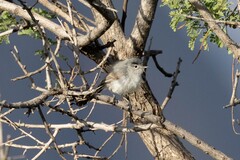


Black-tailed Gnatcatcher

Black-tailed Gnatcatcher

Polioptila melanura

Silhouette: Sheatherius · PhyloPic

LCLeast ConcernNTVUENCR
Daily sighting probability ~30% · Possible
at Saguaro National Park

In 3 days ~60% in a week ~90%

2,136 Verified sightings at Saguaro National Park From 2019 to 2026
4,176 In all 6 parks
August Best month
☀️ Diurnal When it's spotted

About the Black-tailed Gnatcatcher

The black-tailed gnatcatcher (Polioptila melanura) is a small, insectivorous bird which ranges throughout the Sonoran and Chihuahuan Deserts of the southwestern United States and northern Mexico. It is nonmigratory and found in arid desert areas year-round.

The black-tailed gnatcatcher was described by American ornithologist George Newbold Lawrence in 1857. Meaning 'black-tailed', its specific name is derived from the Ancient Greek melano- 'black' and oura 'tail'. The black-tailed gnatcatcher reaches about 4.5 to 5 inches in length, much of it taken up by a long black tail lined with white outer feathers. The body is blue-grey, with white underparts, and while it is similar to the blue-grey gnatcatcher, the two birds are differentiated by the amount of black in the tail feathers. The male has a black cap during the summer that extends to the eyes. Females and winter males, lacking the black cap, are difficult to distinguish from the blue-grey gnatcatcher. The best way to tell the two apart is the tail; that of the blue-grey is mostly white when viewed from below, and the black-tailed is predominantly black underneath. Like other gnatcatchers, it... Wikipedia →

Sounds

Song0:43

Mexico · 2025

© Barry Edmonston · XC1000843 · CC BY-NC-SA 4.0

Call1:00

Mexico · 2019

© Richard E. Webster · XC503156 · CC BY-NC-SA 4.0

Begging call0:38

United States · 2016

© Bobby Wilcox · XC314498 · CC BY-NC-SA 4.0

Global Distribution

Parks Where Found

# Park Country Daily sighting probability
1 Saguaro National Park 🇺🇸 United States
~30%
2 Big Bend National Park 🇺🇸 United States
~30%
3 Joshua Tree National Park 🇺🇸 United States
~20%
4 Death Valley National Park 🇺🇸 United States
~10%
5 Cumbres de Monterrey National Park 🇲🇽 Mexico
<5%
6 Guadalupe Mountains National Park 🇺🇸 United States
<5%

Cities Where Found

# City Country Daily sighting probability
1 Phoenix 🇺🇸 United States
~10%
2 Mesa 🇺🇸 United States
~10%
3 Las Vegas 🇺🇸 United States
~10%

Before you go

What are the chances of seeing a Black-tailed Gnatcatcher in Saguaro National Park?

Possible

About 30% of wildlife watchers report a Black-tailed Gnatcatcher sighting in Saguaro National Park on a given day, based on 2,136 verified sightings from GBIF citizen-science data from 2019 to 2026. It is the 25th most-seen of the 220 birds we can rate there. Over three days the chance rises to about 60%, and over a week to about 90%, if each day is a fresh chance.

When is the best time to see a Black-tailed Gnatcatcher in Saguaro National Park?

August

In that month about 40% of wildlife watchers report a Black-tailed Gnatcatcher in Saguaro National Park on a given day, against about 20% in January–May and October–November, the lowest months. That is one of Saguaro National Park's wettest months, with about 45 mm of rain against almost none in May.

What time of day is best to see a Black-tailed Gnatcatcher?

Between 7 and 10 am

Across all the parks we cover, that three-hour window holds the most Black-tailed Gnatcatcher sightings with a recorded time, and about 9 in 10 of them come between 6 am and 6 pm: it is a daytime animal.

Is Saguaro National Park the best place to see a Black-tailed Gnatcatcher?

Yes

Of the 6 parks where we can rate Black-tailed Gnatcatcher sightings, Saguaro National Park has the highest daily chance: about 30%. Next come Big Bend National Park (United States, about 30%) and Joshua Tree National Park (United States, about 20%).

Where does the Black-tailed Gnatcatcher sighting chance come from?

GBIF citizen-science records

It is estimated from how often the Black-tailed Gnatcatcher is recorded against all the birds logged in Saguaro National Park (2,136 verified sightings from 2019 to 2026), calibrated against known sighting rates. Figures are rounded to the nearest 10% because citizen-science data supports honest approximations, not decimals, and months with records from fewer than five people show "—". How it works.

← Back to Saguaro National Park