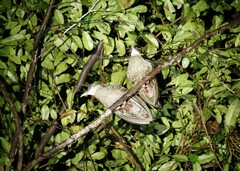
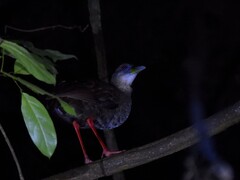
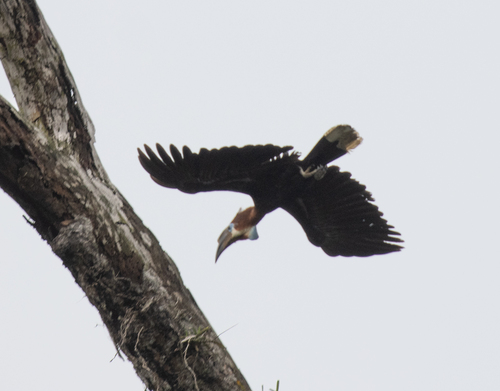
Nkulengu Rail

Nkulengu Rail

Himantornis haematopus

Silhouette: Sheatherius · PhyloPic

LCLeast ConcernNTVUENCR
Daily sighting probability <5% · Rare
at Semuliki National Park

In 3 days ~10% in a week ~20%

10 Verified sightings at Semuliki National Park From 2019 to 2026
22 In all 3 parks
January Best month
🌅 Crepuscular When it's spotted

About the Nkulengu Rail

The Nkulengu rail (Himantornis haematopus) is a species of bird in the family Rallidae. It belongs to the monotypic genus Himantornis. For long, this singular rail was considered a member of a distinct subfamily Himantornithinae. This was based on the assumption that it was a sort of "living fossil", as it resembles other Gruiformes rather than other rails in many traits. But as it seems, the supposed plesiomorphies are actually atavistic or otherwise re-evolved traits in reaction to its African rainforest habitat. Its closest living relatives seem to be the Asian genera Amaurornis, Gallicrex, Megacrex, and the widespread African Aenigmatolimnas, with Megacrex and Himantornis representing ancient and ecologically quite similar lineages at the extreme ends of the group's distribution. However a later genetic study found that it was basal to the radiation containing Porzana, Tribonyx, Gallinula and Fulica.

It is found in Angola, Cameroon, Central African Republic, Republic of the Congo, Democratic Republic of the Congo, Ivory Coast, Equatorial Guinea, Gabon, Ghana, Guinea, Liberia, Nigeria, Sierra Leone, Togo, and Uganda. It is notoriously difficult to visually observe, preferring to hide, but has a loud and distinctive call often made in pairs. Wikipedia →

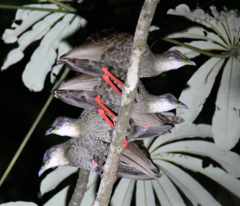
Sounds

Song0:56

Ivory Coast · 2026

© Étienne Leroy · XC1085724 · CC BY-NC-SA 4.0

Call0:53

Ghana · 2018

© Bram Vogels · XC404539 · CC BY-NC-SA 4.0

Song0:20

Ivory Coast · 1986

© Nature sounds by Simply Birding · XC615362 · CC BY-NC-ND 4.0

Global Distribution

Parks Where Found

# Park Country Daily sighting probability
1 Odzala-Kokoua National Park 🇨🇬 Republic of the Congo
~20%
2 Taï National Park 🇨🇮 Ivory Coast
~10%
3 Semuliki National Park 🇺🇬 Uganda
<5%

Before you go

What are the chances of seeing a Nkulengu Rail in Semuliki National Park?

Rare

Under 5% of wildlife watchers report a Nkulengu Rail sighting in Semuliki National Park on a given day, based on 10 verified sightings from GBIF citizen-science data from 2019 to 2026. It is the 213th most-seen of the 280 birds we can rate there. Over three days the chance rises to about 10%, and over a week to about 20%, if each day is a fresh chance.

When is the best time to see a Nkulengu Rail in Semuliki National Park?

January, May and November

In those months about 10% of wildlife watchers report a Nkulengu Rail in Semuliki National Park on a given day, against under 5% in February–April, June–October and December, the lowest months.

What time of day is best to see a Nkulengu Rail?

Between 5 and 8 am

Across all the parks we cover, that three-hour window holds the most Nkulengu Rail sightings with a recorded time, and about half of them come between 6 am and 6 pm: it is most active around dawn and dusk.

Is Semuliki National Park the best place to see a Nkulengu Rail?

3rd of 3

Of the 3 parks where we can rate Nkulengu Rail sightings, Semuliki National Park ranks 3rd at under 5%. The best odds are in Odzala-Kokoua National Park (Republic of the Congo, about 20%) and Taï National Park (Ivory Coast, about 10%).

Where does the Nkulengu Rail sighting chance come from?

GBIF citizen-science records

It is estimated from how often the Nkulengu Rail is recorded against all the birds logged in Semuliki National Park (10 verified sightings from 2019 to 2026), calibrated against known sighting rates. Figures are rounded to the nearest 10% because citizen-science data supports honest approximations, not decimals, and months with records from fewer than five people show "—". How it works.

← Back to Semuliki National Park