Fiery Minivet

Fiery Minivet

Pericrocotus igneus

Silhouette: PhyloPic

LCNTNear ThreatenedVUENCR
Daily sighting probability ~20% · Possible
at Sepilok

In 3 days ~50% in a week ~80%

550 Verified sightings at Sepilok From 2019 to 2026
862 In all 8 parks
December Best month
☀️ Diurnal When it's spotted

About the Fiery Minivet

The fiery minivet (Pericrocotus igneus) is a species of bird in the family Campephagidae. Its range includes Thailand, Malaysia, Indonesia and the Philippines. Its natural habitats are broadleaf, secondary and coastal forests. It is threatened by forest clearance and has been assessed as near-threatened by the International Union for Conservation of Nature (IUCN).

This species was described from Malacca by Edward Blyth in 1846. The species name is from the Latin igneus "fiery". Harry C. Oberholser described the larger subspecies Pericrocotus igneus trophis from Simeulue in 1912. A 2010 molecular phylogenetic study confirmed the previously hypothesised relationship that the fiery minivet and small minivet (Pericrocotus cinnamomeus) are sister species.

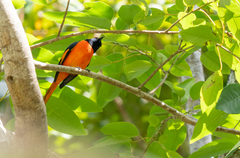
The fiery minivet is 15–16.5 cm (5.9–6.5 in) long. It is sexually dimorphic. The male has a glossy black head and mantle and an orange-red back. The wings are mostly glossy black, with orange-red edges to the secondary coverts and an orange-red patch on the flight feathers. The gradated tail is black and orange-red. The chin and throat are glossy black, and the rest of the underparts is orange-red. The eyes... Wikipedia →

Sounds

Song0:31

Philippines · 2010

© Frank Lambert · XC269351 · CC BY-NC-ND 4.0

Call0:51

Malaysia · 2014

© Marc Anderson · XC462053 · CC BY-NC-ND 4.0

Song1:12

Malaysia · 2024

© Greg Irving · XC919671 · CC BY-NC-SA 4.0

Global Distribution

Parks Where Found

# Park Country Daily sighting probability
1 Sepilok 🇲🇾 Malaysia
~20%
2 Way Kambas National Park 🇮🇩 Indonesia
~20%
3 Tanjung Puting National Park 🇮🇩 Indonesia
~20%
4 Danum Valley Conservation Area 🇲🇾 Malaysia
~10%
5 Khao Luang National Park 🇹🇭 Thailand
~10%
6 Taman Negara National Park 🇲🇾 Malaysia
<5%
7 Kerinci Seblat National Park 🇮🇩 Indonesia
<5%
8 Kinabatangan Wildlife Sanctuary 🇲🇾 Malaysia
<5%

Cities Where Found

# City Country Daily sighting probability
1 Kuala Lumpur 🇲🇾 Malaysia
<5%

Before you go

What are the chances of seeing a Fiery Minivet in Sepilok?

Possible

About 20% of wildlife watchers report a Fiery Minivet sighting in Sepilok on a given day, based on 550 verified sightings from GBIF citizen-science data from 2019 to 2026. It is the 66th most-seen of the 242 birds we can rate there. Over three days the chance rises to about 50%, and over a week to about 80%, if each day is a fresh chance.

When is the best time to see a Fiery Minivet in Sepilok?

December

In that month about 40% of wildlife watchers report a Fiery Minivet in Sepilok on a given day, against about 10% in May and September, the lowest months.

What time of day is best to see a Fiery Minivet?

Between 8 and 11 am

Across all the parks we cover, that three-hour window holds the most Fiery Minivet sightings with a recorded time, and about 9 in 10 of them come between 6 am and 6 pm: it is a daytime animal.

Is Sepilok the best place to see a Fiery Minivet?

Yes

Of the 8 parks where we can rate Fiery Minivet sightings, Sepilok has the highest daily chance: about 20%. Next come Way Kambas National Park (Indonesia, about 20%) and Tanjung Puting National Park (Indonesia, about 20%).

Where does the Fiery Minivet sighting chance come from?

GBIF citizen-science records

It is estimated from how often the Fiery Minivet is recorded against all the birds logged in Sepilok (550 verified sightings from 2019 to 2026), calibrated against known sighting rates. Figures are rounded to the nearest 10% because citizen-science data supports honest approximations, not decimals, and months with records from fewer than five people show "—". How it works.

← Back to Sepilok