
California Newt

California Newt

Taricha torosa

Silhouette: Neil Kelley · PhyloPic

LCNTNear ThreatenedVUENCR Endemic
Daily sighting probability ~20% · Possible
at Sequoia and Kings Canyon National Parks

In 3 days ~40% in a week ~70%

25 Verified sightings at Sequoia and Kings Canyon National Parks From 2019 to 2026
25 In 1 park
April Best month
☀️ Diurnal When it's spotted

About the California Newt

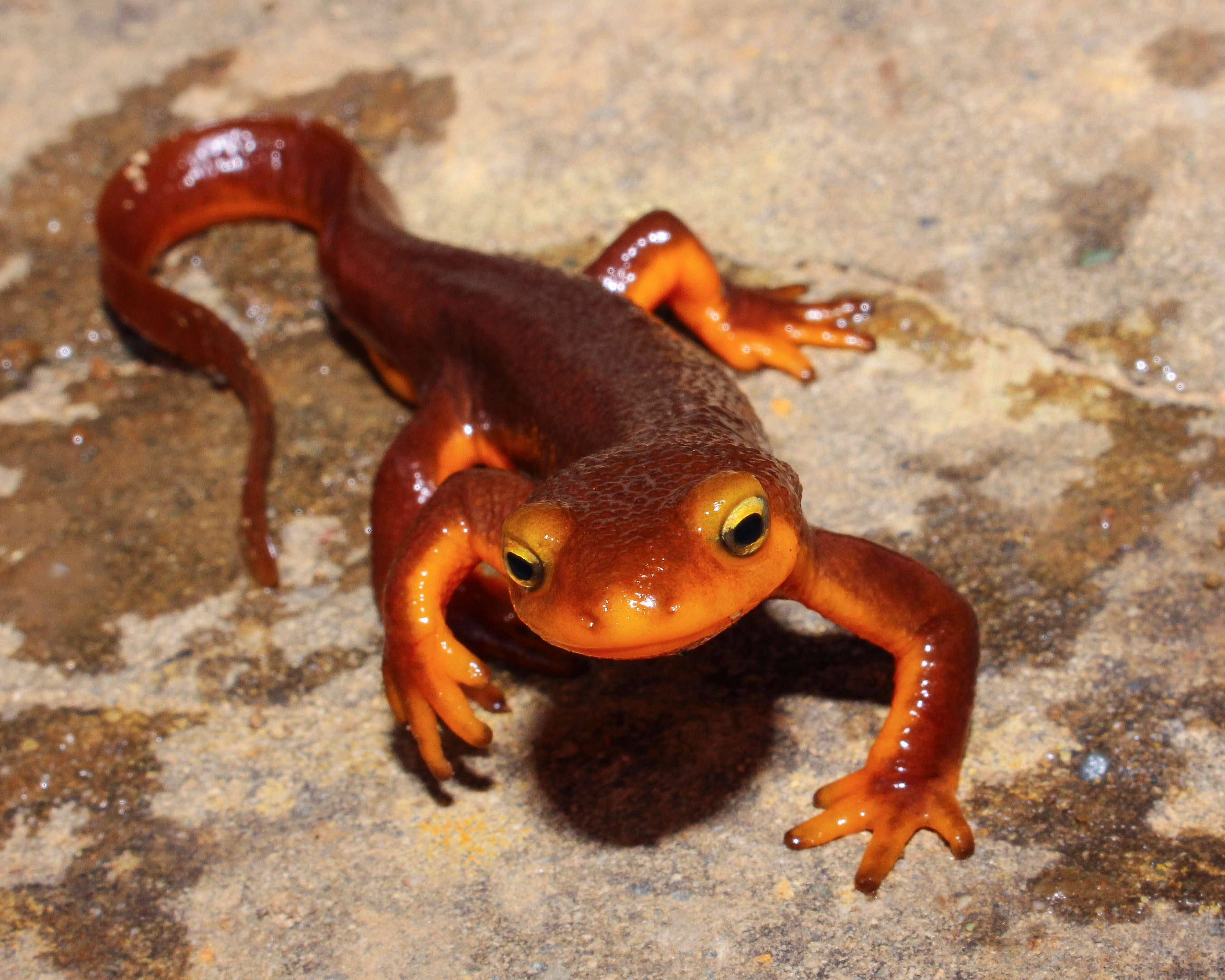
The California newt or orange-bellied newt (Taricha torosa), is a species of newt endemic to California, in the Western United States. Its adult length can range from 5 to 8 in (13 to 20 cm). Its skin produces the potent toxin tetrodotoxin.

Taricha torosa was divided into two subspecies until 2007, when it was determined that the Sierra and coastal populations represent distinct evolutionary lineages. The former subspecies Taricha torosa sierrae was elevated to full species level and it is now known as Taricha sierrae, the Sierra newt. Taricha torosa torosa has been retired and now all coastal populations are simply known as Taricha torosa, the California newt.

California newts reside in the coastal counties of California and in the southern and central Sierra Nevada and occupy a diverse array of habitats found near the small ponds and creeks where they breed, including woodlands and chaparral.

The California newt has warty, slate-gray skin on its back and bright orange-yellow skin underneath. It is very similar in appearance to the rough-skinned newt and they are often indistinguishable without dissection, but in general, the... Wikipedia →

Sounds

Recording0:06

United States · 2026

© napabirder · iNaturalist · CC BY-NC 4.0

Global Distribution

Parks Where Found

# Park Country Daily sighting probability
1 Sequoia and Kings Canyon National Parks 🇺🇸 United States
~20%

More parks will be added in future updates.

Cities Where Found

# City Country Daily sighting probability
1 San Francisco 🇺🇸 United States
<5%
2 Los Angeles 🇺🇸 United States
<5%

Zoos & Centres Where Found

# Zoo / Centre Country
1 California Academy of Sciences 🇺🇸 United States In captivity
2 San Francisco Zoo 🇺🇸 United States In captivity
3 ABQ BioPark Zoo 🇺🇸 United States In captivity
4 California Living Museum 🇺🇸 United States In captivity
5 Aquarium of the Pacific 🇺🇸 United States In captivity
6 Aquarium of the Bay 🇺🇸 United States In captivity

Before you go

What are the chances of seeing a California Newt in Sequoia and Kings Canyon National Parks?

Possible

About 20% of wildlife watchers report a California Newt sighting in Sequoia and Kings Canyon National Parks on a given day, based on 25 verified sightings from GBIF citizen-science data from 2019 to 2026. It is the 7th most-seen of the 12 amphibians we can rate there. Over three days the chance rises to about 40%, and over a week to about 70%, if each day is a fresh chance.

When is the best time to see a California Newt in Sequoia and Kings Canyon National Parks?

April

In that month about 50% of wildlife watchers report a California Newt in Sequoia and Kings Canyon National Parks on a given day, against under 5% in June to November, the lowest months.

What time of day is best to see a California Newt?

Between 10 am and 1 pm

Across all the parks we cover, that three-hour window holds the most California Newt sightings with a recorded time, and about 8 in 10 of them come between 6 am and 6 pm: it is a daytime animal.

Where else can you see a California Newt?

Only Sequoia and Kings Canyon National Parks, in our data

Sequoia and Kings Canyon National Parks is the only park on Wallace's Line with enough records to rate California Newt sightings: about 20% of wildlife watchers there report one on a given day.

Where does the California Newt sighting chance come from?

GBIF citizen-science records

It is estimated from how often the California Newt is recorded against all the amphibians logged in Sequoia and Kings Canyon National Parks (25 verified sightings from 2019 to 2026), calibrated against known sighting rates. Figures are rounded to the nearest 10% because citizen-science data supports honest approximations, not decimals, and months with records from fewer than five people show "—". How it works.

← Back to Sequoia and Kings Canyon National Parks