Southern Mountain Yellow-legged Frog

Southern Mountain Yellow-legged Frog

Rana muscosa

Silhouette: Sharp Photography, sharpphotography.co.uk · PhyloPic

LCNTVUENEndangeredCR Endemic
Daily sighting probability ~10% · With luck
at Sequoia and Kings Canyon National Parks

In 3 days ~20% in a week ~40%

49 Verified sightings at Sequoia and Kings Canyon National Parks From 2019 to 2026
49 In 1 park
August Best month
☀️ Diurnal When it's spotted

About the Southern Mountain Yellow-legged Frog

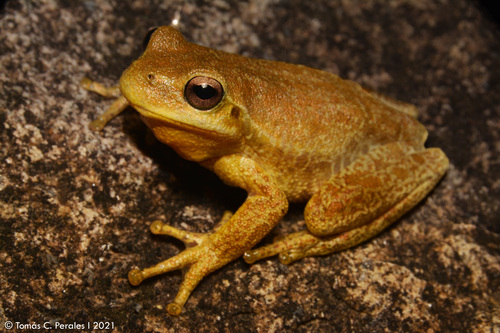
The southern mountain yellow-legged frog (Rana muscosa), formerly known as the mountain yellow-legged frog, is a species of true frog endemic to California in the United States. It occurs in the San Jacinto Mountains, San Bernardino Mountains, and San Gabriel Mountains in Southern California and the Southern Sierra Nevada. It is a federally listed endangered species, separated into two distinct population segments (DPS): a northern DPS, listed endangered in 2014, and a southern DPS that was listed endangered in 2002.

Populations formerly classified as Rana muscosa in the northern Sierra Nevada have since been redescribed as a new species: Rana sierrae, the Sierra Nevada yellow-legged frog. The Sierra Nevada yellow-legged frog has also been classified as a federally endangered species since 2014. The mountains separating the headwaters of the South Fork and Middle Fork of the Kings River mark the boundary between the ranges of the two species.

Rana muscosa is 4 to 8.9 centimetres (1.6 to 3.5 in) long. Females tend to be larger than males. Its color and patterning are variable. It is yellowish, brownish, or olive with black and brown markings. The underside of its hind... Wikipedia →

Global Distribution

Parks Where Found

# Park Country Daily sighting probability
1 Sequoia and Kings Canyon National Parks 🇺🇸 United States
~10%

More parks will be added in future updates.

Zoos & Centres Where Found

# Zoo / Centre Country
1 Birch Aquarium 🇺🇸 United States In captivity
2 ResQue Ranch Inc. 🇺🇸 United States In captivity
3 Universal City Zoo 🇺🇸 United States In captivity

Before you go

What are the chances of seeing a Southern Mountain Yellow-legged Frog in Sequoia and Kings Canyon National Parks?

With luck

About 10% of wildlife watchers report a Southern Mountain Yellow-legged Frog sighting in Sequoia and Kings Canyon National Parks on a given day, based on 49 verified sightings from GBIF citizen-science data from 2019 to 2026. It is the 12th most-seen of the 12 amphibians we can rate there. Over three days the chance rises to about 20%, and over a week to about 40%, if each day is a fresh chance.

When is the best time to see a Southern Mountain Yellow-legged Frog in Sequoia and Kings Canyon National Parks?

August and September

In those months about 10% of wildlife watchers report a Southern Mountain Yellow-legged Frog in Sequoia and Kings Canyon National Parks on a given day, against under 5% in October to July, the lowest months. Those are among Sequoia and Kings Canyon National Parks's driest months, with about 20 mm of rain a month against 190 mm in January.

What time of day is best to see a Southern Mountain Yellow-legged Frog?

Between 9 am and noon

Across all the parks we cover, that three-hour window holds the most Southern Mountain Yellow-legged Frog sightings with a recorded time, and nearly all of them come between 6 am and 6 pm: it is a daytime animal.

Where else can you see a Southern Mountain Yellow-legged Frog?

Only Sequoia and Kings Canyon National Parks, in our data

Sequoia and Kings Canyon National Parks is the only park on Wallace's Line with enough records to rate Southern Mountain Yellow-legged Frog sightings: about 10% of wildlife watchers there report one on a given day.

Where does the Southern Mountain Yellow-legged Frog sighting chance come from?

GBIF citizen-science records

It is estimated from how often the Southern Mountain Yellow-legged Frog is recorded against all the amphibians logged in Sequoia and Kings Canyon National Parks (49 verified sightings from 2019 to 2026), calibrated against known sighting rates. Figures are rounded to the nearest 10% because citizen-science data supports honest approximations, not decimals, and months with records from fewer than five people show "—". How it works.

← Back to Sequoia and Kings Canyon National Parks