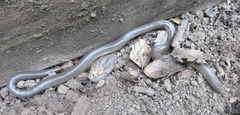
Northern Rubber Boa

Northern Rubber Boa

Charina bottae

Silhouette: Alex Slavenko · PhyloPic

LCLeast ConcernNTVUENCR
Daily sighting probability ~20% · Possible
at Sequoia and Kings Canyon National Parks

In 3 days ~60% in a week ~90%

44 Verified sightings at Sequoia and Kings Canyon National Parks From 2019 to 2026
106 In all 4 parks
February Best month
☀️🌙 Day & Night When it's spotted

About the Northern Rubber Boa

The rubber boa (Charina bottae) is a species of snake in the family Boidae and is native to western North America. It is sometimes known as the coastal rubber boa or the northern rubber boa and is not to be confused with the southern rubber boa (Charina umbratica).

Henri Marie Ducrotay de Blainville described the rubber boa in 1835. The generic name Charina is from the Ancient Greek "graceful" or "delightful", and the specific name bottae honors Dr. Paolo E. Botta, an Italian ship's surgeon, explorer, and naturalist.

The family Boidae consists of the nonvenomous snakes commonly called boas and consists of 43 species. The genus Charina consists of two species, both of which are found in North America. There is debate on whether the southern rubber boa, a population found in the San Bernardino and San Jacinto Mountains east of Los Angeles in California, should be a separate species or a subspecies (as Charina bottae umbratica). A study published in 2001 concluded there is enough evidence to indicate that the proposed independent species, Charina umbratica, is a separate species based on its geologically separate genetic nature and morphological differences. Wikipedia →

Sounds

Recording0:11

United States · 2022

© jamiecatchfly · iNaturalist · CC BY-NC 4.0

Global Distribution

Parks Where Found

# Park Country Daily sighting probability
1 Sequoia and Kings Canyon National Parks 🇺🇸 United States
~20%
2 Yosemite National Park 🇺🇸 United States
~10%
3 Grand Teton National Park 🇺🇸 United States
~10%
4 Yellowstone National Park 🇺🇸 United States
~10%

Cities Where Found

# City Country Daily sighting probability
1 San Francisco 🇺🇸 United States
<5%

Zoos & Centres Where Found

# Zoo / Centre Country
1 Living Desert Zoo and Gardens 🇺🇸 United States In captivity
2 Sedgwick County Zoo 🇺🇸 United States In captivity
3 Woodland Park Zoo 🇺🇸 United States In captivity
4 Santa Barbara Zoo 🇺🇸 United States In captivity
5 Reptile Gardens 🇺🇸 United States In captivity

Closest Relatives at Sequoia and Kings Canyon National Parks

No species of the same family or order lives in Sequoia and Kings Canyon National Parks, so these are its closest relatives here: other reptiles.

Before you go

What are the chances of seeing a Northern Rubber Boa in Sequoia and Kings Canyon National Parks?

Possible

About 20% of wildlife watchers report a Northern Rubber Boa sighting in Sequoia and Kings Canyon National Parks on a given day, based on 44 verified sightings from GBIF citizen-science data from 2019 to 2026. It is the 9th most-seen of the 17 reptiles we can rate there. Over three days the chance rises to about 60%, and over a week to about 90%, if each day is a fresh chance.

When is the best time to see a Northern Rubber Boa in Sequoia and Kings Canyon National Parks?

February, May–July and September

In those months about 30% of wildlife watchers report a Northern Rubber Boa in Sequoia and Kings Canyon National Parks on a given day, against under 5% in March–April and November–January, the lowest months.

What time of day is best to see a Northern Rubber Boa?

Between 6 and 9 pm

Across all the parks we cover, that three-hour window holds the most Northern Rubber Boa sightings with a recorded time, and about half of them come between 6 am and 6 pm: it is seen both by day and at night.

Is Sequoia and Kings Canyon National Parks the best place to see a Northern Rubber Boa?

Yes

Of the 4 parks where we can rate Northern Rubber Boa sightings, Sequoia and Kings Canyon National Parks has the highest daily chance: about 20%. Next come Yosemite National Park (United States, about 10%) and Grand Teton National Park (United States, about 10%).

Where does the Northern Rubber Boa sighting chance come from?

GBIF citizen-science records

It is estimated from how often the Northern Rubber Boa is recorded against all the reptiles logged in Sequoia and Kings Canyon National Parks (44 verified sightings from 2019 to 2026), calibrated against known sighting rates. Figures are rounded to the nearest 10% because citizen-science data supports honest approximations, not decimals, and months with records from fewer than five people show "—". How it works.

← Back to Sequoia and Kings Canyon National Parks