California Mountain Kingsnake

California Mountain Kingsnake

Lampropeltis zonata

Silhouette: Andy Wilson · PhyloPic

LCLeast ConcernNTVUENCR Endemic
Daily sighting probability ~30% · Possible
at Sequoia and Kings Canyon National Parks

In 3 days ~70% in a week ~90%

71 Verified sightings at Sequoia and Kings Canyon National Parks From 2019 to 2026
197 In all 2 parks
May Best month
☀️🌙 Day & Night When it's spotted

About the California Mountain Kingsnake

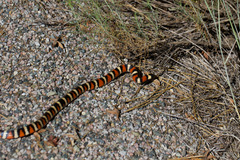
The California mountain kingsnake (Lampropeltis zonata) is a species of nonvenomous colubrid snake that is endemic to North America. It is a coral snake mimic, having a similar pattern consisting of red, black, and yellow on its body, but the snake is completely harmless. Seven subspecies are recognized, with five found in the U.S., including the nominotypical subspecies, and two in Mexico.

The California mountain kingsnake is endemic to western North America. It ranges from extreme southern Washington state, where it has a disjunct population, through Oregon and California, to northern Baja California. The majority of its range lies within the state of California, which is the reason for its common name.

California mountain kingsnakes have a banded pattern that consists of red, black, and white crossbands. The bands are always arranged in the same order with each red crossband being surrounded by two black crossbands, forming what is called a triad. Each triad is separated from the next triad by a white crossband, or in some examples by a cream or yellow crossband. Some individuals may have reduced amounts of red pigment, and rare individuals... Wikipedia →

Global Distribution

Parks Where Found

# Park Country Daily sighting probability
1 Sequoia and Kings Canyon National Parks 🇺🇸 United States
~30%
2 Yosemite National Park 🇺🇸 United States
~20%

Zoos & Centres Where Found

# Zoo / Centre Country
1 San Diego Zoo 🇺🇸 United States In captivity
2 San Francisco Zoo 🇺🇸 United States In captivity
3 Buin Zoo 🇨🇱 Chile In captivity
4 放牧區 🇹🇼 Taiwan In captivity
5 Kung Fu Corals 🇺🇸 United States In captivity

Before you go

What are the chances of seeing a California Mountain Kingsnake in Sequoia and Kings Canyon National Parks?

Possible

About 30% of wildlife watchers report a California Mountain Kingsnake sighting in Sequoia and Kings Canyon National Parks on a given day, based on 71 verified sightings from GBIF citizen-science data from 2019 to 2026. It is the 7th most-seen of the 17 reptiles we can rate there. Over three days the chance rises to about 70%, and over a week to about 90%, if each day is a fresh chance.

When is the best time to see a California Mountain Kingsnake in Sequoia and Kings Canyon National Parks?

May

In that month about 50% of wildlife watchers report a California Mountain Kingsnake in Sequoia and Kings Canyon National Parks on a given day, against under 5% in November to March, the lowest months.

What time of day is best to see a California Mountain Kingsnake?

Between 1 and 4 pm

Across all the parks we cover, that three-hour window holds the most California Mountain Kingsnake sightings with a recorded time, and about 7 in 10 of them come between 6 am and 6 pm: it is seen both by day and at night.

Is Sequoia and Kings Canyon National Parks the best place to see a California Mountain Kingsnake?

Yes

Of the 2 parks where we can rate California Mountain Kingsnake sightings, Sequoia and Kings Canyon National Parks has the highest daily chance: about 30%. Next come Yosemite National Park (United States, about 20%).

Where does the California Mountain Kingsnake sighting chance come from?

GBIF citizen-science records

It is estimated from how often the California Mountain Kingsnake is recorded against all the reptiles logged in Sequoia and Kings Canyon National Parks (71 verified sightings from 2019 to 2026), calibrated against known sighting rates. Figures are rounded to the nearest 10% because citizen-science data supports honest approximations, not decimals, and months with records from fewer than five people show "—". How it works.

← Back to Sequoia and Kings Canyon National Parks