Black-faced Sandgrouse

Black-faced Sandgrouse

Pterocles decoratus

Silhouette: PhyloPic

LCLeast ConcernNTVUENCR
Daily sighting probability ~10% · With luck
at Serengeti National Park

In 3 days ~20% in a week ~40%

190 Verified sightings at Serengeti National Park From 2019 to 2026
2,759 In all 12 parks
April Best month
☀️ Diurnal When it's spotted

About the Black-faced Sandgrouse

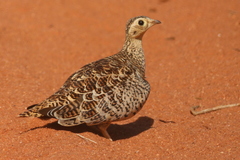
The black-faced sandgrouse (Pterocles decoratus) is a species of ground-dwelling bird in the Pteroclidae family. It is a mainly sedentary bird found in East Africa, ranging from Ethiopia, Kenya, Somalia, Tanzania, and Uganda. It is a medium-sized bird which is well-adapted and well-camouflaged to life in arid environments. It is a dove-like bird due to its physical resemblance, particularly its small head, short legs, and pointed wings. It is listed as least concern on the IUCN Red List.

The black-faced sandgrouse is a medium-sized bird approximately 28 cm (11 in) long and weighing between 140 and 210 g (4.9 and 7.4 oz). Overall, it has a small and compact body, with a short tail, pointed wings, as well as short and feathered legs. The wing tips are black when in flight.

As its name suggests, the male is easily recognizable with black face markings extending from the forehead down to the throat. The male is also characterized by a black and a white eyebrow stripe above the eye, a pinkish-orange bill, and a yellow eye-ring contrasting against its black facial colour. The chest is a pale brown with a thin bold black stripe followed by a thick white stripe on the breast... Wikipedia →

Sounds

Call0:15

Ethiopia · 2015

© Peter Boesman · XC300648 · CC BY-NC-ND 4.0

Flight call0:11

Kenya · 2018

© Frank Lambert · XC451470 · CC BY-NC-ND 4.0

Flight call0:04

Tanzania · 2018

© Bernard BOUSQUET · XC434314 · CC BY-NC-SA 4.0

Global Distribution

Parks Where Found

# Park Country Daily sighting probability
1 Ruaha National Park 🇹🇿 Tanzania
~60%
2 Samburu National Reserve 🇰🇪 Kenya
~50%
3 Tarangire National Park 🇹🇿 Tanzania
~50%
4 Tsavo East National Park 🇰🇪 Kenya
~50%
5 Meru National Park 🇰🇪 Kenya
~50%
6 Tsavo West National Park 🇰🇪 Kenya
~40%
7 Mkomazi National Park 🇹🇿 Tanzania
~10%
8 Amboseli National Park 🇰🇪 Kenya
~10%
9 Serengeti National Park 🇹🇿 Tanzania
~10%
10 Nairobi National Park 🇰🇪 Kenya
<5%
11 Ngorongoro Conservation Area 🇹🇿 Tanzania
<5%
12 Masai Mara National Reserve 🇰🇪 Kenya
<5%

Before you go

What are the chances of seeing a Black-faced Sandgrouse in Serengeti National Park?

With luck

About 10% of wildlife watchers report a Black-faced Sandgrouse sighting in Serengeti National Park on a given day, based on 190 verified sightings from GBIF citizen-science data from 2019 to 2026. It is the 210th most-seen of the 469 birds we can rate there. Over three days the chance rises to about 20%, and over a week to about 40%, if each day is a fresh chance.

When is the best time to see a Black-faced Sandgrouse in Serengeti National Park?

April–June and November–February

In those months about 10% of wildlife watchers report a Black-faced Sandgrouse in Serengeti National Park on a given day, against under 5% in March and July–October, the lowest months.

What time of day is best to see a Black-faced Sandgrouse?

Between 6 and 9 am

Across all the parks we cover, that three-hour window holds the most Black-faced Sandgrouse sightings with a recorded time, and about 8 in 10 of them come between 6 am and 6 pm: it is a daytime animal.

Which relatives of the Black-faced Sandgrouse live in Serengeti National Park?

Same genus: Pterocles

The closest relatives of the Black-faced Sandgrouse that you can see in Serengeti National Park (genus Pterocles, Typical Sandgrouse) are Yellow-throated Sandgrouse (about 20%) and Chestnut-bellied Sandgrouse (about 10%), with each one's daily chance of a sighting.

Where does the Black-faced Sandgrouse sighting chance come from?

GBIF citizen-science records

It is estimated from how often the Black-faced Sandgrouse is recorded against all the birds logged in Serengeti National Park (190 verified sightings from 2019 to 2026), calibrated against known sighting rates. Figures are rounded to the nearest 10% because citizen-science data supports honest approximations, not decimals, and months with records from fewer than five people show "—". How it works.

← Back to Serengeti National Park