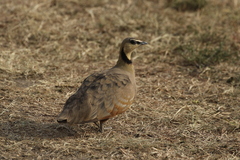
Yellow-throated Sandgrouse

Yellow-throated Sandgrouse

Pterocles gutturalis

Silhouette: PhyloPic

LCLeast ConcernNTVUENCR
Daily sighting probability ~20% · Possible
at Serengeti National Park

In 3 days ~40% in a week ~70%

550 Verified sightings at Serengeti National Park From 2019 to 2026
1,620 In all 9 parks
November Best month
☀️ Diurnal When it's spotted

About the Yellow-throated Sandgrouse

The yellow-throated sandgrouse (Pterocles gutturalis) is a bird species of the family Pteroclidae. The species common name is derived from the male's distinctive yellow throat. It is found in arid and semi-arid environments and inhabits regions distributed across 10 different African countries. The yellow-throated sandgrouse is listed as Near Threatened in the South African regional assessment but regarded as Least Concerned globally.

Pterocles gutturalis is one of the 16 species in Pteroclidae, the only family in the order Pterocliformes. Early morphological analyses placed the group at an intermediate position between fowls and pigeons (Columbiformes). However, a later study on feather structure suggest a closer evolutionary connection with shorebirds (Charadriiformes).

Molecular and behavioural analyses support that the yellow-throated sandgrouse is part of the short-tailed clade, which also includes the Madagascar sandgrouse (P. personatus), and the crowned sandgrouse (P. coronatus). Genetic assessments indicate that P. personatus, a species found only in Madagascar, is the sister species of... Wikipedia →

Sounds

Call0:30

Zimbabwe · 2024

© Dries Van de Loock · XC962497 · CC BY-NC-ND 4.0

Flight call0:18

Tanzania · 2018

© Bernard BOUSQUET · XC424861 · CC BY-NC-SA 4.0

Call0:14

Ethiopia · 2015

© Andrew Spencer · XC276854 · CC BY-NC-ND 4.0

Global Distribution

Parks Where Found

# Park Country Daily sighting probability
1 Serengeti National Park 🇹🇿 Tanzania
~20%
2 Masai Mara National Reserve 🇰🇪 Kenya
~20%
3 Ngorongoro Conservation Area 🇹🇿 Tanzania
~20%
4 Tarangire National Park 🇹🇿 Tanzania
~10%
5 Amboseli National Park 🇰🇪 Kenya
~10%
6 Hwange National Park 🇿🇼 Zimbabwe
<5%
7 Nairobi National Park 🇰🇪 Kenya
<5%
8 Lake Nakuru National Park 🇰🇪 Kenya
<5%
9 Chobe National Park 🇧🇼 Botswana
<5%

Before you go

What are the chances of seeing a Yellow-throated Sandgrouse in Serengeti National Park?

Possible

About 20% of wildlife watchers report a Yellow-throated Sandgrouse sighting in Serengeti National Park on a given day, based on 550 verified sightings from GBIF citizen-science data from 2019 to 2026. It is the 97th most-seen of the 469 birds we can rate there. Over three days the chance rises to about 40%, and over a week to about 70%, if each day is a fresh chance.

When is the best time to see a Yellow-throated Sandgrouse in Serengeti National Park?

June and November

In those months about 30% of wildlife watchers report a Yellow-throated Sandgrouse in Serengeti National Park on a given day, against about 10% in April–May, October and December–January, the lowest months.

What time of day is best to see a Yellow-throated Sandgrouse?

Between 7 and 10 am

Across all the parks we cover, that three-hour window holds the most Yellow-throated Sandgrouse sightings with a recorded time, and about 8 in 10 of them come between 6 am and 6 pm: it is a daytime animal.

Is Serengeti National Park the best place to see a Yellow-throated Sandgrouse?

Yes

Of the 9 parks where we can rate Yellow-throated Sandgrouse sightings, Serengeti National Park has the highest daily chance: about 20%. Next come Masai Mara National Reserve (Kenya, about 20%) and Ngorongoro Conservation Area (Tanzania, about 20%).

Which relatives of the Yellow-throated Sandgrouse live in Serengeti National Park?

Same genus: Pterocles

The closest relatives of the Yellow-throated Sandgrouse that you can see in Serengeti National Park (genus Pterocles, Typical Sandgrouse) are Chestnut-bellied Sandgrouse (about 10%) and Black-faced Sandgrouse (about 10%), with each one's daily chance of a sighting.

Where does the Yellow-throated Sandgrouse sighting chance come from?

GBIF citizen-science records

It is estimated from how often the Yellow-throated Sandgrouse is recorded against all the birds logged in Serengeti National Park (550 verified sightings from 2019 to 2026), calibrated against known sighting rates. Figures are rounded to the nearest 10% because citizen-science data supports honest approximations, not decimals, and months with records from fewer than five people show "—". How it works.

← Back to Serengeti National Park