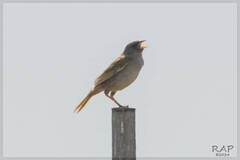
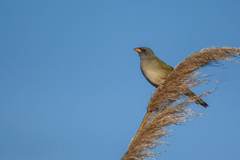

Great Pampa-Finch

Great Pampa-Finch

Embernagra platensis

Silhouette: Sheatherius · PhyloPic

LCLeast ConcernNTVUENCR
Daily sighting probability ~20% · Possible
at Serra da Canastra National Park

In 3 days ~40% in a week ~70%

83 Verified sightings at Serra da Canastra National Park From 2019 to 2026
1,634 In all 4 parks
November Best month
☀️ Diurnal When it's spotted

About the Great Pampa-Finch

The Pampa finch (Embernagra platensis), also known as the great Pampa-finch, is a species of bird in the family Thraupidae, the tanagers and allies. It is found in Argentina, Bolivia, Brazil, Paraguay, and Uruguay. The Pampa finch was formally described in 1789 with the binomial Emberiza platensis. It was later declared the type species for the genus Embernagra that had been erected in 1831.

The Pampa finch's further taxonomy is complicated and not fully resolved. Some early twentieth century authors placed the genus Embernagra in the finch family Carduelidae. Others later reassigned it to what was then a large family of Old and New World species, Emberizidae. A molecular phylogenetic study published in 2014 found that the Pampa finch belonged in the tanager family Thraupidae. The Pampa finch shares genus Embernagra with the serra finch (E. longicauda), which some systems call the pale-throated Pampa-finch.

Most taxonomic systems assign these four subspecies to the Pampa finch: However, as of late 2025 the Clements taxonomy includes... Wikipedia →

Sounds

Call0:17

Argentina · 2026

© Marcos E. Sosa · XC1133738 · CC BY-NC-SA 4.0

Song0:30

Brazil · 2024

© Carlos Henrique Luz Nunes de Almeida · XC942942 · CC BY-NC-SA 4.0

Uncertain0:13

Brazil · 2021

© Marcelo da Rocha · XC654649 · CC BY-NC-SA 4.0

Global Distribution

Parks Where Found

# Park Country Daily sighting probability
1 Iberá National Park 🇦🇷 Argentina
~60%
2 El Palmar National Park 🇦🇷 Argentina
~30%
3 Serra da Canastra National Park 🇧🇷 Brazil
~20%
4 Itatiaia National Park 🇧🇷 Brazil
~10%

Cities Where Found

# City Country Daily sighting probability
1 Curitiba 🇧🇷 Brazil
~10%
2 Cordoba 🇦🇷 Argentina
~10%
3 Asuncion 🇵🇾 Paraguay
<5%
4 Montevideo 🇺🇾 Uruguay
<5%
5 Buenos Aires 🇦🇷 Argentina
<5%

Before you go

What are the chances of seeing a Great Pampa-Finch in Serra da Canastra National Park?

Possible

About 20% of wildlife watchers report a Great Pampa-Finch sighting in Serra da Canastra National Park on a given day, based on 83 verified sightings from GBIF citizen-science data from 2019 to 2026. It is the 112th most-seen of the 294 birds we can rate there. Over three days the chance rises to about 40%, and over a week to about 70%, if each day is a fresh chance.

When is the best time to see a Great Pampa-Finch in Serra da Canastra National Park?

November

In that month about 30% of wildlife watchers report a Great Pampa-Finch in Serra da Canastra National Park on a given day, against about 10% in March–April, June–July, September and December–January, the lowest months. That is one of Serra da Canastra National Park's wettest months, with about 240 mm of rain against almost none in July.

What time of day is best to see a Great Pampa-Finch?

Between 3 and 6 pm

Across all the parks we cover, that three-hour window holds the most Great Pampa-Finch sightings with a recorded time, and about 9 in 10 of them come between 6 am and 6 pm: it is a daytime animal.

Is Serra da Canastra National Park the best place to see a Great Pampa-Finch?

3rd of 4

Of the 4 parks where we can rate Great Pampa-Finch sightings, Serra da Canastra National Park ranks 3rd at about 20%. The best odds are in Iberá National Park (Argentina, about 60%) and El Palmar National Park (Argentina, about 30%).

Which relatives of the Great Pampa-Finch live in Serra da Canastra National Park?

Same family: Thraupidae

The closest relatives of the Great Pampa-Finch that you can see in Serra da Canastra National Park (family Thraupidae, Tanagers and Allies) are Saffron Finch (about 80%), Sayaca Tanager (about 60%) and Burnished-buff Tanager (about 60%), with each one's daily chance of a sighting.

Where does the Great Pampa-Finch sighting chance come from?

GBIF citizen-science records

It is estimated from how often the Great Pampa-Finch is recorded against all the birds logged in Serra da Canastra National Park (83 verified sightings from 2019 to 2026), calibrated against known sighting rates. Figures are rounded to the nearest 10% because citizen-science data supports honest approximations, not decimals, and months with records from fewer than five people show "—". How it works.

← Back to Serra da Canastra National Park