
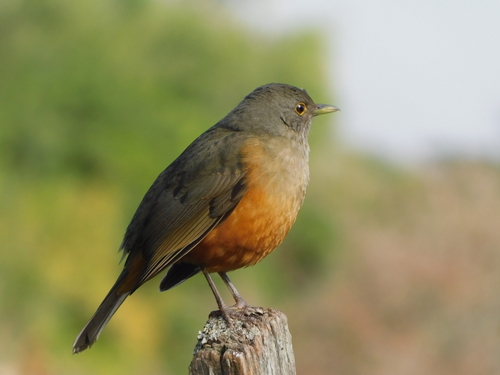
Black-cheeked Gnateater

Black-cheeked Gnateater

Conopophaga melanops

Silhouette: Sheatherius · PhyloPic

LCLeast ConcernNTVUENCR Endemic
Daily sighting probability ~40% · Likely
at Serra dos Órgãos National Park

In 3 days ~80% in a week >90%

229 Verified sightings at Serra dos Órgãos National Park From 2019 to 2026
489 In all 3 parks
July Best month
☀️ Diurnal When it's spotted

About the Black-cheeked Gnateater

The black-cheeked gnateater (Conopophaga melanops) is a species of bird in the family Conopophagidae endemic to Brazil. The male is distinguished by its orange crown, black face and white throat, while the female has brown plumage.

French naturalist Louis Pierre Vieillot described the black-cheeked gnateater in 1818, giving it the species name melanops from the Ancient Greek words melas "black" and ops "face". The black-cheeked gnateater has three subspecies:

It exhibits sexual dimorphism, as the male has distinctive coloured plumage and the female is a more overall brown in color. The male has a black face and cheeks with a contrasting orange crown and white throat. The upperparts are brownish and the underparts pale grey, the belly feathers more white and the flanks tending to buff. The female is more brown above with a white eyebrow and buff patch on... Wikipedia →

Sounds

Call0:33

Brazil · 2025

© Augusto Matheus dos Santos · XC1023796 · CC BY-NC-SA 4.0

Song0:48

Brazil · 2022

© Paulo Sillig · XC791828 · CC BY-NC-SA 4.0

Chamado0:59

Brazil · 2018

© Caio Brito · XC556237 · CC BY-NC-SA 4.0

Global Distribution

Parks Where Found

# Park Country Daily sighting probability
1 Serra dos Órgãos National Park 🇧🇷 Brazil
~40%
2 Tijuca National Park 🇧🇷 Brazil
~10%
3 Itatiaia National Park 🇧🇷 Brazil
<5%

Cities Where Found

# City Country Daily sighting probability
1 Santos 🇧🇷 Brazil
~10%
2 Rio de Janeiro 🇧🇷 Brazil
<5%

Before you go

What are the chances of seeing a Black-cheeked Gnateater in Serra dos Órgãos National Park?

Likely

About 40% of wildlife watchers report a Black-cheeked Gnateater sighting in Serra dos Órgãos National Park on a given day, based on 229 verified sightings from GBIF citizen-science data from 2019 to 2026. It is the 60th most-seen of the 336 birds we can rate there. Over three days the chance rises to about 80%, and over a week to over 90%, if each day is a fresh chance.

When is the best time to see a Black-cheeked Gnateater in Serra dos Órgãos National Park?

May and July–August

In those months about 50% of wildlife watchers report a Black-cheeked Gnateater in Serra dos Órgãos National Park on a given day, against about 20% in March and November, the lowest months. Those are among Serra dos Órgãos National Park's driest months, with about 80 mm of rain a month against 310 mm in November.

What time of day is best to see a Black-cheeked Gnateater?

Between 8 and 11 am

Across all the parks we cover, that three-hour window holds the most Black-cheeked Gnateater sightings with a recorded time, and about 9 in 10 of them come between 6 am and 6 pm: it is a daytime animal.

Is Serra dos Órgãos National Park the best place to see a Black-cheeked Gnateater?

Yes

Of the 3 parks where we can rate Black-cheeked Gnateater sightings, Serra dos Órgãos National Park has the highest daily chance: about 40%. Next come Tijuca National Park (Brazil, about 10%) and Itatiaia National Park (Brazil, under 5%).

Where does the Black-cheeked Gnateater sighting chance come from?

GBIF citizen-science records

It is estimated from how often the Black-cheeked Gnateater is recorded against all the birds logged in Serra dos Órgãos National Park (229 verified sightings from 2019 to 2026), calibrated against known sighting rates. Figures are rounded to the nearest 10% because citizen-science data supports honest approximations, not decimals, and months with records from fewer than five people show "—". How it works.

← Back to Serra dos Órgãos National Park