Dusky-throated Hermit

Dusky-throated Hermit

Phaethornis squalidus

Silhouette: Andy Wilson · PhyloPic

LCLeast ConcernNTVUENCR Endemic
Daily sighting probability <5% · Rare
at Serra dos Órgãos National Park

In 3 days ~10% in a week ~20%

21 Verified sightings at Serra dos Órgãos National Park From 2019 to 2026
238 In all 3 parks
September Best month
☀️ Diurnal When it's spotted

About the Dusky-throated Hermit

The dusky-throated hermit (Phaethornis squalidus) is a species of hummingbird in the family Trochilidae. It is endemic to Brazil. The dusky-throated hermit has sometimes included what is now (2021) the streak-throated hermit (P. rupurumii), but it is now treated as monotypic.

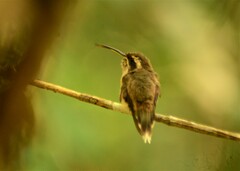
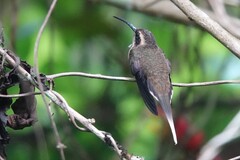
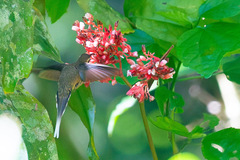
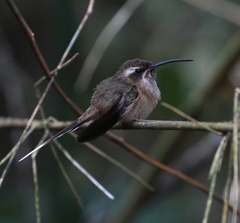
The dusky-throated hermit is 10 to 12.5 cm (3.9 to 4.9 in) long and weighs 2.5 to 3.5 g (0.088 to 0.12 oz). A medium-sized hermit hummingbird, it is generally brownish with a greenish back and ochraceous underparts and has a black "mask," white supercilium, malar stripe, and a dark brown throat. The sexes are generally alike, though the female may have paler underparts and a slightly more decurved bill.

The dusky-throated hermit is found in southeastern Brazil, mostly from southern Minas Gerais and Espírito Santo south to Santa Catarina, and also in the Iguazu Falls area of western Paraná. It inhabits the understory of humid primary and secondary forests from the littoral zone to an elevation of 2,250 m (7,400 ft).

The dusky-throated hermit is believed to be sedentary. The dusky-throated hermit... Wikipedia →

Sounds

Song0:50

Brazil · 2025

© Douglas Meyer · XC1068252 · CC BY-NC-SA 4.0

Call0:18

Brazil · 2020

© Fernando Igor de Godoy · XC705796 · CC BY-NC-SA 4.0

Song1:05

Brazil · 2019

© Ricardo Gagliardi · XC555876 · CC BY-NC-SA 4.0

Global Distribution

Parks Where Found

# Park Country Daily sighting probability
1 Itatiaia National Park 🇧🇷 Brazil
~10%
2 Tijuca National Park 🇧🇷 Brazil
<5%
3 Serra dos Órgãos National Park 🇧🇷 Brazil
<5%

Cities Where Found

# City Country Daily sighting probability
1 Rio de Janeiro 🇧🇷 Brazil
<5%

Before you go

What are the chances of seeing a Dusky-throated Hermit in Serra dos Órgãos National Park?

Rare

Under 5% of wildlife watchers report a Dusky-throated Hermit sighting in Serra dos Órgãos National Park on a given day, based on 21 verified sightings from GBIF citizen-science data from 2019 to 2026. It is the 231st most-seen of the 336 birds we can rate there. Over three days the chance rises to about 10%, and over a week to about 20%, if each day is a fresh chance.

When is the best time to see a Dusky-throated Hermit in Serra dos Órgãos National Park?

September

In that month about 20% of wildlife watchers report a Dusky-throated Hermit in Serra dos Órgãos National Park on a given day, against under 5% in March–June, August and October–January, the lowest months.

What time of day is best to see a Dusky-throated Hermit?

Between 8 and 11 am

Across all the parks we cover, that three-hour window holds the most Dusky-throated Hermit sightings with a recorded time, and about 9 in 10 of them come between 6 am and 6 pm: it is a daytime animal.

Is Serra dos Órgãos National Park the best place to see a Dusky-throated Hermit?

3rd of 3

Of the 3 parks where we can rate Dusky-throated Hermit sightings, Serra dos Órgãos National Park ranks 3rd at under 5%. The best odds are in Itatiaia National Park (Brazil, about 10%) and Tijuca National Park (Brazil, under 5%).

Which relatives of the Dusky-throated Hermit live in Serra dos Órgãos National Park?

Same genus: Phaethornis

The closest relatives of the Dusky-throated Hermit that you can see in Serra dos Órgãos National Park (genus Phaethornis, Typical Hermits) are Scale-throated Hermit (about 20%) and Reddish Hermit (about 20%), with each one's daily chance of a sighting.

Where does the Dusky-throated Hermit sighting chance come from?

GBIF citizen-science records

It is estimated from how often the Dusky-throated Hermit is recorded against all the birds logged in Serra dos Órgãos National Park (21 verified sightings from 2019 to 2026), calibrated against known sighting rates. Figures are rounded to the nearest 10% because citizen-science data supports honest approximations, not decimals, and months with records from fewer than five people show "—". How it works.

← Back to Serra dos Órgãos National Park