Spot-billed Toucanet

Spot-billed Toucanet

Selenidera maculirostris

Silhouette: Edwin Price · PhyloPic

LCLeast ConcernNTVUENCR
Daily sighting probability ~20% · Possible
at Serra dos Órgãos National Park

In 3 days ~50% in a week ~80%

123 Verified sightings at Serra dos Órgãos National Park From 2019 to 2026
764 In all 5 parks
August Best month
☀️ Diurnal When it's spotted

About the Spot-billed Toucanet

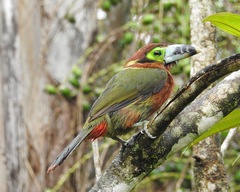
The spot-billed toucanet (Selenidera maculirostris) is a near-passerine bird in the toucan family Ramphastidae. It is found in Argentina, Brazil, and Paraguay. The spot-billed toucanet was originally described in the genus Pteroglossus. It has at times been considered conspecific with Gould's toucanet (S. gouldii) and the two are sister species. It is monotypic.

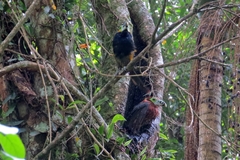
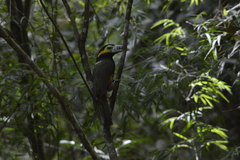
The spot-billed toucanet is 33 to 37 cm (13 to 15 in) long and weighs 137 to 193 g (4.8 to 6.8 oz). Males and females have the same bill pattern but the female's bill is shorter. The bill has a thin vertical black line at its base. The bill is mostly ivory at the base to greenish-yellow at the tip. The middle of the culmen is black, the maxilla has three to five vertical black stripes, and the mandible has a black patch near the end. Both sexes have bare green-yellow to blue skin around the eye and a golden-yellow tuft of feathers behind it; both are paler in the female. Adult males have a black head, nape, chin, throat, and belly. Their upperparts are green with a yellow band on the lower neck. Their tail is green with chestnut tips on the central three pairs of feathers. Their... Wikipedia →

Sounds

Call0:42

Brazil · 2019

© Fernando Igor de Godoy · XC705748 · CC BY-NC-SA 4.0

Song0:46

Brazil · 2021

© Ricardo Gagliardi · XC663702 · CC BY-NC-SA 4.0

Call0:16

Brazil · 2016

© Jerome Fischer · XC332774 · CC BY-NC-SA 4.0

Global Distribution

Parks Where Found

# Park Country Daily sighting probability
1 Serra dos Órgãos National Park 🇧🇷 Brazil
~20%
2 Iguaçu National Park 🇧🇷 Brazil
~10%
3 Iguazú National Park 🇦🇷 Argentina
~10%
4 Itatiaia National Park 🇧🇷 Brazil
<5%
5 Tijuca National Park 🇧🇷 Brazil
<5%

Zoos & Centres Where Found

# Zoo / Centre Country
1 Parque das Aves 🇧🇷 Brazil In captivity
2 Zoobotanic Park of Brusque 🇧🇷 Brazil In captivity

Before you go

What are the chances of seeing a Spot-billed Toucanet in Serra dos Órgãos National Park?

Possible

About 20% of wildlife watchers report a Spot-billed Toucanet sighting in Serra dos Órgãos National Park on a given day, based on 123 verified sightings from GBIF citizen-science data from 2019 to 2026. It is the 115th most-seen of the 336 birds we can rate there. Over three days the chance rises to about 50%, and over a week to about 80%, if each day is a fresh chance.

When is the best time to see a Spot-billed Toucanet in Serra dos Órgãos National Park?

August and September

In those months about 30% of wildlife watchers report a Spot-billed Toucanet in Serra dos Órgãos National Park on a given day, against about 10% in February–April, June and December, the lowest months.

What time of day is best to see a Spot-billed Toucanet?

Between 9 am and noon

Across all the parks we cover, that three-hour window holds the most Spot-billed Toucanet sightings with a recorded time, and about 9 in 10 of them come between 6 am and 6 pm: it is a daytime animal.

Is Serra dos Órgãos National Park the best place to see a Spot-billed Toucanet?

Yes

Of the 5 parks where we can rate Spot-billed Toucanet sightings, Serra dos Órgãos National Park has the highest daily chance: about 20%. Next come Iguaçu National Park (Brazil, about 10%) and Iguazú National Park (Argentina, about 10%).

Where does the Spot-billed Toucanet sighting chance come from?

GBIF citizen-science records

It is estimated from how often the Spot-billed Toucanet is recorded against all the birds logged in Serra dos Órgãos National Park (123 verified sightings from 2019 to 2026), calibrated against known sighting rates. Figures are rounded to the nearest 10% because citizen-science data supports honest approximations, not decimals, and months with records from fewer than five people show "—". How it works.

← Back to Serra dos Órgãos National Park