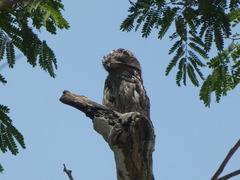
Northern Potoo

Northern Potoo

Nyctibius jamaicensis

Silhouette: Dominic Sherony (photo) and Albertonykus (silhouette) · PhyloPic

LCLeast ConcernNTVUENCR
Daily sighting probability <5% · Rare
at Sian Ka'an Biosphere Reserve

In 3 days <5%

10 Verified sightings at Sian Ka'an Biosphere Reserve From 2019 to 2026
528 In all 9 parks
June Best month
☀️🌙 Day & Night When it's spotted

About the Northern Potoo

The northern potoo (Nyctibius jamaicensis) is a nocturnal bird belonging to the potoo family, Nyctibiidae. It is found from Mexico south to Costa Rica, and on the islands of Jamaica and Hispaniola (in the Dominican Republic and Haiti). It was formerly classified as a subspecies of the common potoo (Nyctibius griseus) but is now usually treated as a separate species based on differences in vocalizations.

The northern potoo was formally described in 1789 by the German naturalist Johann Friedrich Gmelin in his revised and expanded edition of Carl Linnaeus's Systema Naturae. He placed it with all the nightjar like species in the genus Caprimulgus and coined the binomial name Caprimulgus jamaicensis. Gmelin based his description on earlier accounts of the bird in Jamaica, including Hans Sloane's "Wood owle" published in 1725 and John Latham's "Jamaican goatsucker" published in 1783. The northern potoo is now one of the seven potoos placed in the genus Nyctibius that was introduced in 1816 by the French ornithologist Louis Pierre Vieillot. The genus name is from Ancient Greek nuktibios meaning "night-feeding", from nux night and bios "life". The specific epithet is from the... Wikipedia →

Sounds

Song0:58

Mexico · 2000

© Peter Boesman · XC226748 · CC BY-NC-ND 4.0

Call0:07

Nicaragua · 2005

© Doug Knapp · XC11703 · CC BY-NC-ND 2.5

Song0:43

Costa Rica · 2019

© Carlos Venegas-Elizondo · XC467214 · CC BY-NC-SA 4.0

Global Distribution

Parks Where Found

# Park Country Daily sighting probability
1 Tikal National Park 🇬🇹 Guatemala
~20%
2 Santa Rosa National Park 🇨🇷 Costa Rica
<5%
3 Calakmul Biosphere Reserve 🇲🇽 Mexico
<5%
4 Montes Azules Biosphere Reserve 🇲🇽 Mexico
<5%
5 Biotopo Cerro Cahuí 🇬🇹 Guatemala
<5%
6 Blue and John Crow Mountains National Park 🇯🇲 Jamaica
<5%
7 Cerro Azul Meámbar National Park 🇭🇳 Honduras
<5%
8 Pico Bonito National Park 🇭🇳 Honduras
<5%
9 Sian Ka'an Biosphere Reserve 🇲🇽 Mexico
<5%

Cities Where Found

# City Country Daily sighting probability
1 San Pedro Sula 🇭🇳 Honduras
~10%

Before you go

What are the chances of seeing a Northern Potoo in Sian Ka'an Biosphere Reserve?

Rare

Under 5% of wildlife watchers report a Northern Potoo sighting in Sian Ka'an Biosphere Reserve on a given day, based on 10 verified sightings from GBIF citizen-science data from 2019 to 2026. It is the 272nd most-seen of the 288 birds we can rate there. Over three days the chance rises to under 5%, if each day is a fresh chance.

When is the best time to see a Northern Potoo in Sian Ka'an Biosphere Reserve?

Any time of year

In every month with enough records, under 5% of wildlife watchers report a Northern Potoo in Sian Ka'an Biosphere Reserve on a given day, so our monthly data shows no clear season.

What time of day is best to see a Northern Potoo?

Between 8 and 11 am

Across all the parks we cover, that three-hour window holds the most Northern Potoo sightings with a recorded time, and about 6 in 10 of them come between 6 am and 6 pm: it is seen both by day and at night.

Is Sian Ka'an Biosphere Reserve the best place to see a Northern Potoo?

9th of 9

Of the 9 parks where we can rate Northern Potoo sightings, Sian Ka'an Biosphere Reserve ranks 9th at under 5%. The best odds are in Tikal National Park (Guatemala, about 20%), Santa Rosa National Park (Costa Rica, under 5%) and Calakmul Biosphere Reserve (Mexico, under 5%).

Where does the Northern Potoo sighting chance come from?

GBIF citizen-science records

It is estimated from how often the Northern Potoo is recorded against all the birds logged in Sian Ka'an Biosphere Reserve (10 verified sightings from 2019 to 2026), calibrated against known sighting rates. Figures are rounded to the nearest 10% because citizen-science data supports honest approximations, not decimals, and months with records from fewer than five people show "—". How it works.

← Back to Sian Ka'an Biosphere Reserve