New Forest Fly

New Forest Fly

Hippobosca equina

Daily sighting probability <5% · Rare
at Sierra de Guadarrama National Park

In 3 days ~10% in a week ~20%

5 Verified sightings at Sierra de Guadarrama National Park From 2019 to 2026
33 In all 4 parks
September Best month
☀️🌙 Day & Night When it's spotted

About the New Forest Fly

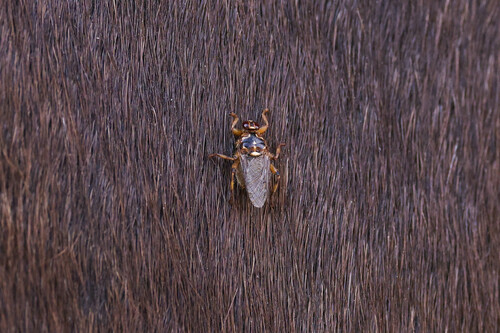
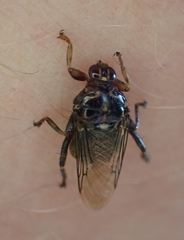
Hippobosca equina, also known as the forest fly or New Forest fly, is a biting fly from the family Hippoboscidae. They are blood-feeding ectoparasites of primarily horses and other large mammals including cattle. It is a permanently fully winged fly, not shedding its wings on finding its host, as in some other Hippoboscidae. With its wings retained, it may thus fly away from its host to deposit its larvae. They are good fliers.

Wing length 6.0–8.5 millimetres (0.24–0.33 in). Generally pale reddish brown with yellow spots on the indistinctly segmented abdomen. They have one pair of sub-triangular wings and the wing veins are crowded together towards the anterior border.

The characteristic feature of these flies is that they move sidewards and they feed preferably between the hind legs and on the perineum region. The New Forest fly lays larvae singly in late instar (stage III). They rapidly pupate over one hour and exhibit varying duration as pupae, depending on temperature.

The primary distribution is in Europe and parts of Asia and Africa. It has been introduced to other locations, though in some cases latter eradicated by modern... Wikipedia →
Global Distribution

Parks Where Found

# Park Country Daily sighting probability
1 Sierra Nevada National Park 🇪🇸 Spain
~10%
2 Pyrénées National Park 🇫🇷 France
~10%
3 Cévennes National Park 🇫🇷 France
<5%
4 Sierra de Guadarrama National Park 🇪🇸 Spain
<5%

Before you go

What are the chances of seeing a New Forest Fly in Sierra de Guadarrama National Park?

Rare

Under 5% of wildlife watchers report a New Forest Fly sighting in Sierra de Guadarrama National Park on a given day, based on 5 verified sightings from GBIF citizen-science data from 2019 to 2026. It is the 528th most-seen of the 597 insects we can rate there. Over three days the chance rises to about 10%, and over a week to about 20%, if each day is a fresh chance.

When is the best time to see a New Forest Fly in Sierra de Guadarrama National Park?

June and September

In those months about 10% of wildlife watchers report a New Forest Fly in Sierra de Guadarrama National Park on a given day, against under 5% in July–August and October–May, the lowest months.

What time of day is best to see a New Forest Fly?

Between noon and 3 pm

Across all the parks we cover, that three-hour window holds the most New Forest Fly sightings with a recorded time, and about 6 in 10 of them come between 6 am and 6 pm: it is seen both by day and at night.

Which relatives of the New Forest Fly live in Sierra de Guadarrama National Park?

Same order: Diptera

The closest relatives of the New Forest Fly that you can see in Sierra de Guadarrama National Park (order Diptera, Flies) are Common Drone Fly (about 10%), Volucella elegans (about 10%) and Tapered Drone Fly (about 10%), with each one's daily chance of a sighting.

Where does the New Forest Fly sighting chance come from?

GBIF citizen-science records

It is estimated from how often the New Forest Fly is recorded against all the insects logged in Sierra de Guadarrama National Park (5 verified sightings from 2019 to 2026), calibrated against known sighting rates. Figures are rounded to the nearest 10% because citizen-science data supports honest approximations, not decimals, and months with records from fewer than five people show "—". How it works.

← Back to Sierra de Guadarrama National Park