Northern Bald Ibis

Northern Bald Ibis

Geronticus eremita

Silhouette: Sheatherius · PhyloPic

LCNTVUENEndangeredCR
Daily sighting probability <5% · Rare
at Sierra de Guadarrama National Park

In 3 days ~10% in a week ~20%

8 Verified sightings at Sierra de Guadarrama National Park From 2019 to 2026
8 In 1 park
May Best month
☀️ Diurnal When it's spotted

About the Northern Bald Ibis

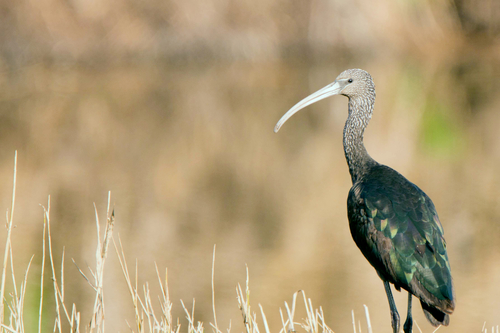
The northern bald ibis, hermit ibis, or Waldrapp (Geronticus eremita) is a migratory Old World ibis found in open areas such as grasslands, rocky mountains, and semi-deserts, often close to running water. This 70–80 cm (28–31 in) glossy black ibis, which, unlike many members of the ibis family, is non-wading, has an unfeathered red face and head, and a long, curved red bill. It breeds colonially on coastal or mountain cliff ledges, where it typically lays two to three eggs in a stick nest, and feeds on lizards, insects, and other small animals.

The northern bald ibis was once widespread across the Middle East, northern Africa, southern and central Europe, with a fossil record dating back at least 1.8 million years. It disappeared from Europe over 300 years ago, although reintroduction programmes in the region are underway. In 2019 there were about 700 wild birds remaining in southern Morocco.

To combat these low numbers, reintroduction programs have been instituted internationally in recent times, with a semi-wild breeding colony in Turkey which counted almost 250 birds in 2018 as well as sites in Austria, Italy, Spain, and northern Morocco. There are about 2000 northern bald ibises living in captivity. These programmes and the natural growth in Morocco from about 200 birds in the 1990s helped to downlist the northern bald ibis from Critically Endangered to Endangered on the IUCN Red List in 2018. The down-listing of conservation status for the species has been described as controversial decision and not taking fully into account the recent extinction in the wild of the genetically distinct and only long-range migratory population that used to breed in the Middle East and wintering in Eastern Africa.

The long-term decline in Europe has been linked to hunting and use as food, especially the fledglings. The slow reproduction means this can cause local extinction. Wikipedia →

Sounds

Call0:44

Spain · 2022

© SonoNatura · XC712492 · CC BY-NC-SA 4.0

Call0:07

Turkey · 2007

© Tero Linjama · XC341259 · CC BY-NC-SA 4.0

Call0:36

Italy · 2011

© Marco Dragonetti · XC71695 · CC BY-NC-ND 2.5

Global Distribution

Parks Where Found

# Park Country Daily sighting probability
1 Sierra de Guadarrama National Park 🇪🇸 Spain
<5%

More parks will be added in future updates.

Cities Where Found

# City Country Daily sighting probability
1 Tel Aviv 🇮🇱 Israel
<5%

Zoos & Centres Where Found

# Zoo / Centre Country
1 Denver Zoo 🇺🇸 United States In captivity
2 Copenhagen Zoo 🇩🇰 Denmark In captivity
3 Tierpark Berlin 🇩🇪 Germany In captivity
4 Dublin Zoo 🇮🇪 Ireland In captivity
5 Lisbon Oceanarium 🇵🇹 Portugal In captivity
6 Ostrava Zoo 🇨🇿 Czechia In captivity
7 Paris Zoological Park 🇫🇷 France In captivity
8 Zoo Pilsen 🇨🇿 Czechia In captivity
9 Réserve africaine de Sigean 🇫🇷 France In captivity
10 Muséum de Besançon 🇫🇷 France In captivity
11 Parc des oiseaux 🇫🇷 France In captivity
12 Aquarium du palais de la Porte Dorée 🇫🇷 France In captivity
13 Zoobotánico Jerez 🇪🇸 Spain In captivity
14 Nordens Ark 🇸🇪 Sweden In captivity
15 Wildpark Ebersberg 🇩🇪 Germany In captivity
16 Zoo Miami 🇺🇸 United States In captivity
17 Living Desert Zoo and Gardens 🇺🇸 United States In captivity
18 Columbus Zoo and Aquarium 🇺🇸 United States In captivity
19 Bronx Zoo 🇺🇸 United States In captivity
20 Omaha’s Henry Doorly Zoo and Aquarium 🇺🇸 United States In captivity
21 Milwaukee County Zoo 🇺🇸 United States In captivity
22 The Maryland Zoo 🇺🇸 United States In captivity
23 Toledo Zoo 🇺🇸 United States In captivity
24 Jacksonville Zoo and Gardens 🇺🇸 United States In captivity
25 Tama Zoological Park 🇯🇵 Japan In captivity
26 Marwell Zoo 🇬🇧 United Kingdom In captivity
27 Selwo Aventura 🇪🇸 Spain In captivity
28 Parco Natura Viva 🇮🇹 Italy In captivity
29 Wildpark Leipzig 🇩🇪 Germany In captivity
30 Louisville Zoo 🇺🇸 United States In captivity
31 Luisenpark 🇩🇪 Germany In captivity
32 Caldwell Zoo 🇺🇸 United States In captivity
33 Edinburgh Zoo 🇬🇧 United Kingdom In captivity
34 Calgary Zoo 🇨🇦 Canada In captivity
35 San Francisco Zoo 🇺🇸 United States In captivity
36 Nyíregyháza Zoo 🇭🇺 Hungary In captivity
37 Oregon Zoo 🇺🇸 United States In captivity
38 Zoo Knoxville 🇺🇸 United States In captivity
39 Lisbon Zoo 🇵🇹 Portugal In captivity
40 Natur- und Tierpark Goldau 🇨🇭 Switzerland In captivity
41 Parc Zoologique et Botanique de Mulhouse 🇫🇷 France In captivity
42 Centro Cicogne e Anatidi 🇮🇹 Italy In captivity
43 Bad Mergentheim Wildlife Park 🇩🇪 Germany In captivity
44 Budapest Zoo & Botanical Garden 🇭🇺 Hungary In captivity
45 Łódź Zoo 🇵🇱 Poland In captivity
46 Wildpark Pforzheim 🇩🇪 Germany In captivity
47 Jersey Zoo 🇯🇪 Jersey In captivity
48 London Zoo 🇬🇧 United Kingdom In captivity
49 Rosamond Gifford Zoo 🇺🇸 United States In captivity
50 Apenheul Primate Park 🇳🇱 Netherlands In captivity

Before you go

What are the chances of seeing a Northern Bald Ibis in Sierra de Guadarrama National Park?

Rare

Under 5% of wildlife watchers report a Northern Bald Ibis sighting in Sierra de Guadarrama National Park on a given day, based on 8 verified sightings from GBIF citizen-science data from 2019 to 2026. It is the 118th most-seen of the 202 birds we can rate there. Over three days the chance rises to about 10%, and over a week to about 20%, if each day is a fresh chance.

When is the best time to see a Northern Bald Ibis in Sierra de Guadarrama National Park?

May

In that month about 10% of wildlife watchers report a Northern Bald Ibis in Sierra de Guadarrama National Park on a given day, against under 5% in June to April, the lowest months.

What time of day is best to see a Northern Bald Ibis?

Between 10 am and 1 pm

Across all the parks we cover, that three-hour window holds the most Northern Bald Ibis sightings with a recorded time, and about 8 in 10 of them come between 6 am and 6 pm: it is a daytime animal.

Where else can you see a Northern Bald Ibis?

Only Sierra de Guadarrama National Park, in our data

Sierra de Guadarrama National Park is the only park on Wallace's Line with enough records to rate Northern Bald Ibis sightings: under 5% of wildlife watchers there report one on a given day.

Where does the Northern Bald Ibis sighting chance come from?

GBIF citizen-science records

It is estimated from how often the Northern Bald Ibis is recorded against all the birds logged in Sierra de Guadarrama National Park (8 verified sightings from 2019 to 2026), calibrated against known sighting rates. Figures are rounded to the nearest 10% because citizen-science data supports honest approximations, not decimals, and months with records from fewer than five people show "—". How it works.

← Back to Sierra de Guadarrama National Park