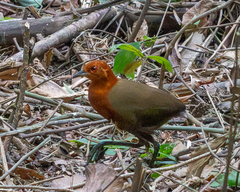
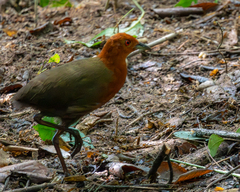
Chestnut-headed Crake

Chestnut-headed Crake

Anurolimnas castaneiceps

Silhouette: Sheatherius · PhyloPic

Daily sighting probability <5% · Rare
at Sierra de la Macarena National Park

In 3 days <5%

6 Verified sightings at Sierra de la Macarena National Park From 2019 to 2026
54 In all 4 parks
December Best month
☀️ Diurnal When it's spotted

About the Chestnut-headed Crake

The chestnut-headed crake (Anurolimnas castaneiceps) is a species of bird in subfamily Rallinae of family Rallidae, the rails, gallinules, and coots. It is the only species placed in the genus Anurolimnas. It is found in Bolivia, Brazil, Colombia, Ecuador, and Peru.

The chestnut-headed crake was formally described in 1869 by the English ornithologists Philip Sclater and Osbert Salvin based on a specimen that had been collected in the Napo River region of eastern Ecuador. They coined the binomial name Porzana castaneiceps. The taxonomy of the chestnut-headed crake was previously uncertain and the species was placed in either Rufirallus or Anurolimnas. A molecular phylogenetic study published in 2023 found the chestnut-headed crake formed a basal branch within the Pardirallini clade (genera Mustelirallus, Pardirallus, Amaurolimnas and Aramides) with a date of divergence from the rest of the Pardirallini estimated at 15.4 to 18.5 Mya. Based on this result the chestnut-headed crake is now the only species placed in the genus Anurolimnas had been introduced in 1893 by the English ornithologist Richard Bowdler Sharpe. The genus name Anurolimnas combines the... Wikipedia →

Sounds

Recording0:16

Brazil · 2024

© Luciano Bernardes · iNaturalist · CC BY-NC 4.0

Recording0:38

Peru · 2010

© dbeadle · iNaturalist · CC BY-NC 4.0

Global Distribution

Parks Where Found

# Park Country Daily sighting probability
1 Sierra de la Macarena National Park 🇨🇴 Colombia
<5%
2 Tambopata National Reserve 🇵🇪 Peru
<5%
3 Manu National Park 🇵🇪 Peru
<5%
4 Yasuní National Park 🇪🇨 Ecuador
<5%

Before you go

What are the chances of seeing a Chestnut-headed Crake in Sierra de la Macarena National Park?

Rare

Under 5% of wildlife watchers report a Chestnut-headed Crake sighting in Sierra de la Macarena National Park on a given day, based on 6 verified sightings from GBIF citizen-science data from 2019 to 2026. It is the 380th most-seen of the 418 birds we can rate there. Over three days the chance rises to under 5%, if each day is a fresh chance.

When is the best time to see a Chestnut-headed Crake in Sierra de la Macarena National Park?

Any time of year

In every month with enough records, under 5% of wildlife watchers report a Chestnut-headed Crake in Sierra de la Macarena National Park on a given day, so our monthly data shows no clear season.

What time of day is best to see a Chestnut-headed Crake?

Between 2 and 5 pm

Across all the parks we cover, that three-hour window holds the most Chestnut-headed Crake sightings with a recorded time, and about 8 in 10 of them come between 6 am and 6 pm: it is a daytime animal.

Is Sierra de la Macarena National Park the best place to see a Chestnut-headed Crake?

Yes

Of the 4 parks where we can rate Chestnut-headed Crake sightings, Sierra de la Macarena National Park has the highest daily chance: under 5%. Next come Tambopata National Reserve (Peru, under 5%) and Manu National Park (Peru, under 5%).

Where does the Chestnut-headed Crake sighting chance come from?

GBIF citizen-science records

It is estimated from how often the Chestnut-headed Crake is recorded against all the birds logged in Sierra de la Macarena National Park (6 verified sightings from 2019 to 2026), calibrated against known sighting rates. Figures are rounded to the nearest 10% because citizen-science data supports honest approximations, not decimals, and months with records from fewer than five people show "—". How it works.

← Back to Sierra de la Macarena National Park