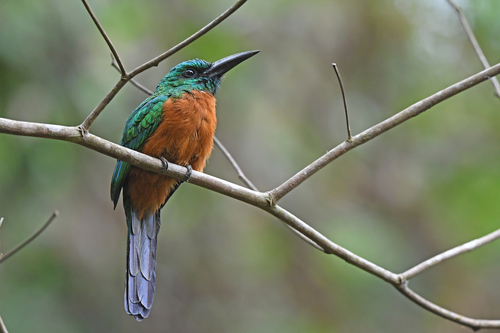
Black-breasted Puffbird

Black-breasted Puffbird

Notharchus pectoralis

Silhouette: Matt Wilkins (Photo by Len Blumin) · PhyloPic

LCLeast ConcernNTVUENCR
Daily sighting probability ~30% · Possible
at Soberanía National Park

In 3 days ~70% in a week ~90%

3,397 Verified sightings at Soberanía National Park From 2019 to 2026
3,510 In all 5 parks
October Best month
☀️ Diurnal When it's spotted

About the Black-breasted Puffbird

The black-breasted puffbird (Notharchus pectoralis) is a species of bird in the family Bucconidae, the puffbirds, nunlets, and nunbirds. It is found in Colombia, Ecuador, and Panama. The black-breasted puffbird is monotypic. It is closely related to the brown-banded puffbird (N. ordii) and some authors have proposed that they form a superspecies.

The black-breasted puffbird is 19 to 23 cm (7.5 to 9.1 in) long and weighs between 60 and 69 g (2.1 and 2.4 oz). The plumage is mostly glossy blue-black, with a white collar, cheeks, throat, and belly, a blue-black breast band, and a black tail with white tips on the feathers. The closed wing and rump show narrow white scallops. The flanks are dark gray with buffy marks. The heavy bill is black, as are the feet, and the iris of the eye is dark brown or red. The two sexes are the same, and the plumage of juvenile birds has not been described.

The black-breasted puffbird is found from the Canal Zone of Panama east into central Colombia and south through western Colombia into northwestern Ecuador. It inhabits humid lowland rainforest and secondary forest from sea level... Wikipedia →

Sounds

Song0:55

Panama · 2018

© Rainforest Connection · XC621790 · CC BY-NC-SA 4.0

Call0:31

Panama · 2016

© Marcos Melo · XC590415 · CC BY-NC-SA 4.0

Song0:26

Colombia · 2018

© Andrea Lopera-Salazar · XC452314 · CC BY-NC-SA 4.0

Global Distribution

Parks Where Found

# Park Country Daily sighting probability
1 Soberanía National Park 🇵🇦 Panama
~30%
2 Utría National Natural Park 🇨🇴 Colombia
~30%
3 San Lorenzo Protected Forest 🇵🇦 Panama
~10%
4 Darién National Park 🇵🇦 Panama
~10%
5 Chagres National Park 🇵🇦 Panama
<5%

Before you go

What are the chances of seeing a Black-breasted Puffbird in Soberanía National Park?

Possible

About 30% of wildlife watchers report a Black-breasted Puffbird sighting in Soberanía National Park on a given day, based on 3,397 verified sightings from GBIF citizen-science data from 2019 to 2026. It is the 66th most-seen of the 449 birds we can rate there. Over three days the chance rises to about 70%, and over a week to about 90%, if each day is a fresh chance.

When is the best time to see a Black-breasted Puffbird in Soberanía National Park?

April and September–October

In those months about 40% of wildlife watchers report a Black-breasted Puffbird in Soberanía National Park on a given day, against about 20% in August and December, the lowest months.

What time of day is best to see a Black-breasted Puffbird?

Between 8 and 11 am

Across all the parks we cover, that three-hour window holds the most Black-breasted Puffbird sightings with a recorded time, and nearly all of them come between 6 am and 6 pm: it is a daytime animal.

Is Soberanía National Park the best place to see a Black-breasted Puffbird?

Yes

Of the 5 parks where we can rate Black-breasted Puffbird sightings, Soberanía National Park has the highest daily chance: about 30%. Next come Utría National Natural Park (Colombia, about 30%) and San Lorenzo Protected Forest (Panama, about 10%).

Which relatives of the Black-breasted Puffbird live in Soberanía National Park?

Same genus: Notharchus

The closest relatives of the Black-breasted Puffbird that you can see in Soberanía National Park (genus Notharchus, Black-and-white Puffbirds) are White-necked Puffbird (about 10%) and Pied Puffbird (about 10%), with each one's daily chance of a sighting.

Where does the Black-breasted Puffbird sighting chance come from?

GBIF citizen-science records

It is estimated from how often the Black-breasted Puffbird is recorded against all the birds logged in Soberanía National Park (3,397 verified sightings from 2019 to 2026), calibrated against known sighting rates. Figures are rounded to the nearest 10% because citizen-science data supports honest approximations, not decimals, and months with records from fewer than five people show "—". How it works.

← Back to Soberanía National Park