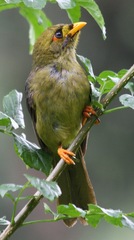
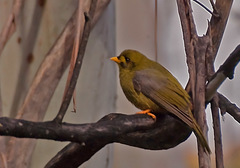
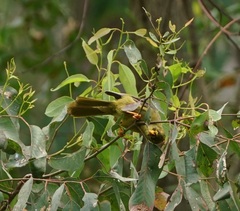

Bell Miner

Bell Miner

Manorina melanophrys

Silhouette: Rachael Joakim · PhyloPic

LCLeast ConcernNTVUENCR Endemic
Daily sighting probability <5% · Rare
at Springbrook National Park

In 3 days ~10% in a week ~30%

25 Verified sightings at Springbrook National Park From 2019 to 2026
1,032 In all 3 parks
March Best month
☀️ Diurnal When it's spotted

About the Bell Miner

The bell miner or bellbird (Manorina melanophrys) is a colonial honeyeater, endemic to southeastern Australia. The common name refers to their bell-like call. "Miner" is an old alternative spelling of "myna", and is shared with other members of the genus Manorina. The birds feed almost exclusively on the dome-like coverings, referred to as lerps, of certain psyllid bugs.

Bell miners live in large, complex, social groups. Within each group, there are subgroups consisting of several breeding pairs, but also including a number of birds that are not currently breeding. The nonbreeders help in providing food for the young in all the nests within the subgroup, even though they are not necessarily closely related to them. The birds defend their colony area communally and aggressively, excluding most other passerine species. They do this in order to protect their territory from other insect-eating birds that would eat the bell lerps on which they feed. Whenever the local forests die back, due to increased lerp psyllid infestations, bell miners undergo a population boom.

The heritage listed mountain village of Bellbrook was named after the distinctive sound of local bellbirds in 1882. ��2�... Wikipedia →

Sounds

Song0:18

Australia · 2023

© Romuald Mikusek · XC1169749 · CC BY-NC-SA 4.0

Uncertain0:23

Australia · 2026

© Nick Talbot · XC1085954 · CC BY-NC-SA 4.0

Call0:24

Australia · 2025

© Marc Anderson · XC1015891 · CC BY-NC-ND 4.0

Global Distribution

Parks Where Found

# Park Country Daily sighting probability
1 Blue Mountains National Park 🇦🇺 Australia
~10%
2 Lamington National Park 🇦🇺 Australia
~10%
3 Springbrook National Park 🇦🇺 Australia
<5%

Cities Where Found

# City Country Daily sighting probability
1 Melbourne 🇦🇺 Australia
~20%
2 Sydney 🇦🇺 Australia
<5%

Before you go

What are the chances of seeing a Bell Miner in Springbrook National Park?

Rare

Under 5% of wildlife watchers report a Bell Miner sighting in Springbrook National Park on a given day, based on 25 verified sightings from GBIF citizen-science data from 2019 to 2026. It is the 101st most-seen of the 136 birds we can rate there. Over three days the chance rises to about 10%, and over a week to about 30%, if each day is a fresh chance.

When is the best time to see a Bell Miner in Springbrook National Park?

February–April and August

In those months about 10% of wildlife watchers report a Bell Miner in Springbrook National Park on a given day, against under 5% in May–July and September–January, the lowest months.

What time of day is best to see a Bell Miner?

Between noon and 3 pm

Across all the parks we cover, that three-hour window holds the most Bell Miner sightings with a recorded time, and nearly all of them come between 6 am and 6 pm: it is a daytime animal.

Is Springbrook National Park the best place to see a Bell Miner?

3rd of 3

Of the 3 parks where we can rate Bell Miner sightings, Springbrook National Park ranks 3rd at under 5%. The best odds are in Blue Mountains National Park (Australia, about 10%) and Lamington National Park (Australia, about 10%).

Where does the Bell Miner sighting chance come from?

GBIF citizen-science records

It is estimated from how often the Bell Miner is recorded against all the birds logged in Springbrook National Park (25 verified sightings from 2019 to 2026), calibrated against known sighting rates. Figures are rounded to the nearest 10% because citizen-science data supports honest approximations, not decimals, and months with records from fewer than five people show "—". How it works.

← Back to Springbrook National Park