



Completed



Noisy Miner
Manorina melanocephala
Silhouette: Rachael Joakim · PhyloPic
- KingdomAnimalia (Animals)
- PhylumChordata (Chordates)
- ClassAves (Birds)
- OrderPasseriformes (Perching Birds)
- FamilyMeliphagidae (Honeyeaters)
- GenusManorina (Australian Miners)
- SpeciesManorina melanocephala (Noisy Miner)
In 3 days ~70% in a week ~90%
123 Verified sightings at Springbrook National Park From 2019 to 2026
5,657 In all 10 parks
February Best month
☀️ Diurnal When it's spotted
About the Noisy Miner
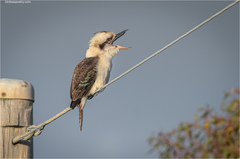
The noisy miner (Manorina melanocephala) is a bird in the honeyeater family, Meliphagidae, and is endemic to eastern and southeastern Australia. This miner is a grey bird, with a black head, orange-yellow beak and feet, a distinctive yellow patch behind the eye, and white tips on the tail feathers. The Tasmanian subspecies has a more intense yellow panel in the wing, and a broader white tip to the tail. Males, females and juveniles are similar in appearance, though young birds are a brownish-grey. As the common name suggests, the noisy miner is a vocal species with a large range of songs, calls, scoldings and alarms, and almost constant vocalisations, particularly from young birds. One of four species in the genus Manorina, the noisy miner itself is divided into four subspecies.
Found in a broad arc from Far North Queensland through New South Wales and Victoria to Tasmania and southeastern South Australia, and out to far north-west Queensland, the noisy miner primarily inhabits dry, open eucalypt forests that lack understory shrubs. These include forests dominated by spotted gum, box and ironbark, as well as in degraded woodland where the understory has been cleared, such as recently burned areas, farming and grazing areas, roadside reserves, and suburban parks and gardens with trees and grass, but without dense shrubbery. The density of noisy miner populations has significantly increased in many locations across its range, particularly in human-dominated habitats. The popularity of nectar-producing garden plants, such as the large-flowered grevilleas, was thought to play a role in its proliferation, but studies now show that the noisy miner has benefited primarily from landscaping practices that create open areas dominated by eucalypts.
Noisy miners are gregarious and territorial; they forage, bathe, roost, breed and defend territory communally, forming colonies that can contain several hundred birds. Each bird has an 'activity space', and birds with overlapping activity spaces form associations called 'coteries', which are the most stable units within the colony. The birds also form temporary flocks called 'coalitions' for specific activities, such as mobbing a predator. Group cohesion is facilitated not only by vocalisations, but also through ritualised displays, which have been categorised as flight displays, postural displays, and facial displays. Wikipedia →
Recent sightings of Noisy Miner in Springbrook National Park
LIVEiNaturalistGlobal Distribution
Parks Where Found
| # | Park | Country | Daily sighting probability |
|---|---|---|---|
| 1 | Hattah-Kulkyne National Park | 🇦🇺 Australia | |
| 2 | Noosa National Park | 🇦🇺 Australia | |
| 3 | Royal National Park | 🇦🇺 Australia | |
| 4 | Blue Mountains National Park | 🇦🇺 Australia | |
| 5 | Springbrook National Park | 🇦🇺 Australia | |
| 6 | Lamington National Park | 🇦🇺 Australia | |
| 7 | Grampians National Park | 🇦🇺 Australia | |
| 8 | Wilsons Promontory National Park | 🇦🇺 Australia | |
| 9 | Great Otway National Park | 🇦🇺 Australia | |
| 10 | Kosciuszko National Park | 🇦🇺 Australia |
Closest Relatives at Springbrook National Park


Before you go
What are the chances of seeing a Noisy Miner in Springbrook National Park?
Possible
About 30% of wildlife watchers report a Noisy Miner sighting in Springbrook National Park on a given day, based on 123 verified sightings from GBIF citizen-science data from 2019 to 2026. It is the 21st most-seen of the 136 birds we can rate there. Over three days the chance rises to about 70%, and over a week to about 90%, if each day is a fresh chance.
When is the best time to see a Noisy Miner in Springbrook National Park?
February–March, July and December
In those months about 40% of wildlife watchers report a Noisy Miner in Springbrook National Park on a given day, against about 20% in June, August and November, the lowest months.
What time of day is best to see a Noisy Miner?
Between 2 and 5 pm
Across all the parks we cover, that three-hour window holds the most Noisy Miner sightings with a recorded time, and nearly all of them come between 6 am and 6 pm: it is a daytime animal.
Is Springbrook National Park the best place to see a Noisy Miner?
5th of 10
Of the 10 parks where we can rate Noisy Miner sightings, Springbrook National Park ranks 5th at about 30%. The best odds are in Hattah-Kulkyne National Park (Australia, about 60%), Noosa National Park (Australia, about 60%) and Royal National Park (Australia, about 60%). All parks ranked.
Where does the Noisy Miner sighting chance come from?
GBIF citizen-science records
It is estimated from how often the Noisy Miner is recorded against all the birds logged in Springbrook National Park (123 verified sightings from 2019 to 2026), calibrated against known sighting rates. Figures are rounded to the nearest 10% because citizen-science data supports honest approximations, not decimals, and months with records from fewer than five people show "—". How it works.
