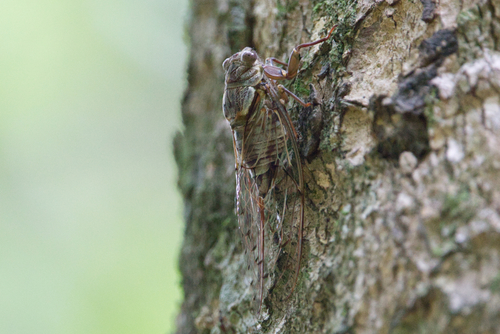
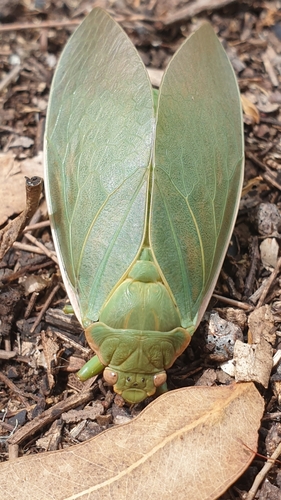
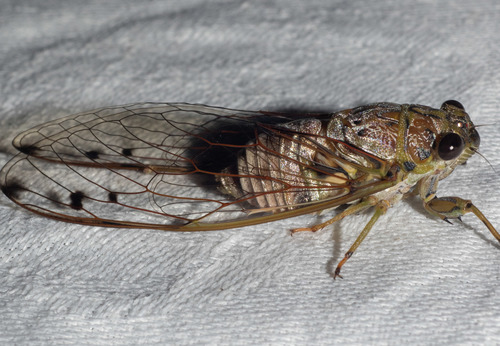
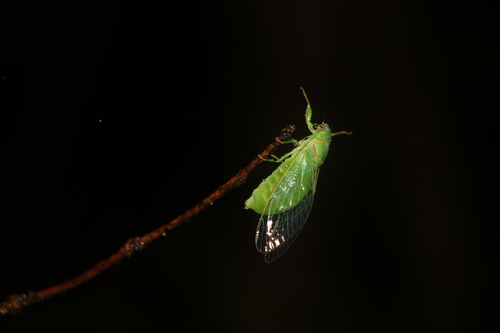
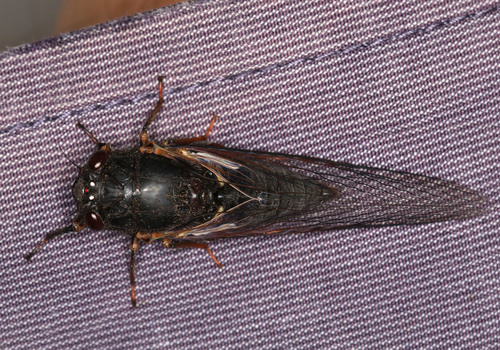
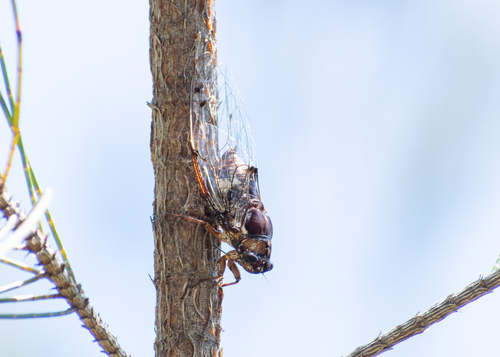
Black Prince
Daily sighting probability ~10% · With luck
at Springbrook National Park

In 3 days ~20% in a week ~40%

6 Verified sightings at Springbrook National Park From 2019 to 2026
128 In all 3 parks
March Best month
☀️ Diurnal When it's spotted

About the Black Prince

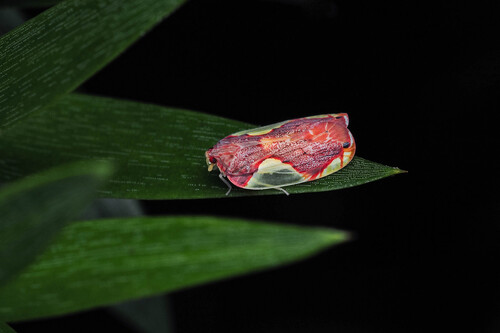
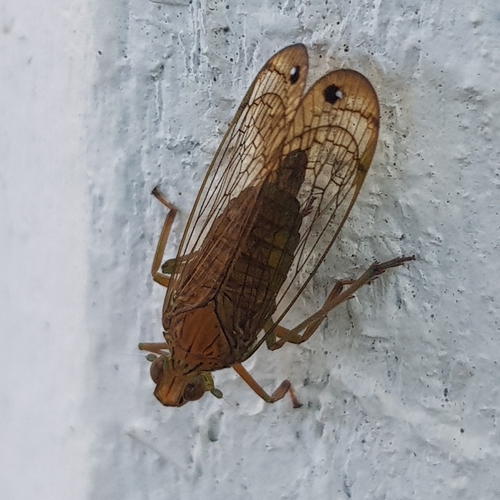
Psaltoda plaga is a species of cicada native to eastern Australia, from Maryborough in central Queensland to Bega in southern New South Wales. Adult cicadas appear over the summer and inhabit forested areas near bodies of water. The predominantly black form from the Sydney and Central Coast regions is commonly known as the black prince, while the term silver knight is used for the species as a whole.

The black prince was originally described by German naturalist Ernst Friedrich Germar in 1834 as Cicada argentata, the species name derived from the Latin argentum "silver". Swedish entomologist Carl Stål defined the new genus Psaltoda in 1861 with three species, including the black prince as Psaltoda argentata. Meanwhile, English entomologist Francis Walker described Cicada plaga in 1850 as well as querying further specimens as Cicada argentata. He noted in 1858 that the binomial Cicada argentata had been used by a European species, and declared that Germar's cicada needed a new name. The older combination was ruled invalid as the binomial name Cicada argentata had been originally used for a European cicada now known as Cicadetta argentata, and the black prince became Psaltoda... Wikipedia →

Global Distribution

Parks Where Found

# Park Country Daily sighting probability
1 Royal National Park 🇦🇺 Australia
~20%
2 Blue Mountains National Park 🇦🇺 Australia
~10%
3 Springbrook National Park 🇦🇺 Australia
~10%

Cities Where Found

# City Country Daily sighting probability
1 Sydney 🇦🇺 Australia
~20%

Before you go

What are the chances of seeing a Black Prince in Springbrook National Park?

With luck

About 10% of wildlife watchers report a Black Prince sighting in Springbrook National Park on a given day, based on 6 verified sightings from GBIF citizen-science data from 2019 to 2026. It is the 312th most-seen of the 429 insects we can rate there. Over three days the chance rises to about 20%, and over a week to about 40%, if each day is a fresh chance.

When is the best time to see a Black Prince in Springbrook National Park?

January–March and November

In those months about 10% of wildlife watchers report a Black Prince in Springbrook National Park on a given day, against under 5% in April–October and December, the lowest months. Those are among Springbrook National Park's wettest months, with about 160 mm of rain a month against 45 mm in August.

What time of day is best to see a Black Prince?

Between 9 am and noon

Across all the parks we cover, that three-hour window holds the most Black Prince sightings with a recorded time, and about 9 in 10 of them come between 6 am and 6 pm: it is a daytime animal.

Is Springbrook National Park the best place to see a Black Prince?

3rd of 3

Of the 3 parks where we can rate Black Prince sightings, Springbrook National Park ranks 3rd at about 10%. The best odds are in Royal National Park (Australia, about 20%) and Blue Mountains National Park (Australia, about 10%).

Which relatives of the Black Prince live in Springbrook National Park?

Same family: Cicadidae

The closest relatives of the Black Prince that you can see in Springbrook National Park (family Cicadidae, Typical Cicadas) are Razor Grinder (about 10%), Green Grocer (about 10%) and Bladder Cicada (about 10%), with each one's daily chance of a sighting.

Where does the Black Prince sighting chance come from?

GBIF citizen-science records

It is estimated from how often the Black Prince is recorded against all the insects logged in Springbrook National Park (6 verified sightings from 2019 to 2026), calibrated against known sighting rates. Figures are rounded to the nearest 10% because citizen-science data supports honest approximations, not decimals, and months with records from fewer than five people show "—". How it works.

← Back to Springbrook National Park