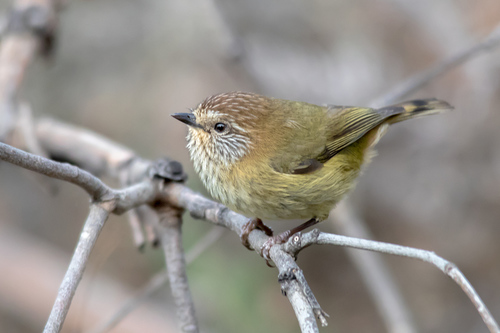
Yellow-Throated Scrubwren

Yellow-Throated Scrubwren

Sericornis citreogularis

Silhouette: Sheatherius · PhyloPic

Daily sighting probability ~10% · With luck
at Springbrook National Park

In 3 days ~30% in a week ~60%

61 Verified sightings at Springbrook National Park From 2019 to 2026
4,014 In all 5 parks
January Best month
☀️ Diurnal When it's spotted

About the Yellow-Throated Scrubwren

The yellow-throated scrubwren (Neosericornis citreogularis) is a passerine in the family Acanthizidae that is found in parts of eastern coastal Australia. It was formerly placed in the genus Sericornis, but is now the only species in the genus Neosericornis.

A small ground-dwelling bird that inhabits wet forest or rainforest, it is mainly insectivorous. The bird has a distinctive yellow throat and eyebrow. The male face is black and the female brown. The crown and upperparts are dark- to olive-brown, and the underparts cream, white or washed-out olive. The wings are dark brown and edged with yellow. Breeding twice or more in a long breeding season, it nests in large, suspended, pear-shaped structures. Often over water, they resemble flood debris, which they are often placed nearby. These nests are the preferred roosts of the golden-tipped bat (Phoniscus papuensis).

The yellow-throated scrubwren was described and illustrated by the English bird artist and ornithologist John Gould in 1838, and given the binomial name Sericornis citreogularis. The specific epithet is derived from the Latin terms cǐtreus 'pertaining to citrus' and gǔla 'throat', hence 'yellow-throated'. The... Wikipedia →

Sounds

Recording0:21

Australia · 2025

© Charley Rayner · iNaturalist · CC BY-NC 4.0

Recording0:10

Australia · 2025

© wcrrwng · iNaturalist · CC BY-NC 4.0

Recording0:11

Australia · 2025

© napierd · iNaturalist · CC BY-NC 4.0

Global Distribution

Parks Where Found

# Park Country Daily sighting probability
1 Lamington National Park 🇦🇺 Australia
~80%
2 Royal National Park 🇦🇺 Australia
~10%
3 Springbrook National Park 🇦🇺 Australia
~10%
4 Blue Mountains National Park 🇦🇺 Australia
<5%
5 Daintree National Park 🇦🇺 Australia
<5%

Before you go

What are the chances of seeing a Yellow-Throated Scrubwren in Springbrook National Park?

With luck

About 10% of wildlife watchers report a Yellow-Throated Scrubwren sighting in Springbrook National Park on a given day, based on 61 verified sightings from GBIF citizen-science data from 2019 to 2026. It is the 62nd most-seen of the 136 birds we can rate there. Over three days the chance rises to about 30%, and over a week to about 60%, if each day is a fresh chance.

When is the best time to see a Yellow-Throated Scrubwren in Springbrook National Park?

January

In that month about 40% of wildlife watchers report a Yellow-Throated Scrubwren in Springbrook National Park on a given day, against under 5% in November, the lowest month.

What time of day is best to see a Yellow-Throated Scrubwren?

Between 11 am and 2 pm

Across all the parks we cover, that three-hour window holds the most Yellow-Throated Scrubwren sightings with a recorded time, and about 9 in 10 of them come between 6 am and 6 pm: it is a daytime animal.

Is Springbrook National Park the best place to see a Yellow-Throated Scrubwren?

3rd of 5

Of the 5 parks where we can rate Yellow-Throated Scrubwren sightings, Springbrook National Park ranks 3rd at about 10%. The best odds are in Lamington National Park (Australia, about 80%) and Royal National Park (Australia, about 10%).

Which relatives of the Yellow-Throated Scrubwren live in Springbrook National Park?

Same genus: Sericornis

The closest relatives of the Yellow-Throated Scrubwren that you can see in Springbrook National Park (genus Sericornis, Typical Scrubwrens) are White-browed Scrubwren (about 50%) and Large-billed Scrubwren (about 30%), with each one's daily chance of a sighting.

Where does the Yellow-Throated Scrubwren sighting chance come from?

GBIF citizen-science records

It is estimated from how often the Yellow-Throated Scrubwren is recorded against all the birds logged in Springbrook National Park (61 verified sightings from 2019 to 2026), calibrated against known sighting rates. Figures are rounded to the nearest 10% because citizen-science data supports honest approximations, not decimals, and months with records from fewer than five people show "—". How it works.

← Back to Springbrook National Park