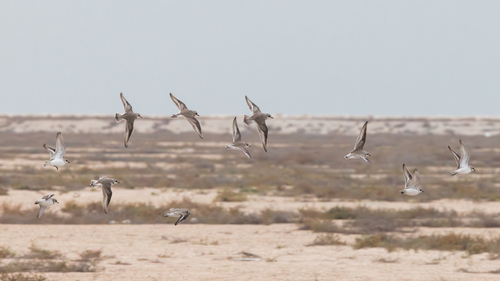
Brown-headed Gull

Brown-headed Gull

Chroicocephalus brunnicephalus

Silhouette: Michael Scroggie · PhyloPic

Daily sighting probability ~10% · With luck
at Sundarbans National Park

In 3 days ~20% in a week ~50%

100 Verified sightings at Sundarbans National Park From 2019 to 2026
159 In all 5 parks
December Best month
☀️ Diurnal When it's spotted

About the Brown-headed Gull

The brown-headed gull (Chroicocephalus brunnicephalus) is a small gull which breeds in the high plateaus of central Asia from Tajikistan to Ordos in Inner Mongolia. It is migratory, wintering on the coasts and large inland lakes of the Indian subcontinent. As is the case with many gulls, was traditionally placed in the genus Larus.

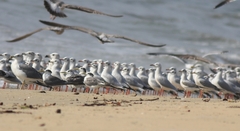
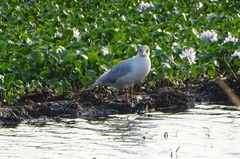
This gull breeds in colonies in large reedbeds or marshes, or on islands in lakes, nesting on the ground. Like most gulls, it is highly gregarious in winter, both when feeding or in evening roosts. It is not a pelagic species, and is rarely seen at sea far from coasts.

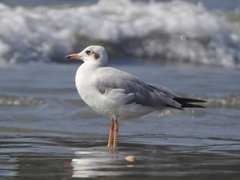
This is a bold and opportunist feeder, which will scavenge in towns or take invertebrates in ploughed fields with equal relish. The brown-headed gull is slightly larger than black-headed gull. The summer adult has a pale brown head, lighter than that of black-headed, a pale grey body, and red bill and legs. The black tips to the primary wing feathers have conspicuous white "mirrors". The underwing is grey with black flight feathers. The brown hood is lost in winter, leaving just dark vertical streaks.

This bird takes two years to reach maturity. First year birds have a black terminal tail band, more dark areas in the wings, and, in summer, a less homogeneous hood. This is a noisy species, especially at colonies. Wikipedia →

Sounds

Call0:21

China · 2025

© Jelle Scharringa · XC1028025 · CC BY-NC-SA 4.0

Call0:28

India · 2022

© Sreekumar Chirukandoth · XC769892 · CC BY-NC-SA 4.0

Call0:34

Thailand · 2026

© Ding Li Yong · XC1073252 · CC BY-NC-ND 4.0

Global Distribution

Parks Where Found

# Park Country Daily sighting probability
1 Sundarbans National Park 🇮🇳 India
~10%
2 Kaziranga National Park 🇮🇳 India
<5%
3 Ranthambore National Park 🇮🇳 India
<5%
4 Keoladeo National Park 🇮🇳 India
<5%
5 Satpura National Park 🇮🇳 India
<5%

Cities Where Found

# City Country Daily sighting probability
1 Mumbai 🇮🇳 India
~10%
2 Kochi 🇮🇳 India
~10%
3 Rajkot 🇮🇳 India
~10%
4 Kozhikode 🇮🇳 India
~10%
5 Ponnani 🇮🇳 India
~10%
6 Srinagar 🇮🇳 India
~10%
7 Karachi 🇵🇰 Pakistan
~10%
8 Varanasi 🇮🇳 India
~10%
9 Prayagraj 🇮🇳 India
<5%
10 Ranchi 🇮🇳 India
<5%

Before you go

What are the chances of seeing a Brown-headed Gull in Sundarbans National Park?

With luck

About 10% of wildlife watchers report a Brown-headed Gull sighting in Sundarbans National Park on a given day, based on 100 verified sightings from GBIF citizen-science data from 2019 to 2026. It is the 85th most-seen of the 177 birds we can rate there. Over three days the chance rises to about 20%, and over a week to about 50%, if each day is a fresh chance.

When is the best time to see a Brown-headed Gull in Sundarbans National Park?

March and December–January

In those months about 20% of wildlife watchers report a Brown-headed Gull in Sundarbans National Park on a given day, against under 5% in July to October, the lowest months. Those are among Sundarbans National Park's driest months, with about 30 mm of rain a month against 480 mm in July. May and June have too few records to rate.

What time of day is best to see a Brown-headed Gull?

Between 8 and 11 am

Across all the parks we cover, that three-hour window holds the most Brown-headed Gull sightings with a recorded time, and about 9 in 10 of them come between 6 am and 6 pm: it is a daytime animal.

Is Sundarbans National Park the best place to see a Brown-headed Gull?

Yes

Of the 5 parks where we can rate Brown-headed Gull sightings, Sundarbans National Park has the highest daily chance: about 10%. Next come Kaziranga National Park (India, under 5%) and Ranthambore National Park (India, under 5%).

Where does the Brown-headed Gull sighting chance come from?

GBIF citizen-science records

It is estimated from how often the Brown-headed Gull is recorded against all the birds logged in Sundarbans National Park (100 verified sightings from 2019 to 2026), calibrated against known sighting rates. Figures are rounded to the nearest 10% because citizen-science data supports honest approximations, not decimals, and months with records from fewer than five people show "—". How it works.

← Back to Sundarbans National Park