
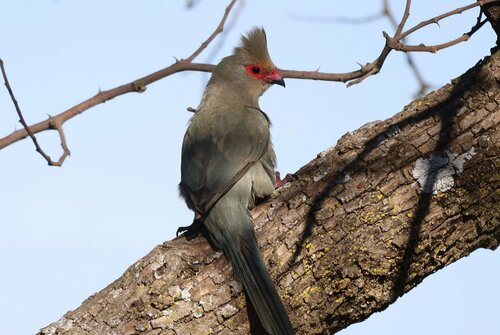
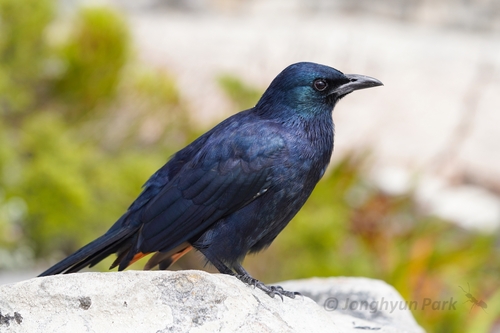
White-backed Mousebird

White-backed Mousebird

Colius colius

Silhouette: Enoch Joseph Wetsy (photo), John E. McCormack, Michael G. Harvey, Brant C. Faircloth, Nicholas G. Crawford, Travis C. Glenn, Robb T. Brumfield & T. Michael Keesey · PhyloPic

LCLeast ConcernNTVUENCR
Daily sighting probability ~10% · With luck
at Table Mountain National Park

In 3 days ~20% in a week ~40%

516 Verified sightings at Table Mountain National Park From 2019 to 2026
1,643 In all 9 parks
January Best month
☀️ Diurnal When it's spotted

About the White-backed Mousebird

The white-backed mousebird (Colius colius) is a large species of mousebird. It is distributed in western and central regions of southern Africa from Namibia and southern Botswana eastwards to Central Transvaal and the eastern Cape.

This mousebird prefers scrubby dry habitats, such as thornveld, fynbos scrub and semi-desert. This bird is about 34 cm (13.5 in) long, with the tail comprising approximately half the length, and weighs 38–64 g (1.3–2.3 oz). The upper parts, head, prominent crest and breast are grey apart from a white back stripe flanked by two broad black stripes and a dark red, or maroon, transverse band at the base of the tail. The white is not visible unless the wings are at least partly open, such as when the birds are alighting, or sometimes in hot weather. The belly is buff in colour. The bill is bluish white with a black tip, and the legs and feet are red.

The speckled mousebird can be distinguished from this species by its differently coloured beak, legs and upperparts. The white-backed mousebird has a whistled zwee-wewit call. It also has a buzzing or crackling call that might be for alarm or keeping in contact with the group.

The... Wikipedia →

Sounds

Alarm call0:32

South Africa · 2026

© JJSUN · XC1077944 · CC BY-NC-SA 4.0

Flight call0:26

South Africa · 2021

© Nature sounds by Simply Birding · XC645834 · CC BY-NC-ND 4.0

Call0:47

South Africa · 2020

© Dawie de Swardt · XC581360 · CC BY-NC-SA 4.0

Global Distribution

Parks Where Found

# Park Country Daily sighting probability
1 West Coast National Park 🇿🇦 South Africa
~60%
2 Namib-Naukluft National Park 🇳🇦 Namibia
~30%
3 Kgalagadi Transfrontier Park 🇿🇦 South Africa
~10%
4 Table Mountain National Park 🇿🇦 South Africa
~10%
5 Pilanesberg National Park 🇿🇦 South Africa
<5%
6 Addo Elephant National Park 🇿🇦 South Africa
<5%
7 De Hoop Nature Reserve 🇿🇦 South Africa
<5%
8 Garden Route National Park 🇿🇦 South Africa
<5%
9 Etosha National Park 🇳🇦 Namibia
<5%

Cities Where Found

# City Country Daily sighting probability
1 Cape Town 🇿🇦 South Africa
~20%
2 Johannesburg 🇿🇦 South Africa
<5%

Before you go

What are the chances of seeing a White-backed Mousebird in Table Mountain National Park?

With luck

About 10% of wildlife watchers report a White-backed Mousebird sighting in Table Mountain National Park on a given day, based on 516 verified sightings from GBIF citizen-science data from 2019 to 2026. It is the 92nd most-seen of the 223 birds we can rate there. Over three days the chance rises to about 20%, and over a week to about 40%, if each day is a fresh chance.

When is the best time to see a White-backed Mousebird in Table Mountain National Park?

March–August, October and December–January

In those months about 10% of wildlife watchers report a White-backed Mousebird in Table Mountain National Park on a given day, against under 5% in February, September and November, the lowest months.

What time of day is best to see a White-backed Mousebird?

Between 9 am and noon

Across all the parks we cover, that three-hour window holds the most White-backed Mousebird sightings with a recorded time, and nearly all of them come between 6 am and 6 pm: it is a daytime animal.

Where does the White-backed Mousebird sighting chance come from?

GBIF citizen-science records

It is estimated from how often the White-backed Mousebird is recorded against all the birds logged in Table Mountain National Park (516 verified sightings from 2019 to 2026), calibrated against known sighting rates. Figures are rounded to the nearest 10% because citizen-science data supports honest approximations, not decimals, and months with records from fewer than five people show "—". How it works.

← Back to Table Mountain National Park