Johnston's Genet

Johnston's Genet

Genetta johnstoni

Silhouette: Margot Michaud · PhyloPic

LCNTNear ThreatenedVUENCR
Daily sighting probability ~40% · Likely
at Taï National Park

In 3 days ~80% in a week >90%

9 Verified sightings at Taï National Park From 2019 to 2026
9 In 1 park
June Best month
☀️🌙 Day & Night When it's spotted

About the Johnston's Genet

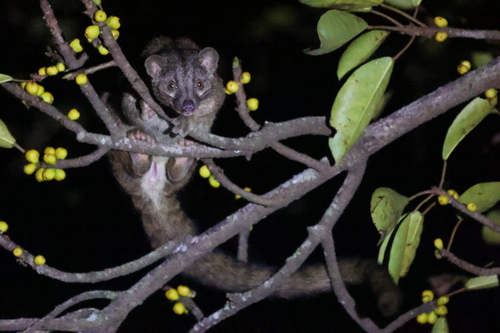
Johnston's genet (Genetta johnstoni) is a genet species native to the Upper Guinean forests in West Africa. It was classified as a separate species by Reginald Innes Pocock in 1908. It is listed as Near Threatened on the IUCN Red List.

Johnston's genet was first scientifically described and classified as a distinct species by Reginald Innes Pocock in 1907. Johnston's genet has a short fur which is rich golden to ochre yellowish in color. It has small reddish spots on the sides, and a dark stripe along the spine. The limbs are darker in color with its hind legs predominantly grey. It has a large tail with eight black and seven pale rings, and a brown tip that is whitish below. The skin colorization provides a camouflage in its regular environment within the forests. Its incisors and mandibles are designed and adapted for an insectivorous diet.

Johnston's genet is found in the Upper Guinean forests along the north west coast of Africa, across the countries of Guinea, Sierra Leone, Liberia, Ghana and the Ivory Coast. In January 2000, a dead individual was recovered in Taï National Park in Ivory Coast, and the first live individual... Wikipedia →

Global Distribution

Parks Where Found

# Park Country Daily sighting probability
1 Taï National Park 🇨🇮 Ivory Coast
~40%

More parks will be added in future updates.

Before you go

What are the chances of seeing a Johnston's Genet in Taï National Park?

Likely

About 40% of wildlife watchers report a Johnston's Genet sighting in Taï National Park on a given day, based on 9 verified sightings from GBIF citizen-science data from 2019 to 2026. It is the 5th most-seen of the 14 mammals we can rate there. Over three days the chance rises to about 80%, and over a week to over 90%, if each day is a fresh chance.

When is the best time to see a Johnston's Genet in Taï National Park?

June

In that month about 70% of wildlife watchers report a Johnston's Genet in Taï National Park on a given day, against about 10% in May, July and September, the lowest months. That is one of Taï National Park's wettest months, with about 280 mm of rain against 40 mm in December. October and December–February have too few records to rate.

What time of day is best to see a Johnston's Genet?

Between 2 and 5 pm

Across all the parks we cover, that three-hour window holds the most Johnston's Genet sightings with a recorded time, and about 6 in 10 of them come between 6 am and 6 pm: it is seen both by day and at night.

Where else can you see a Johnston's Genet?

Only Taï National Park, in our data

Taï National Park is the only park on Wallace's Line with enough records to rate Johnston's Genet sightings: about 40% of wildlife watchers there report one on a given day.

Where does the Johnston's Genet sighting chance come from?

GBIF citizen-science records

It is estimated from how often the Johnston's Genet is recorded against all the mammals logged in Taï National Park (9 verified sightings from 2019 to 2026), calibrated against known sighting rates. Figures are rounded to the nearest 10% because citizen-science data supports honest approximations, not decimals, and months with records from fewer than five people show "—". How it works.

← Back to Taï National Park