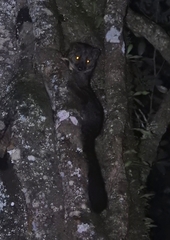
African Palm-civet

African Palm-civet

Nandinia binotata

Silhouette: PhyloPic

LCLeast ConcernNTVUENCR
Daily sighting probability ~40% · Likely
at Taï National Park

In 3 days ~80% in a week >90%

6 Verified sightings at Taï National Park From 2019 to 2026
11 In all 2 parks
August Best month
🌙 Nocturnal When it's spotted

About the African Palm-civet

The African palm civet (Nandinia binotata), also known as the two-spotted palm civet, is a small feliform mammal widely distributed in sub-Saharan Africa. It is listed as least concern on the IUCN Red List. It is the sole member of the superfamily Nandinioidea and the most genetically isolated carnivoran.

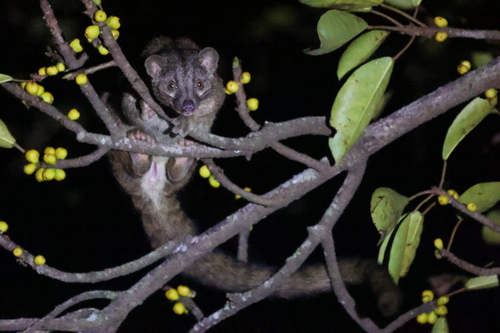
The African palm civet is grey to dark brown with dark spots on the back. It has short legs, small ears, a lean body, and a long, ringed tail. It has two sets of scent glands on the lower abdomen and between the third and fourth toes on each foot, which secrete a strong-smelling substance used to mark territory and in mating. Adult females reach a body length of 37–61 cm (15–24 in) with a 34–70 cm (13–28 in) long tail and weigh 1.2–2.7 kg (2.6–6.0 lb). Adult males reach 39.8–62.5 cm (15.7–24.6 in) in body length with a 43–76.2 cm (16.9–30.0 in) long tail and weigh 1.3–3 kg (2.9–6.6 lb).

The African palm civet's ear canal is not divided and cartilaginous at the end. The African palm civet ranges throughout much of sub-Saharan Africa from Guinea to South Sudan, south to Angola, and into eastern Zimbabwe. It has been recorded in deciduous... Wikipedia →
Sounds

Uncertain0:20

Central African Republic · 2025

© Antoine Ede, Dzanga-Sangha protected Areas · XC1052405 · CC BY-NC-SA 4.0

Call0:12

Ivory Coast · 2023

© Étienne Leroy · XC960204 · CC BY-NC-SA 4.0

Recording0:03

Congo - Kinshasa · 2026

© Daniel Alempijevic · iNaturalist · CC BY-NC 4.0

Global Distribution

Parks Where Found

# Park Country Daily sighting probability
1 Taï National Park 🇨🇮 Ivory Coast
~40%
2 Odzala-Kokoua National Park 🇨🇬 Republic of the Congo
~20%

Zoos & Centres Where Found

# Zoo / Centre Country
1 Poznań Nowe Zoo 🇵🇱 Poland In captivity

Before you go

What are the chances of seeing an African Palm-civet in Taï National Park?

Likely

About 40% of wildlife watchers report an African Palm-civet sighting in Taï National Park on a given day, based on 6 verified sightings from GBIF citizen-science data from 2019 to 2026. It is the 8th most-seen of the 14 mammals we can rate there. Over three days the chance rises to about 80%, and over a week to over 90%, if each day is a fresh chance.

When is the best time to see an African Palm-civet in Taï National Park?

May and August

In those months about 50% of wildlife watchers report an African Palm-civet in Taï National Park on a given day, against about 10% in March, July and September, the lowest months. October to February have too few records to rate.

What time of day is best to see an African Palm-civet?

Between 7 and 10 pm

Across all the parks we cover, that three-hour window holds the most African Palm-civet sightings with a recorded time, and about 8 in 10 of them come between 6 pm and 6 am: it is mostly seen at night.

Is Taï National Park the best place to see an African Palm-civet?

Yes

Of the 2 parks where we can rate African Palm-civet sightings, Taï National Park has the highest daily chance: about 40%. Next come Odzala-Kokoua National Park (Republic of the Congo, about 20%).

Where does the African Palm-civet sighting chance come from?

GBIF citizen-science records

It is estimated from how often the African Palm-civet is recorded against all the mammals logged in Taï National Park (6 verified sightings from 2019 to 2026), calibrated against known sighting rates. Figures are rounded to the nearest 10% because citizen-science data supports honest approximations, not decimals, and months with records from fewer than five people show "—". How it works.

← Back to Taï National Park