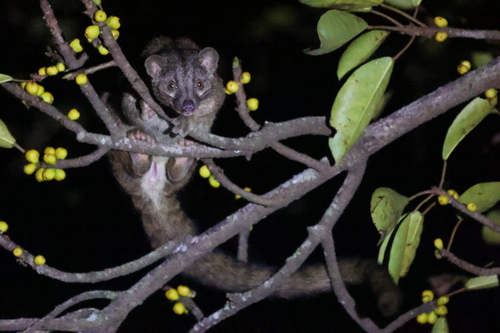
Lesser Spot-nosed Monkey

Lesser Spot-nosed Monkey

Cercopithecus petaurista

Silhouette: Kai R. Caspar · PhyloPic

LCNTNear ThreatenedVUENCR
Daily sighting probability ~40% · Likely
at Taï National Park

In 3 days ~70% in a week >90%

5 Verified sightings at Taï National Park From 2019 to 2026
5 In 1 park
September Best month
🌅 Crepuscular When it's spotted

About the Lesser Spot-nosed Monkey

The lesser spot-nosed monkey (Cercopithecus petaurista), also known as the lesser spot-nosed guenon, lesser white-nosed guenon, or lesser white-nosed monkey, is a species of primate in the family Cercopithecidae. It is found in Ivory Coast, Ghana, Guinea, Liberia, Sierra Leone, Togo, Guinea-Bissau, and possibly Senegal.

The lesser spot-nosed monkey is a small arboreal species with a long tail. Its face is black with a white spot above its nose. A white stripe extends from the temple to below the ear. The fur of the crown, back, outer side of the limbs and upper surface of the tail are olive-green or khaki. In some forms, the middle and lower back have a reddish tinge. The individual hairs, especially on the crown, are flecked with black and yellow. The underparts, inner side of the limbs and underside of the tail are white or cream.

The species is found in West Africa. Its range includes Guinea-Bissau, Guinea, Sierra Leone, Liberia, Ivory Coast, Ghana and Togo, and it has also been recorded in southeastern Senegal. It is adaptable and is found in a range of habitats including primary and secondary forests, gallery forests, regenerating... Wikipedia →

Sounds

Call0:28

Ivory Coast · 2018

© Lars Lachmann · XC402300 · CC BY-NC-SA 4.0

Call0:19

Ivory Coast · 2023

© Étienne Leroy · XC960360 · CC BY-NC-SA 4.0

Recording0:14

Ghana · 2024

© dbeadle · iNaturalist · CC BY-NC 4.0

Global Distribution

Parks Where Found

# Park Country Daily sighting probability
1 Taï National Park 🇨🇮 Ivory Coast
~40%

More parks will be added in future updates.

Zoos & Centres Where Found

# Zoo / Centre Country
1 San Diego Zoo 🇺🇸 United States In captivity
2 Central Florida Zoo and Botanical Gardens 🇺🇸 United States In captivity
3 Zoo La Barben 🇫🇷 France In captivity
4 Memphis Zoo 🇺🇸 United States In captivity
5 Abidjan zoo 🇨🇮 Côte d’Ivoire In captivity
6 Safari North Wildlife Park 🇺🇸 United States In captivity
7 Зоопарк ХІІ Місяців 🇺🇦 Ukraine In captivity

Before you go

What are the chances of seeing a Lesser Spot-nosed Monkey in Taï National Park?

Likely

About 40% of wildlife watchers report a Lesser Spot-nosed Monkey sighting in Taï National Park on a given day, based on 5 verified sightings from GBIF citizen-science data from 2019 to 2026. It is the 12th most-seen of the 14 mammals we can rate there. Over three days the chance rises to about 70%, and over a week to over 90%, if each day is a fresh chance.

When is the best time to see a Lesser Spot-nosed Monkey in Taï National Park?

March–June and September

In those months about 40% of wildlife watchers report a Lesser Spot-nosed Monkey in Taï National Park on a given day, against about 10% in July and August, the lowest months. October to February have too few records to rate.

What time of day is best to see a Lesser Spot-nosed Monkey?

Between 9 am and noon

Across all the parks we cover, that three-hour window holds the most Lesser Spot-nosed Monkey sightings with a recorded time, and about 6 in 10 of them come between 6 am and 6 pm: it is most active around dawn and dusk.

Where else can you see a Lesser Spot-nosed Monkey?

Only Taï National Park, in our data

Taï National Park is the only park on Wallace's Line with enough records to rate Lesser Spot-nosed Monkey sightings: about 40% of wildlife watchers there report one on a given day.

Where does the Lesser Spot-nosed Monkey sighting chance come from?

GBIF citizen-science records

It is estimated from how often the Lesser Spot-nosed Monkey is recorded against all the mammals logged in Taï National Park (5 verified sightings from 2019 to 2026), calibrated against known sighting rates. Figures are rounded to the nearest 10% because citizen-science data supports honest approximations, not decimals, and months with records from fewer than five people show "—". How it works.

← Back to Taï National Park