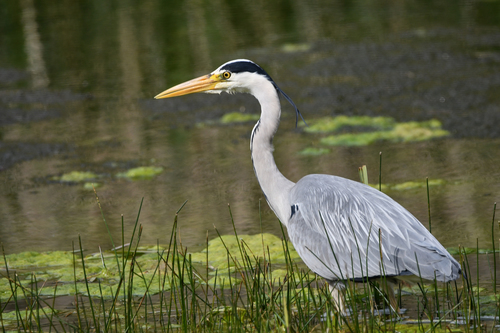
Chinese Pond Heron

Chinese Pond Heron

Ardeola bacchus

Silhouette: Andy Wilson · PhyloPic

LCLeast ConcernNTVUENCR
Daily sighting probability <5% · Rare
at Taman Negara National Park

In 3 days <5%

9 Verified sightings at Taman Negara National Park From 2019 to 2026
3,143 In all 9 parks
February Best month
🌅 Crepuscular When it's spotted

About the Chinese Pond Heron

The Chinese pond heron (Ardeola bacchus) is an East Asian freshwater bird of the heron family, (Ardeidae). It is one of six species of birds known as "pond herons" (genus Ardeola). It is parapatric (or nearly so) with the Indian pond heron (A. grayii) to the west and the Javan pond heron (A. speciosa) to the south, and these three are presumed to form a superspecies. As a group they are variously affiliated with the squacco heron (A. ralloides) or the Malagasy pond heron (A. idae). As of mid-2011 there are no published molecular analyses of pond heron interrelationships and osteological data is likewise not analyzed for all relevant comparison taxa.

The Chinese pond heron is typically 47 cm (19 in) long with white wings, a yellow bill with a black tip, yellow eyes and legs. Its overall colour is red, blue and white during breeding season, and greyish-brown and flecked with white at other times.

It is found in shallow fresh and salt water wetlands and ponds in China and adjacent temperate and subtropical East Asia. Essentially a lowland bird, its range is delimited by the subarctic regions in the north, and by the mountain ranges in the west and south.... Wikipedia →

Sounds

Flight call0:10

China · 2021

© Geoff Carey · XC794055 · CC BY-NC-SA 4.0

Call0:09

Thailand · 2017

© Agris Celmins · XC671699 · CC BY-NC-ND 4.0

Flight call0:10

China · 2026

© Bo Shunqi 薄顺奇 · XC1097793 · CC BY-NC-SA 4.0

Global Distribution

Parks Where Found

# Park Country Daily sighting probability
1 Cat Tien National Park 🇻🇳 Vietnam
~40%
2 Khao Sok National Park 🇹🇭 Thailand
~30%
3 Kaeng Krachan National Park 🇹🇭 Thailand
~30%
4 Khao Yai National Park 🇹🇭 Thailand
~20%
5 Doi Inthanon National Park 🇹🇭 Thailand
~10%
6 Khao Luang National Park 🇹🇭 Thailand
~10%
7 Cuc Phuong National Park 🇻🇳 Vietnam
~10%
8 Minneriya National Park 🇱🇰 Sri Lanka
<5%
9 Taman Negara National Park 🇲🇾 Malaysia
<5%

Cities Where Found

# City Country Daily sighting probability
1 Xiuying District 🇨🇳 China
~80%
2 Quanzhou 🇨🇳 China
~70%
3 Tuen Mun 🇨🇳 China
~60%
4 Shantou 🇨🇳 China
~50%
5 Hanoi 🇻🇳 Vietnam
~50%
6 Ho Chi Minh City 🇻🇳 Vietnam
~50%
7 Đà Nẵng 🇻🇳 Vietnam
~50%
8 Guangzhou 🇨🇳 China
~50%
9 Kunming 🇨🇳 China
~40%
10 Fuzhou 🇨🇳 China
~40%

Zoos & Centres Where Found

# Zoo / Centre Country
1 Vinpearl Safari 🇻🇳 Vietnam In captivity
2 Kuala Lumpur Bird Park 🇲🇾 Malaysia In captivity

Before you go

What are the chances of seeing a Chinese Pond Heron in Taman Negara National Park?

Rare

Under 5% of wildlife watchers report a Chinese Pond Heron sighting in Taman Negara National Park on a given day, based on 9 verified sightings from GBIF citizen-science data from 2019 to 2026. It is the 284th most-seen of the 293 birds we can rate there. Over three days the chance rises to under 5%, if each day is a fresh chance.

When is the best time to see a Chinese Pond Heron in Taman Negara National Park?

Any time of year

In every month with enough records, under 5% of wildlife watchers report a Chinese Pond Heron in Taman Negara National Park on a given day, so our monthly data shows no clear season.

What time of day is best to see a Chinese Pond Heron?

Between 10 am and 1 pm

Across all the parks we cover, that three-hour window holds the most Chinese Pond Heron sightings with a recorded time, and about 7 in 10 of them come between 6 am and 6 pm: it is most active around dawn and dusk.

Where does the Chinese Pond Heron sighting chance come from?

GBIF citizen-science records

It is estimated from how often the Chinese Pond Heron is recorded against all the birds logged in Taman Negara National Park (9 verified sightings from 2019 to 2026), calibrated against known sighting rates. Figures are rounded to the nearest 10% because citizen-science data supports honest approximations, not decimals, and months with records from fewer than five people show "—". How it works.

← Back to Taman Negara National Park