
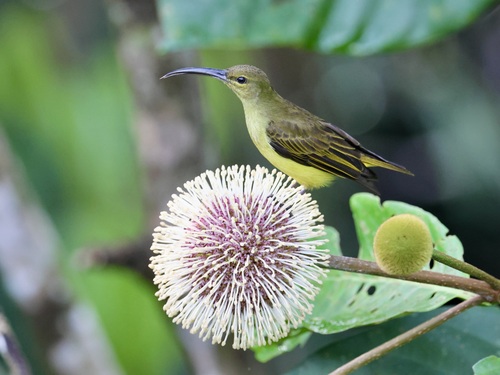
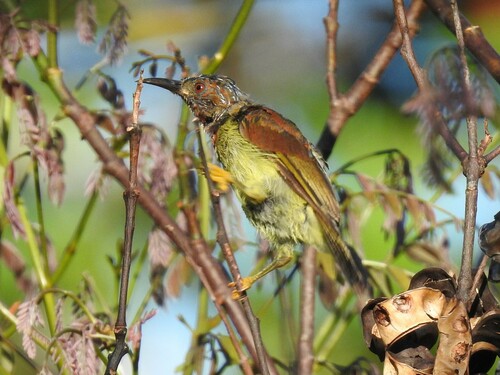
Spectacled Spiderhunter

Spectacled Spiderhunter

Arachnothera flavigaster

Silhouette: Sheatherius · PhyloPic

LCLeast ConcernNTVUENCR
Daily sighting probability ~10% · With luck
at Taman Negara National Park

In 3 days ~20% in a week ~40%

93 Verified sightings at Taman Negara National Park From 2019 to 2026
869 In all 10 parks
January Best month
🌅 Crepuscular When it's spotted

About the Spectacled Spiderhunter

The spectacled spiderhunter (Arachnothera flavigaster) is a species of bird in the family Nectariniidae. It is found in Brunei, Indonesia, Malaysia, Singapore, Thailand, and Vietnam. Its natural habitats are subtropical or tropical moist lowland forest and subtropical or tropical moist montane forest. This is both the largest spiderhunter and the largest representative of the entire sunbird

family. The total length of this species is around 22 cm (8.7 in) and body mass is around 38.4 to 49 g (1.35 to 1.73 oz). Wikipedia →

Sounds

Call1:09

Malaysia · 2023

© Kim Chuah Lim · XC856072 · CC BY-NC-SA 4.0

Uncertain0:21

Malaysia · 2023

© Wai Loon Wong · XC827651 · CC BY-NC-SA 4.0

Subsong0:19

Malaysia · 2022

© Ding Li Yong · XC771712 · CC BY-NC-ND 4.0

Global Distribution

Parks Where Found

# Park Country Daily sighting probability
1 Khao Luang National Park 🇹🇭 Thailand
~20%
2 Danum Valley Conservation Area 🇲🇾 Malaysia
~10%
3 Sepilok 🇲🇾 Malaysia
~10%
4 Taman Negara National Park 🇲🇾 Malaysia
~10%
5 Kerinci Seblat National Park 🇮🇩 Indonesia
~10%
6 Way Kambas National Park 🇮🇩 Indonesia
<5%
7 Gunung Leuser National Park 🇮🇩 Indonesia
<5%
8 Khao Sok National Park 🇹🇭 Thailand
<5%
9 Kinabalu Park 🇲🇾 Malaysia
<5%
10 Kaeng Krachan National Park 🇹🇭 Thailand
<5%

Cities Where Found

# City Country Daily sighting probability
1 Kuala Lumpur 🇲🇾 Malaysia
~10%

Before you go

What are the chances of seeing a Spectacled Spiderhunter in Taman Negara National Park?

With luck

About 10% of wildlife watchers report a Spectacled Spiderhunter sighting in Taman Negara National Park on a given day, based on 93 verified sightings from GBIF citizen-science data from 2019 to 2026. It is the 136th most-seen of the 293 birds we can rate there. Over three days the chance rises to about 20%, and over a week to about 40%, if each day is a fresh chance.

When is the best time to see a Spectacled Spiderhunter in Taman Negara National Park?

January

In that month about 30% of wildlife watchers report a Spectacled Spiderhunter in Taman Negara National Park on a given day, against under 5% in March, June–August and December, the lowest months.

What time of day is best to see a Spectacled Spiderhunter?

Between 4 and 7 am

Across all the parks we cover, that three-hour window holds the most Spectacled Spiderhunter sightings with a recorded time, and about 6 in 10 of them come between 6 pm and 6 am: it is most active around dawn and dusk.

Is Taman Negara National Park the best place to see a Spectacled Spiderhunter?

4th of 10

Of the 10 parks where we can rate Spectacled Spiderhunter sightings, Taman Negara National Park ranks 4th at about 10%. The best odds are in Khao Luang National Park (Thailand, about 20%), Danum Valley Conservation Area (Malaysia, about 10%) and Sepilok (Malaysia, about 10%).

Which relatives of the Spectacled Spiderhunter live in Taman Negara National Park?

Same genus: Arachnothera

The closest relatives of the Spectacled Spiderhunter that you can see in Taman Negara National Park (genus Arachnothera, Typical Spiderhunters) are Gray-breasted Spiderhunter (about 10%) and Little Spiderhunter (about 10%), with each one's daily chance of a sighting.

Where does the Spectacled Spiderhunter sighting chance come from?

GBIF citizen-science records

It is estimated from how often the Spectacled Spiderhunter is recorded against all the birds logged in Taman Negara National Park (93 verified sightings from 2019 to 2026), calibrated against known sighting rates. Figures are rounded to the nearest 10% because citizen-science data supports honest approximations, not decimals, and months with records from fewer than five people show "—". How it works.

← Back to Taman Negara National Park