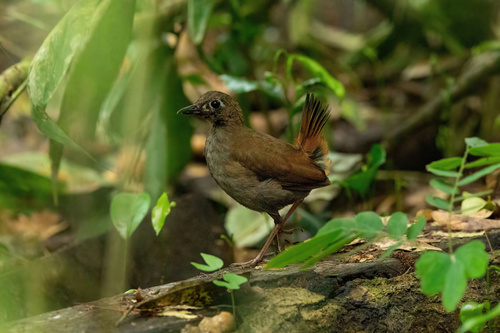
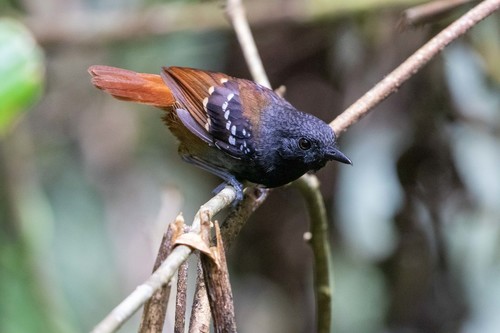
Ash-throated Gnateater

Ash-throated Gnateater

Conopophaga peruviana

Silhouette: Sheatherius · PhyloPic

LCLeast ConcernNTVUENCR
Daily sighting probability <5% · Rare
at Tambopata National Reserve

In 3 days <5%

6 Verified sightings at Tambopata National Reserve From 2019 to 2026
93 In all 3 parks
May Best month
☀️🌙 Day & Night When it's spotted

About the Ash-throated Gnateater

The ash-throated gnateater (Conopophaga peruviana) is a species of bird in the family Conopophagidae. It is found in Bolivia, Brazil, Ecuador, and Peru. The placement of ash-throated gnateater in a linear sequence remains unsettled. The Clements taxonomy places it between chestnut-belted gnateater (Conopophaga aurita) and Ceara gnateater (C. cearae), while the International Ornithological Committee (IOC) places it between hooded gnateater (C. roberti) and Ceara gnateater, with chestnut-belted gnateater preceding hooded. It is monotypic.

The ash-throated gnateater is 11 to 12 cm (4.3 to 4.7 in) long and weighs 22 to 26 g (0.78 to 0.92 oz). The male's face, back, and breast are gray, with the back being darker and having a brownish wash. The crown is brownish, the throat white, and there is a white tuft behind the eye. The lower belly is brown. The female's face and breast are rufous and the upper parts are brown.

The ash-throated gnateater is found in the upper Amazon Basin in eastern Ecuador, eastern Peru, far western Brazil, and slightly into Bolivia's La Paz Department. It primarily inhabits the open understory... Wikipedia →


Sounds

Call1:05

Brazil · 2019

© GABRIEL LEITE · XC474787 · CC BY-NC-SA 4.0

Song0:22

Ecuador · 1999

© Mitch Lysinger · XC260838 · CC BY-NC-SA 4.0

Alarm call0:24

Ecuador · 1995

© John V. Moore · XC258626 · CC BY-NC-SA 4.0

Global Distribution

Parks Where Found

# Park Country Daily sighting probability
1 Manu National Park 🇵🇪 Peru
<5%
2 Yasuní National Park 🇪🇨 Ecuador
<5%
3 Tambopata National Reserve 🇵🇪 Peru
<5%

Before you go

What are the chances of seeing an Ash-throated Gnateater in Tambopata National Reserve?

Rare

Under 5% of wildlife watchers report an Ash-throated Gnateater sighting in Tambopata National Reserve on a given day, based on 6 verified sightings from GBIF citizen-science data from 2019 to 2026. It is the 539th most-seen of the 550 birds we can rate there. Over three days the chance rises to under 5%, if each day is a fresh chance.

When is the best time to see an Ash-throated Gnateater in Tambopata National Reserve?

Any time of year

In every month with enough records, under 5% of wildlife watchers report an Ash-throated Gnateater in Tambopata National Reserve on a given day, so our monthly data shows no clear season.

What time of day is best to see an Ash-throated Gnateater?

Between 9 am and noon

Across all the parks we cover, that three-hour window holds the most Ash-throated Gnateater sightings with a recorded time, and about 6 in 10 of them come between 6 am and 6 pm: it is seen both by day and at night.

Is Tambopata National Reserve the best place to see an Ash-throated Gnateater?

Among the best

Of the 3 parks where we can rate Ash-throated Gnateater sightings, Tambopata National Reserve ranks 3rd at under 5%, level with the leaders once rounded. The best odds are in Manu National Park (Peru, under 5%) and Yasuní National Park (Ecuador, under 5%).

Where does the Ash-throated Gnateater sighting chance come from?

GBIF citizen-science records

It is estimated from how often the Ash-throated Gnateater is recorded against all the birds logged in Tambopata National Reserve (6 verified sightings from 2019 to 2026), calibrated against known sighting rates. Figures are rounded to the nearest 10% because citizen-science data supports honest approximations, not decimals, and months with records from fewer than five people show "—". How it works.

← Back to Tambopata National Reserve