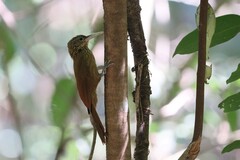
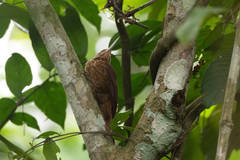
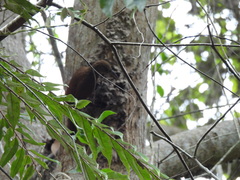
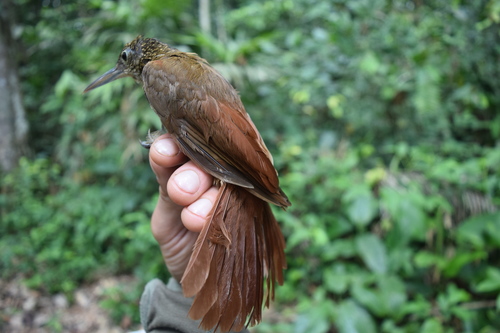
Buff-throated Woodcreeper

Buff-throated Woodcreeper

Xiphorhynchus guttatus

Silhouette: Melo-Ortiz O.E.; Herrera-R, G.A. y Parada-Pedreros S · PhyloPic

LCLeast ConcernNTVUENCR
Daily sighting probability ~40% · Likely
at Tambopata National Reserve

In 3 days ~70% in a week >90%

1,351 Verified sightings at Tambopata National Reserve From 2019 to 2026
4,409 In all 11 parks
August Best month
☀️ Diurnal When it's spotted

About the Buff-throated Woodcreeper

The buff-throated woodcreeper (Xiphorhynchus guttatus) is a species of bird in the subfamily Dendrocolaptinae of the ovenbird family Furnariidae. It is found in Bolivia, Brazil, Colombia, Ecuador, French Guiana, Guyana, Peru, Suriname, and Venezuela.

What is now the cocoa woodcreeper (X. susurrans) of Central America and northwestern South America was long considered conspecific with the buff-throated woodcreeper, but since the 1990s has been treated as a distinct species. The two form a superspecies.

The buff-throated woodcreeper's remaining taxonomy is unsettled. The South American Classification Committee of the American Ornithological Society, the International Ornithological Committee (IOC), and the Clements taxonomy assign it these eight subspecies. Clements subdivides them into three groups.

"Buff-throated" group "Dusky-billed" group, also called the "eytoni" group Wikipedia →

Sounds

Dawn song0:29

Brazil · 2026

© JAYRSON ARAUJO DE OLIVEIRA · XC1183854 · CC BY-NC-SA 4.0

Song0:40

Ecuador · 2025

© Manuel Sánchez-Nivicela · XC1163128 · CC BY-NC-ND 4.0

Call1:09

Ecuador · 2025

© Marc Anderson · XC998174 · CC BY-NC-ND 4.0

Global Distribution

Parks Where Found

# Park Country Daily sighting probability
1 Brownsberg Nature Park 🇸🇷 Suriname
~40%
2 Tambopata National Reserve 🇵🇪 Peru
~40%
3 Yasuní National Park 🇪🇨 Ecuador
~30%
4 Amacayacu National Natural Park 🇨🇴 Colombia
~30%
5 Manu National Park 🇵🇪 Peru
~30%
6 Cuyabeno Wildlife Reserve 🇪🇨 Ecuador
~20%
7 Parque Estadual Encontro das Águas 🇧🇷 Brazil
~10%
8 Sierra de la Macarena National Park 🇨🇴 Colombia
~10%
9 Amboró National Park 🇧🇴 Bolivia
~10%
10 Chapada dos Guimarães National Park 🇧🇷 Brazil
~10%
11 Anavilhanas National Park 🇧🇷 Brazil
~10%

Cities Where Found

# City Country Daily sighting probability
1 Goiânia 🇧🇷 Brazil
~10%
2 Manaus 🇧🇷 Brazil
<5%

Before you go

What are the chances of seeing a Buff-throated Woodcreeper in Tambopata National Reserve?

Likely

About 40% of wildlife watchers report a Buff-throated Woodcreeper sighting in Tambopata National Reserve on a given day, based on 1,351 verified sightings from GBIF citizen-science data from 2019 to 2026. It is the 11th most-seen of the 550 birds we can rate there. Over three days the chance rises to about 70%, and over a week to over 90%, if each day is a fresh chance.

When is the best time to see a Buff-throated Woodcreeper in Tambopata National Reserve?

August

In that month about 50% of wildlife watchers report a Buff-throated Woodcreeper in Tambopata National Reserve on a given day, against about 20% in March, the lowest month. That is one of Tambopata National Reserve's driest months, with about 70 mm of rain against 420 mm in February.

What time of day is best to see a Buff-throated Woodcreeper?

Between 9 am and noon

Across all the parks we cover, that three-hour window holds the most Buff-throated Woodcreeper sightings with a recorded time, and about 8 in 10 of them come between 6 am and 6 pm: it is a daytime animal.

Is Tambopata National Reserve the best place to see a Buff-throated Woodcreeper?

Among the best

Of the 11 parks where we can rate Buff-throated Woodcreeper sightings, Tambopata National Reserve ranks 2nd at about 40%, level with the leaders once rounded. The best odds are in Brownsberg Nature Park (Suriname, about 40%).

Where does the Buff-throated Woodcreeper sighting chance come from?

GBIF citizen-science records

It is estimated from how often the Buff-throated Woodcreeper is recorded against all the birds logged in Tambopata National Reserve (1,351 verified sightings from 2019 to 2026), calibrated against known sighting rates. Figures are rounded to the nearest 10% because citizen-science data supports honest approximations, not decimals, and months with records from fewer than five people show "—". How it works.

← Back to Tambopata National Reserve