About the Buff-tailed Sicklebill
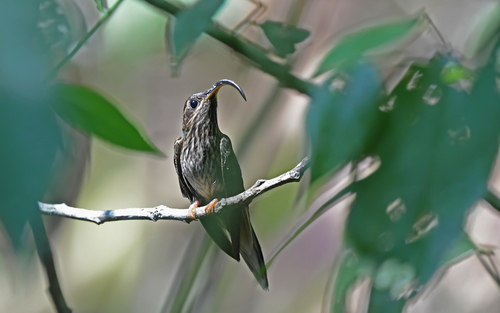
Epimachus albertisi, a bird-of-paradise from New Guinea, is also sometimes called "buff-tailed sicklebill". The buff-tailed sicklebill (Eutoxeres condamini) is a species of hermit hummingbird from the lower Andes and adjacent west Amazonian lowlands from southern Colombia and northern Ecuador to Peru and Bolivia.
With a total length of 5–6 in (13–15 cm) and weighing 0.28–0.44 oz (7.9–12.5 g), it is a relatively large hummingbird. Males and females are virtually identical, differing only in size (especially wing measurements), with the females being some 20% smaller.
Its upperparts are iridescent dull greenish, while the underparts are whitish, densely streaked with dusky. The neck-side has a relatively faint blue patch. The tips of the rectrices (tail feathers) are white, and there is a naked stripe on top of the head (but this is usually concealed). The most conspicuous features, however, are those the common name refers to: the bill is strongly decurved, and the outer three rectrices on each side are deep buff, best visible from below.
Immature birds have light-tipped remiges (pinions), hardly any blue on the neck, and lack the naked crown stripe. Hatchlings have... Wikipedia →