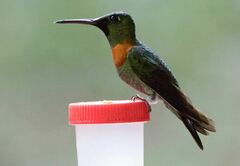

Gould's Jewelfront

Gould's Jewelfront

Heliodoxa aurescens

Silhouette: PhyloPic

LCLeast ConcernNTVUENCR
Daily sighting probability <5% · Rare
at Tambopata National Reserve

In 3 days ~10% in a week ~20%

81 Verified sightings at Tambopata National Reserve From 2019 to 2026
1,388 In all 4 parks
December Best month
☀️ Diurnal When it's spotted

About the Gould's Jewelfront

Gould's jewelfront or Gould's brilliant (Heliodoxa aurescens) is a medium-sized hummingbird in the family Trochilidae. It is found in tropical and equatorial South America. This is an uncommon species with an unusually large range compared to the other members of Heliodoxa.

The common name commemorates the English ornithologist and bird artist John Gould (1804–1881). H.aurescens ranges in size from 11 to 12 cm, with an average weight of about 6.2 g. This is a sexually dimorphic species with minor differences in plumage and bill lengths between sexes. Both sexes have a narrow frontlet of glittering purplish-blue which is underdeveloped in immature individuals. The bill, black to dark coloured is "unspecialised" being relatively short and straight; while the irises are brown and tarsus black. The tail is forked with the central pair of feathers bronze-green while the other tail feathers have chestnut edges and bronze-green tips. Undertail coverts are a deep fawn colour and wings are purplish-brown. It is noted that there is some variation in plumage for this species, but these differences do not relate to location and is minimal when considering the wide range.

Specimens... Wikipedia →

Sounds

Call1:01

Brazil · 2026

© JAYRSON ARAUJO DE OLIVEIRA · XC1186082 · CC BY-NC-SA 4.0

Song0:40

Brazil · 2020

© Sidnei Dantas · XC540736 · CC BY-NC-SA 4.0

Flight call0:08

Peru · 2001

© Daniel F. Lane · XC257058 · CC BY-NC-SA 4.0

Global Distribution

Parks Where Found

# Park Country Daily sighting probability
1 Manu National Park 🇵🇪 Peru
~30%
2 Tambopata National Reserve 🇵🇪 Peru
<5%
3 Yasuní National Park 🇪🇨 Ecuador
<5%
4 Amacayacu National Natural Park 🇨🇴 Colombia
<5%

Before you go

What are the chances of seeing a Gould's Jewelfront in Tambopata National Reserve?

Rare

Under 5% of wildlife watchers report a Gould's Jewelfront sighting in Tambopata National Reserve on a given day, based on 81 verified sightings from GBIF citizen-science data from 2019 to 2026. It is the 331st most-seen of the 550 birds we can rate there. Over three days the chance rises to about 10%, and over a week to about 20%, if each day is a fresh chance.

When is the best time to see a Gould's Jewelfront in Tambopata National Reserve?

September and December

In those months about 10% of wildlife watchers report a Gould's Jewelfront in Tambopata National Reserve on a given day, against under 5% in January–August and October–November, the lowest months.

What time of day is best to see a Gould's Jewelfront?

Between 8 and 11 am

Across all the parks we cover, that three-hour window holds the most Gould's Jewelfront sightings with a recorded time, and about 9 in 10 of them come between 6 am and 6 pm: it is a daytime animal.

Is Tambopata National Reserve the best place to see a Gould's Jewelfront?

2nd of 4

Of the 4 parks where we can rate Gould's Jewelfront sightings, Tambopata National Reserve ranks 2nd at under 5%. The best odds are in Manu National Park (Peru, about 30%).

Which relatives of the Gould's Jewelfront live in Tambopata National Reserve?

Same family: Trochilidae

The closest relatives of the Gould's Jewelfront that you can see in Tambopata National Reserve (family Trochilidae, Hummingbirds) are Reddish Hermit (about 20%), Fork-tailed Woodnymph (about 20%) and White-bearded Hermit (about 10%), with each one's daily chance of a sighting.

Where does the Gould's Jewelfront sighting chance come from?

GBIF citizen-science records

It is estimated from how often the Gould's Jewelfront is recorded against all the birds logged in Tambopata National Reserve (81 verified sightings from 2019 to 2026), calibrated against known sighting rates. Figures are rounded to the nearest 10% because citizen-science data supports honest approximations, not decimals, and months with records from fewer than five people show "—". How it works.

← Back to Tambopata National Reserve