
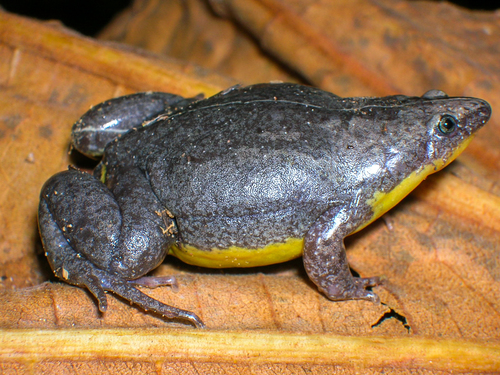
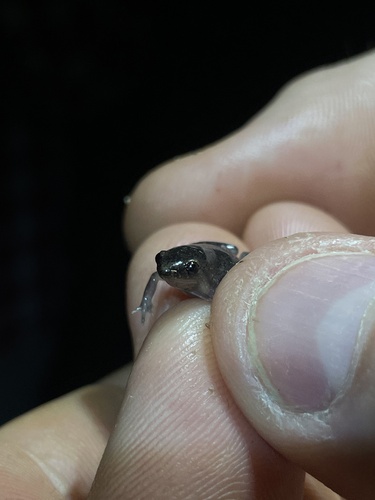
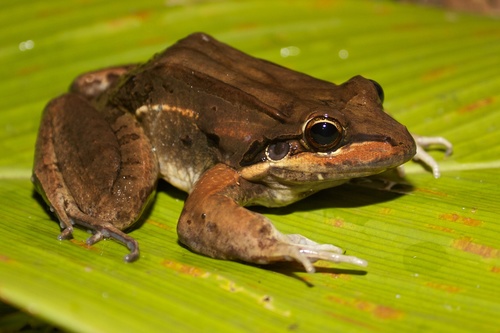
Cuzco Frog

Cuzco Frog

Hamptophryne alios

Silhouette: Vijay Karthick · PhyloPic

Daily sighting probability ~10% · With luck
at Tambopata National Reserve

In 3 days ~30% in a week ~60%

15 Verified sightings at Tambopata National Reserve From 2019 to 2026
15 In 1 park
February Best month
🌅 Crepuscular When it's spotted

About the Cuzco Frog

Hamptophryne alios is a species of frog in the family Microhylidae. It is known from three localities in the southwestern Amazon Basin of Bolivia, Brazil, and Peru. This species used to constitute the monotypic genus Altigius, but molecular phylogenetic analyses have shown it to be close relative of the then-monotypic Hamptophryne, and the two genera have been merged.

The generic name Altigius honors Ronald Altig, specialist in amphibian larvae. The specific name alios is derived from the Latin words ala for "wing" and os for "mouth" and refers to the large, scalloped oral flaps pendant over the mouth of the tadpole.

The species description is based on a single adult male and series of tadpoles, one of them reared past metamorphosis. The adult male measures 49.5 mm (1.95 in) in snout–vent length. The head is broad but much narrower than body. The snout is rounded. The eyes are small. Skin is shagreen, and the occipital fold is complete. The fingers and toes have rounded tips and narrow fringes. Webbing is basal between the fingers and more developed between the toes. The dorsum is tan and mottled with dark brown. The venter is black with bluish-white... Wikipedia →

Global Distribution

Parks Where Found

# Park Country Daily sighting probability
1 Tambopata National Reserve 🇵🇪 Peru
~10%

More parks will be added in future updates.

Before you go

What are the chances of seeing a Cuzco Frog in Tambopata National Reserve?

With luck

About 10% of wildlife watchers report a Cuzco Frog sighting in Tambopata National Reserve on a given day, based on 15 verified sightings from GBIF citizen-science data from 2019 to 2026. It is the 30th most-seen of the 44 amphibians we can rate there. Over three days the chance rises to about 30%, and over a week to about 60%, if each day is a fresh chance.

When is the best time to see a Cuzco Frog in Tambopata National Reserve?

February

In that month about 40% of wildlife watchers report a Cuzco Frog in Tambopata National Reserve on a given day, against under 5% in January, April–June and August–November, the lowest months. That is one of Tambopata National Reserve's wettest months, with about 420 mm of rain against 45 mm in July.

What time of day is best to see a Cuzco Frog?

Between 5 and 8 am

Across all the parks we cover, that three-hour window holds the most Cuzco Frog sightings with a recorded time, and about 6 in 10 of them come between 6 am and 6 pm: it is most active around dawn and dusk.

Where else can you see a Cuzco Frog?

Only Tambopata National Reserve, in our data

Tambopata National Reserve is the only park on Wallace's Line with enough records to rate Cuzco Frog sightings: about 10% of wildlife watchers there report one on a given day.

Where does the Cuzco Frog sighting chance come from?

GBIF citizen-science records

It is estimated from how often the Cuzco Frog is recorded against all the amphibians logged in Tambopata National Reserve (15 verified sightings from 2019 to 2026), calibrated against known sighting rates. Figures are rounded to the nearest 10% because citizen-science data supports honest approximations, not decimals, and months with records from fewer than five people show "—". How it works.

← Back to Tambopata National Reserve