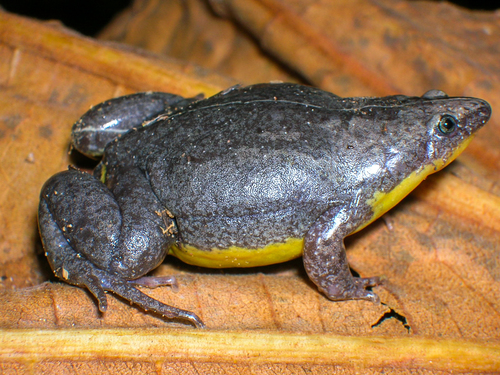
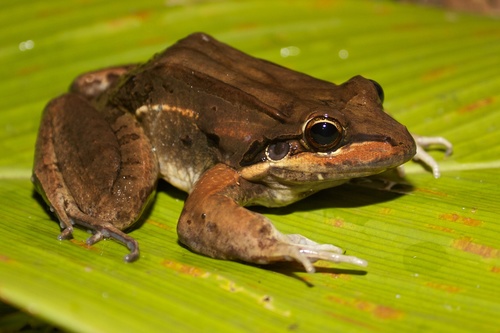
Reticulated Humming Frog

Reticulated Humming Frog

Chiasmocleis royi

Silhouette: Augusto Nunes Carvalho · PhyloPic

LCLeast ConcernNTVUENCR
Daily sighting probability ~10% · With luck
at Tambopata National Reserve

In 3 days ~30% in a week ~50%

9 Verified sightings at Tambopata National Reserve From 2019 to 2026
9 In 1 park
August Best month
🌙 Nocturnal When it's spotted

About the Reticulated Humming Frog

Chiasmocleis royi, the reticulated humming frog, is a frog endemic to Bolivia, Brazil, and Peru. This frog often shares burrows with tarantulas in what may be a mutualistic or commensalistic symbiosis. This frog lives in lowland forests on flood plains. It has been observed between 200 and 530 meters above sea level. Scientists believe it breeds through larval development.

The IUCN classifies this frog as least concern of extinction because of its large range, where it is very common. What threat it faces comes from habitat loss, often associated with mining, and pollution related to that mining. Because much of its range is flood plain, it may be more vulnerable to pollution than otherwise. Said range includes protected parks in all three countries: Manu National Park, Tambopata National Reserve, Parque Estadual Guajará-Mirim, Reserva Extrativista Rio Pacaás Novas, Reserva Extrativista Chico Mendes, Parque Nacional Madidi, Reserva Manuripi, Reserva de Biosfera Estación Biológica del Beni, and Parque Nacional Isiboro Sécure.

Scientists have seen this frog emerging from the same burrows or holes in trees as tarantulas in the genus Pamphobeteus... Wikipedia →
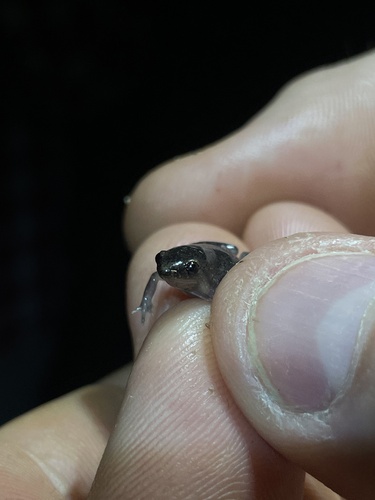
Global Distribution

Parks Where Found

# Park Country Daily sighting probability
1 Tambopata National Reserve 🇵🇪 Peru
~10%

More parks will be added in future updates.

Before you go

What are the chances of seeing a Reticulated Humming Frog in Tambopata National Reserve?

With luck

About 10% of wildlife watchers report a Reticulated Humming Frog sighting in Tambopata National Reserve on a given day, based on 9 verified sightings from GBIF citizen-science data from 2019 to 2026. It is the 35th most-seen of the 44 amphibians we can rate there. Over three days the chance rises to about 30%, and over a week to about 50%, if each day is a fresh chance.

When is the best time to see a Reticulated Humming Frog in Tambopata National Reserve?

January and August–September

In those months about 20% of wildlife watchers report a Reticulated Humming Frog in Tambopata National Reserve on a given day, against under 5% in February–May, October and December, the lowest months.

What time of day is best to see a Reticulated Humming Frog?

Between 7 and 10 pm

Across all the parks we cover, that three-hour window holds the most Reticulated Humming Frog sightings with a recorded time, and about 8 in 10 of them come between 6 pm and 6 am: it is mostly seen at night.

Where else can you see a Reticulated Humming Frog?

Only Tambopata National Reserve, in our data

Tambopata National Reserve is the only park on Wallace's Line with enough records to rate Reticulated Humming Frog sightings: about 10% of wildlife watchers there report one on a given day.

Which relatives of the Reticulated Humming Frog live in Tambopata National Reserve?

Same family: Microhylidae

The closest relatives of the Reticulated Humming Frog that you can see in Tambopata National Reserve (family Microhylidae, Narrow-mouthed Frogs) are Amazon Sheep Frog (about 40%), Acre's Oval Frog (about 30%) and Cuzco Frog (about 10%), with each one's daily chance of a sighting.

Where does the Reticulated Humming Frog sighting chance come from?

GBIF citizen-science records

It is estimated from how often the Reticulated Humming Frog is recorded against all the amphibians logged in Tambopata National Reserve (9 verified sightings from 2019 to 2026), calibrated against known sighting rates. Figures are rounded to the nearest 10% because citizen-science data supports honest approximations, not decimals, and months with records from fewer than five people show "—". How it works.

← Back to Tambopata National Reserve