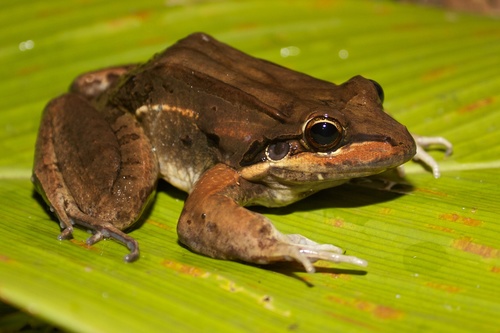
Brown Egg Frog

Brown Egg Frog

Ctenophryne geayi

Silhouette: Dmitry Bogdanov (vectorized by T. Michael Keesey) · PhyloPic

LCLeast ConcernNTVUENCR
Daily sighting probability ~10% · With luck
at Tambopata National Reserve

In 3 days ~30% in a week ~60%

12 Verified sightings at Tambopata National Reserve From 2019 to 2026
26 In all 2 parks
January Best month
☀️🌙 Day & Night When it's spotted

About the Brown Egg Frog

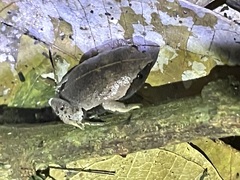
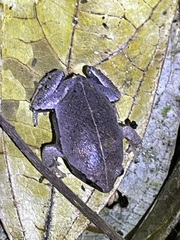
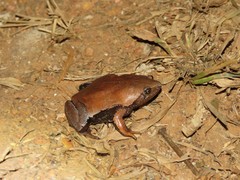
Ctenophryne geayi (common name: brown egg frog, Spanish: sapito apuntado de Geay) is a species of frog in the family Microhylidae. It is widely distributed in the northern parts of South America, in the Guianas (Guyana, Suriname, French Guiana) and in the Amazon Basin in Venezuela, Colombia, Ecuador, Peru, Bolivia, and Brazil. It might actually represent two species.

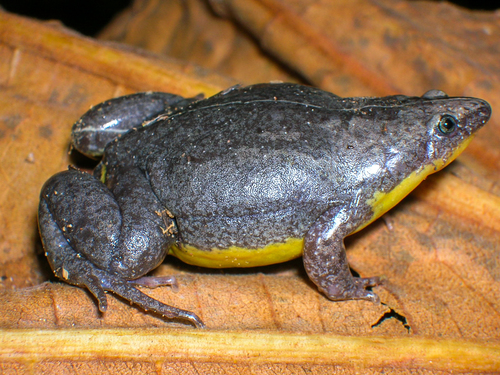
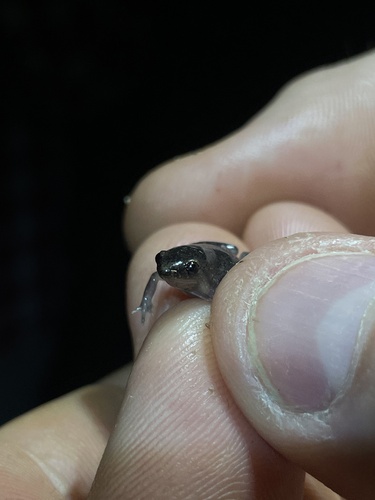
Adult males measure 32–43 mm (1.3–1.7 in) and adult females 42–55 mm (1.7–2.2 in) in snout–vent length. The body is rotund, and the head is narrower than the body. The snout is blunt from above and rounded, slightly projecting in profile. The tympanic ring is barely visible externally. The fingers have rounded tips. The toes have flattened tips and webbing that is more extensive in males than in females.

Coloration is pale brown dorsally, with darker brown flanks and anterior and posterior surfaces of the thighs. The throat is dark grayish brown, and other ventral surfaces are dark brown with white flecks. A vertebral line might be present. There are two ventral color patterns.

Specimens from the northern and western part of the range have pale flecks or very small spots, no more than 1 mm (0.04 in)... Wikipedia →

Sounds

Territorial call0:08

French Guiana · 2024

© Vincent Prémel · XC956137 · CC BY-NC-SA 4.0

Recording

French Guiana · 2024

© Arnaud Aury · Xeno · CC BY-NC-SA 4.0

Global Distribution

Parks Where Found

# Park Country Daily sighting probability
1 Manu National Park 🇵🇪 Peru
~10%
2 Tambopata National Reserve 🇵🇪 Peru
~10%

Before you go

What are the chances of seeing a Brown Egg Frog in Tambopata National Reserve?

With luck

About 10% of wildlife watchers report a Brown Egg Frog sighting in Tambopata National Reserve on a given day, based on 12 verified sightings from GBIF citizen-science data from 2019 to 2026. It is the 33rd most-seen of the 44 amphibians we can rate there. Over three days the chance rises to about 30%, and over a week to about 60%, if each day is a fresh chance.

When is the best time to see a Brown Egg Frog in Tambopata National Reserve?

January and February

In those months about 30% of wildlife watchers report a Brown Egg Frog in Tambopata National Reserve on a given day, against under 5% in March–July, September–October and December, the lowest months. Those are among Tambopata National Reserve's wettest months, with about 400 mm of rain a month against 45 mm in July.

What time of day is best to see a Brown Egg Frog?

Between 8 and 11 pm

Across all the parks we cover, that three-hour window holds the most Brown Egg Frog sightings with a recorded time, and about 6 in 10 of them come between 6 pm and 6 am: it is seen both by day and at night.

Is Tambopata National Reserve the best place to see a Brown Egg Frog?

Among the best

Of the 2 parks where we can rate Brown Egg Frog sightings, Tambopata National Reserve ranks 2nd at about 10%, level with the leaders once rounded. The best odds are in Manu National Park (Peru, about 10%).

Which relatives of the Brown Egg Frog live in Tambopata National Reserve?

Same family: Microhylidae

The closest relatives of the Brown Egg Frog that you can see in Tambopata National Reserve (family Microhylidae, Narrow-mouthed Frogs) are Amazon Sheep Frog (about 40%), Acre's Oval Frog (about 30%) and Cuzco Frog (about 10%), with each one's daily chance of a sighting.

Where does the Brown Egg Frog sighting chance come from?

GBIF citizen-science records

It is estimated from how often the Brown Egg Frog is recorded against all the amphibians logged in Tambopata National Reserve (12 verified sightings from 2019 to 2026), calibrated against known sighting rates. Figures are rounded to the nearest 10% because citizen-science data supports honest approximations, not decimals, and months with records from fewer than five people show "—". How it works.

← Back to Tambopata National Reserve