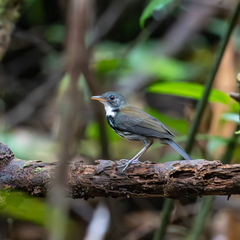
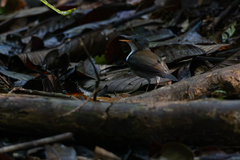

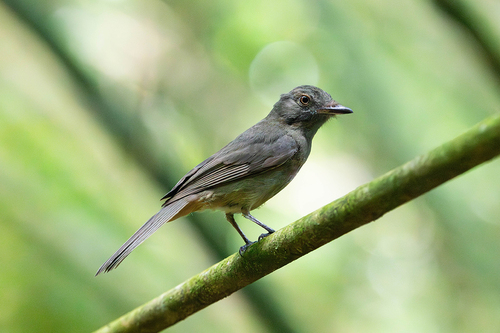
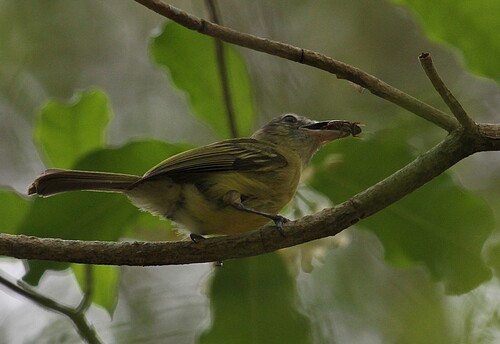
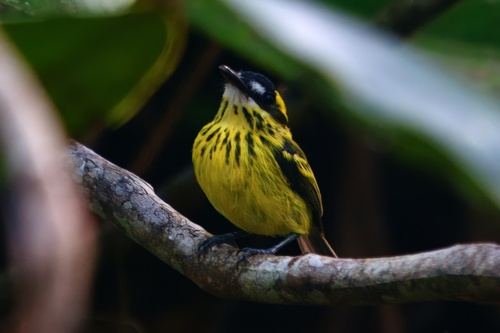
Ringed Antpipit

Ringed Antpipit

Corythopis torquatus

Silhouette: Emily Willoughby · PhyloPic

LCLeast ConcernNTVUENCR
Daily sighting probability ~10% · With luck
at Tambopata National Reserve

In 3 days ~30% in a week ~60%

417 Verified sightings at Tambopata National Reserve From 2019 to 2026
742 In all 3 parks
July Best month
☀️🌙 Day & Night When it's spotted

About the Ringed Antpipit

The ringed antpipit (Corythopis torquatus) is a species of bird in the family Tyrannidae, the tyrant flycatchers. It is found in every mainland South American country except Argentina, Chile, Paraguay, and Uruguay. The ringed antpipit was originally described as Conopophaga torquata, a member of the gnateater family Conopophagidae. Some authors later suggested that it belonged to family Formicariidae, the antthrushes. A study published in 1968 placed the genus in its current family, but there is still uncertainty about where it belongs. The ringed antpipit shares genus Corythopis with the southern antpipit (C. delalandi). They are treated as a superspecies and have been suggested to be conspecific.

The ringed antpipit is 13.5 to 14 cm (5.3 to 5.5 in) long and weighs 15 to 18 g (0.53 to 0.63 oz). The sexes have the same plumage; males are larger than females. Adults of the nominate subspecies have a grayish brown crown, a faint whitish loral spot, and a faint whitish spot behind... Wikipedia →

Sounds

Call0:11

Brazil · 2026

© JAYRSON ARAUJO DE OLIVEIRA · XC1186098 · CC BY-NC-SA 4.0

Song1:07

Bolivia · 2022

© Jacob Wijpkema · XC723556 · CC BY-NC-SA 4.0

Song0:29

Brazil · 2021

© Rainforest Connection · XC653691 · CC BY-NC-SA 4.0

Global Distribution

Parks Where Found

# Park Country Daily sighting probability
1 Tambopata National Reserve 🇵🇪 Peru
~10%
2 Manu National Park 🇵🇪 Peru
~10%
3 Yasuní National Park 🇪🇨 Ecuador
<5%

Before you go

What are the chances of seeing a Ringed Antpipit in Tambopata National Reserve?

With luck

About 10% of wildlife watchers report a Ringed Antpipit sighting in Tambopata National Reserve on a given day, based on 417 verified sightings from GBIF citizen-science data from 2019 to 2026. It is the 113th most-seen of the 550 birds we can rate there. Over three days the chance rises to about 30%, and over a week to about 60%, if each day is a fresh chance.

When is the best time to see a Ringed Antpipit in Tambopata National Reserve?

July and August

In those months about 20% of wildlife watchers report a Ringed Antpipit in Tambopata National Reserve on a given day, against under 5% in March, the lowest month. Those are among Tambopata National Reserve's driest months, with about 60 mm of rain a month against 420 mm in February.

What time of day is best to see a Ringed Antpipit?

Between 7 and 10 am

Across all the parks we cover, that three-hour window holds the most Ringed Antpipit sightings with a recorded time, and about 7 in 10 of them come between 6 am and 6 pm: it is seen both by day and at night.

Is Tambopata National Reserve the best place to see a Ringed Antpipit?

Yes

Of the 3 parks where we can rate Ringed Antpipit sightings, Tambopata National Reserve has the highest daily chance: about 10%. Next come Manu National Park (Peru, about 10%) and Yasuní National Park (Ecuador, under 5%).

Which relatives of the Ringed Antpipit live in Tambopata National Reserve?

Same family: Tyrannidae

The closest relatives of the Ringed Antpipit that you can see in Tambopata National Reserve (family Tyrannidae, Tyrant Flycatchers) are Tropical Kingbird (about 20%), Boat-billed Flycatcher (about 20%) and Forest Elaenia (about 20%), with each one's daily chance of a sighting.

Where does the Ringed Antpipit sighting chance come from?

GBIF citizen-science records

It is estimated from how often the Ringed Antpipit is recorded against all the birds logged in Tambopata National Reserve (417 verified sightings from 2019 to 2026), calibrated against known sighting rates. Figures are rounded to the nearest 10% because citizen-science data supports honest approximations, not decimals, and months with records from fewer than five people show "—". How it works.

← Back to Tambopata National Reserve