
Golden-crowned Spadebill

Golden-crowned Spadebill

Platyrinchus coronatus

Silhouette: Emily Willoughby · PhyloPic

LCLeast ConcernNTVUENCR
Daily sighting probability ~10% · With luck
at Tambopata National Reserve

In 3 days ~30% in a week ~50%

334 Verified sightings at Tambopata National Reserve From 2019 to 2026
3,039 In all 16 parks
November Best month
☀️ Diurnal When it's spotted

About the Golden-crowned Spadebill

The golden-crowned spadebill (Platyrinchus coronatus) is a species of bird in the family Tyrannidae, the tyrant flycatchers. It is found Central America from Honduras to Panama and in every mainland South American country except Argentina, Chile, Paraguay, and Uruguay.

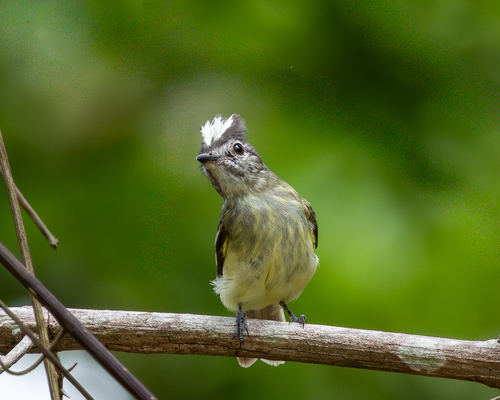
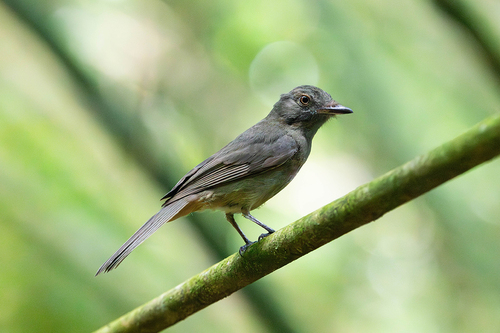
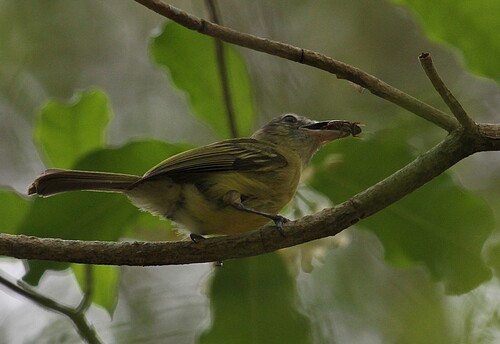
The golden-crowned spadebill is the smallest member of its genus. It is about 8.5 to 9 cm (3.3 to 3.5 in) long and weighs 8 to 9 g (0.28 to 0.32 oz). It has a large head with a bold facial pattern and a stubby tail. The sexes have almost the same plumage. Males of the nominate subspecies have a black crown with a partially hidden orange-rufous patch in the center; females have a purer orange patch. Both sexes have pale buff-yellow as a patch above the lores, as an eye-ring, as a stripe behind the eye, and as a patch on the... Wikipedia →

Sounds

Song1:19

French Guiana · 2024

© Tristan Guillebot de Nerville · XC1162547 · CC BY-NC-SA 4.0

Call0:12

Panama · 2025

© Sue Riffe · XC1075939 · CC BY-NC-SA 4.0

Duet0:14

Ecuador · 1999

© Olaf Jahn · XC262199 · CC BY-NC-SA 4.0

Global Distribution

Parks Where Found

# Park Country Daily sighting probability
1 Corcovado National Park 🇨🇷 Costa Rica
~30%
2 Darién National Park 🇵🇦 Panama
~20%
3 Tambopata National Reserve 🇵🇪 Peru
~10%
4 Carara National Park 🇨🇷 Costa Rica
~10%
5 Soberanía National Park 🇵🇦 Panama
~10%
6 Manu National Park 🇵🇪 Peru
<5%
7 Piedras Blancas National Park 🇨🇷 Costa Rica
<5%
8 Chagres National Park 🇵🇦 Panama
<5%
9 Yasuní National Park 🇪🇨 Ecuador
<5%
10 Parque Natural Metropolitano 🇵🇦 Panama
<5%
11 Tenorio Volcano National Park 🇨🇷 Costa Rica
<5%
12 Rincón de la Vieja National Park 🇨🇷 Costa Rica
<5%
13 Manuel Antonio National Park 🇨🇷 Costa Rica
<5%
14 Braulio Carrillo National Park 🇨🇷 Costa Rica
<5%
15 Arenal Volcano National Park 🇨🇷 Costa Rica
<5%
16 Tapantí-Macizo de la Muerte National Park 🇨🇷 Costa Rica
<5%

Before you go

What are the chances of seeing a Golden-crowned Spadebill in Tambopata National Reserve?

With luck

About 10% of wildlife watchers report a Golden-crowned Spadebill sighting in Tambopata National Reserve on a given day, based on 334 verified sightings from GBIF citizen-science data from 2019 to 2026. It is the 134th most-seen of the 550 birds we can rate there. Over three days the chance rises to about 30%, and over a week to about 50%, if each day is a fresh chance.

When is the best time to see a Golden-crowned Spadebill in Tambopata National Reserve?

February, May–August and October–November

In those months about 10% of wildlife watchers report a Golden-crowned Spadebill in Tambopata National Reserve on a given day, against under 5% in March–April, September and December–January, the lowest months.

What time of day is best to see a Golden-crowned Spadebill?

Between 9 am and noon

Across all the parks we cover, that three-hour window holds the most Golden-crowned Spadebill sightings with a recorded time, and about 9 in 10 of them come between 6 am and 6 pm: it is a daytime animal.

Is Tambopata National Reserve the best place to see a Golden-crowned Spadebill?

3rd of 16

Of the 16 parks where we can rate Golden-crowned Spadebill sightings, Tambopata National Reserve ranks 3rd at about 10%. The best odds are in Corcovado National Park (Costa Rica, about 30%) and Darién National Park (Panama, about 20%).

Where does the Golden-crowned Spadebill sighting chance come from?

GBIF citizen-science records

It is estimated from how often the Golden-crowned Spadebill is recorded against all the birds logged in Tambopata National Reserve (334 verified sightings from 2019 to 2026), calibrated against known sighting rates. Figures are rounded to the nearest 10% because citizen-science data supports honest approximations, not decimals, and months with records from fewer than five people show "—". How it works.

← Back to Tambopata National Reserve