
Malaysian Blue-Flycatcher

Malaysian Blue-Flycatcher

Cyornis turcosus

Silhouette: L. Shyamal · PhyloPic

LCNTNear ThreatenedVUENCR
Daily sighting probability ~20% · Possible
at Tanjung Puting National Park

In 3 days ~50% in a week ~80%

21 Verified sightings at Tanjung Puting National Park From 2019 to 2026
1,278 In all 7 parks
June Best month
☀️🌙 Day & Night When it's spotted

About the Malaysian Blue-Flycatcher

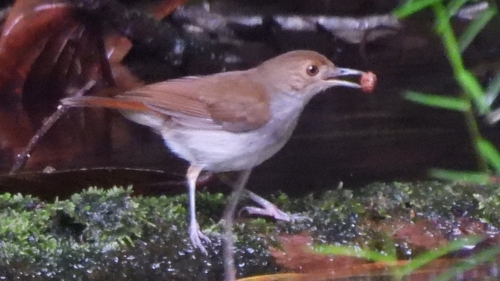
The Malaysian blue flycatcher (Cyornis turcosus) is a species of bird in the family Muscicapidae. It has a brilliant blue upperparts, a pale orange throat and chest, and a white belly. A slightly paler female has a whitish throat, while a male's is blue; the sexes are otherwise quite similar.

The head is fairly uniformly blue, without boldly lighter or darker patches, unlike in many other "blue flycatchers". Pale and restricted orange also serve as a helpful identifying feature. A lowland species, restricted to secluded riverine forests in Sumatra and the Malay Peninsula but found in a variety of dry and wet forests on Borneo.

Its natural habitat is subtropical or tropical moist lowland forests, found in Malaysia, Thailand, Indonesia and Brunei. It is threatened by habitat loss. The bird is well known as 'Burung Sambar Biru' in Malaysia. Wikipedia →

Sounds

Song0:36

Thailand · 2022

© Peter Ericsson · XC735337 · CC BY-NC-SA 4.0

Call0:17

Malaysia · 2015

© Mike Nelson · XC292734 · CC BY-NC-SA 4.0

Song0:23

Thailand · 2022

© Somkiat Pakapinyo (Chai) · XC716670 · CC BY-NC-SA 4.0

Global Distribution

Parks Where Found

# Park Country Daily sighting probability
1 Way Kambas National Park 🇮🇩 Indonesia
~30%
2 Kinabatangan Wildlife Sanctuary 🇲🇾 Malaysia
~30%
3 Tanjung Puting National Park 🇮🇩 Indonesia
~20%
4 Danum Valley Conservation Area 🇲🇾 Malaysia
~20%
5 Taman Negara National Park 🇲🇾 Malaysia
~10%
6 Sepilok 🇲🇾 Malaysia
<5%
7 Kinabalu Park 🇲🇾 Malaysia
<5%

Before you go

What are the chances of seeing a Malaysian Blue-Flycatcher in Tanjung Puting National Park?

Possible

About 20% of wildlife watchers report a Malaysian Blue-Flycatcher sighting in Tanjung Puting National Park on a given day, based on 21 verified sightings from GBIF citizen-science data from 2019 to 2026. It is the 23rd most-seen of the 66 birds we can rate there. Over three days the chance rises to about 50%, and over a week to about 80%, if each day is a fresh chance.

When is the best time to see a Malaysian Blue-Flycatcher in Tanjung Puting National Park?

June

In that month about 40% of wildlife watchers report a Malaysian Blue-Flycatcher in Tanjung Puting National Park on a given day, against about 10% in February, the lowest month. April has too few records to rate.

What time of day is best to see a Malaysian Blue-Flycatcher?

Between 7 and 10 am

Across all the parks we cover, that three-hour window holds the most Malaysian Blue-Flycatcher sightings with a recorded time, and about 7 in 10 of them come between 6 am and 6 pm: it is seen both by day and at night.

Is Tanjung Puting National Park the best place to see a Malaysian Blue-Flycatcher?

3rd of 7

Of the 7 parks where we can rate Malaysian Blue-Flycatcher sightings, Tanjung Puting National Park ranks 3rd at about 20%. The best odds are in Way Kambas National Park (Indonesia, about 30%) and Kinabatangan Wildlife Sanctuary (Malaysia, about 30%).

Which relatives of the Malaysian Blue-Flycatcher live in Tanjung Puting National Park?

Same order: Passeriformes

The closest relatives of the Malaysian Blue-Flycatcher that you can see in Tanjung Puting National Park (order Passeriformes, Perching Birds) are Malaysian Pied-Fantail (about 80%), Black-and-red Broadbill (about 60%) and Olive-winged Bulbul (about 50%), with each one's daily chance of a sighting.

Where does the Malaysian Blue-Flycatcher sighting chance come from?

GBIF citizen-science records

It is estimated from how often the Malaysian Blue-Flycatcher is recorded against all the birds logged in Tanjung Puting National Park (21 verified sightings from 2019 to 2026), calibrated against known sighting rates. Figures are rounded to the nearest 10% because citizen-science data supports honest approximations, not decimals, and months with records from fewer than five people show "—". How it works.

← Back to Tanjung Puting National Park