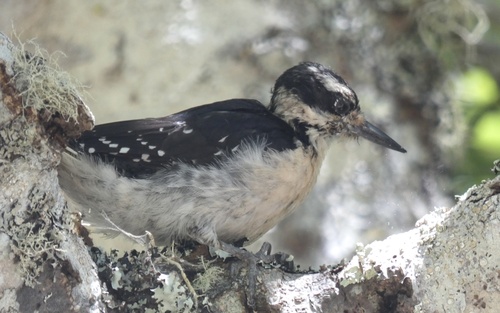
Lanceolated Monklet

Lanceolated Monklet

Micromonacha lanceolata

Silhouette: Matt Wilkins (Photo by Len Blumin) · PhyloPic

LCLeast ConcernNTVUENCR
Daily sighting probability <5% · Rare
at Tapantí-Macizo de la Muerte National Park

In 3 days <5% in a week ~10%

105 Verified sightings at Tapantí-Macizo de la Muerte National Park From 2019 to 2026
263 In all 6 parks
October Best month
☀️ Diurnal When it's spotted

About the Lanceolated Monklet

The lanceolated monklet (Micromonacha lanceolata) is a species of near-passerine bird in the family Bucconidae, the puffbirds, nunlets, and nunbirds. It is found in Bolivia, Brazil, Colombia, Costa Rica, Ecuador, Panama, and Peru.

The lanceolated monklet is the only member of its genus, and the only bird called a "monklet". It has no subspecies, though the population in Costa Rica and western Panama has been discussed as possibly being one. The lanceolated monklet is 13 to 15 cm (5.1 to 5.9 in) long and weighs 19 to 22 g (0.67 to 0.78 oz). It is entirely warm brown with scale-like buffy markings above. It has white bristles around the base of the large bill, and white "whiskers", which are actually tufts of feathers. Its lores and a half ring behind the eye are white. The wings and the top side of the tail are dark brown and the tail's underside is gray. Most of its underparts are white with heavy black streaks; the center of the belly is unstreaked and the vent area has an ochre tinge.

The lanceolated monklet is found in several disjunct areas. One is the Caribbean slope in Costa Rica and into west central... Wikipedia →

Sounds

Song0:10

Colombia · 2009

© Alonso Quevedo · XC503234 · CC BY-NC-SA 4.0

Call0:11

Ecuador · 2005

© John V. Moore · XC257966 · CC BY-NC-SA 4.0

Begging call0:36

Ecuador · 2010

© Andrew Spencer · XC61376 · CC BY-NC-ND 2.5

Global Distribution

Parks Where Found

# Park Country Daily sighting probability
1 Podocarpus National Park 🇪🇨 Ecuador
<5%
2 Sierra de la Macarena National Park 🇨🇴 Colombia
<5%
3 Tapantí-Macizo de la Muerte National Park 🇨🇷 Costa Rica
<5%
4 Yasuní National Park 🇪🇨 Ecuador
<5%
5 Farallones de Cali National Natural Park 🇨🇴 Colombia
<5%
6 Arenal Volcano National Park 🇨🇷 Costa Rica
<5%

Before you go

What are the chances of seeing a Lanceolated Monklet in Tapantí-Macizo de la Muerte National Park?

Rare

Under 5% of wildlife watchers report a Lanceolated Monklet sighting in Tapantí-Macizo de la Muerte National Park on a given day, based on 105 verified sightings from GBIF citizen-science data from 2019 to 2026. It is the 319th most-seen of the 467 birds we can rate there. Over three days the chance rises to under 5%, and over a week to about 10%, if each day is a fresh chance.

When is the best time to see a Lanceolated Monklet in Tapantí-Macizo de la Muerte National Park?

Any time of year

In every month with enough records, under 5% of wildlife watchers report a Lanceolated Monklet in Tapantí-Macizo de la Muerte National Park on a given day, so our monthly data shows no clear season.

What time of day is best to see a Lanceolated Monklet?

Between 9 am and noon

Across all the parks we cover, that three-hour window holds the most Lanceolated Monklet sightings with a recorded time, and about 8 in 10 of them come between 6 am and 6 pm: it is a daytime animal.

Is Tapantí-Macizo de la Muerte National Park the best place to see a Lanceolated Monklet?

Among the best

Of the 6 parks where we can rate Lanceolated Monklet sightings, Tapantí-Macizo de la Muerte National Park ranks 3rd at under 5%, level with the leaders once rounded. The best odds are in Podocarpus National Park (Ecuador, under 5%) and Sierra de la Macarena National Park (Colombia, under 5%).

Which relatives of the Lanceolated Monklet live in Tapantí-Macizo de la Muerte National Park?

Same order: Piciformes

The closest relatives of the Lanceolated Monklet that you can see in Tapantí-Macizo de la Muerte National Park (order Piciformes, Woodpeckers and Allies) are Acorn Woodpecker (about 40%), Hairy Woodpecker (about 30%) and Northern Emerald-Toucanet (about 20%), with each one's daily chance of a sighting.

Where does the Lanceolated Monklet sighting chance come from?

GBIF citizen-science records

It is estimated from how often the Lanceolated Monklet is recorded against all the birds logged in Tapantí-Macizo de la Muerte National Park (105 verified sightings from 2019 to 2026), calibrated against known sighting rates. Figures are rounded to the nearest 10% because citizen-science data supports honest approximations, not decimals, and months with records from fewer than five people show "—". How it works.

← Back to Tapantí-Macizo de la Muerte National Park